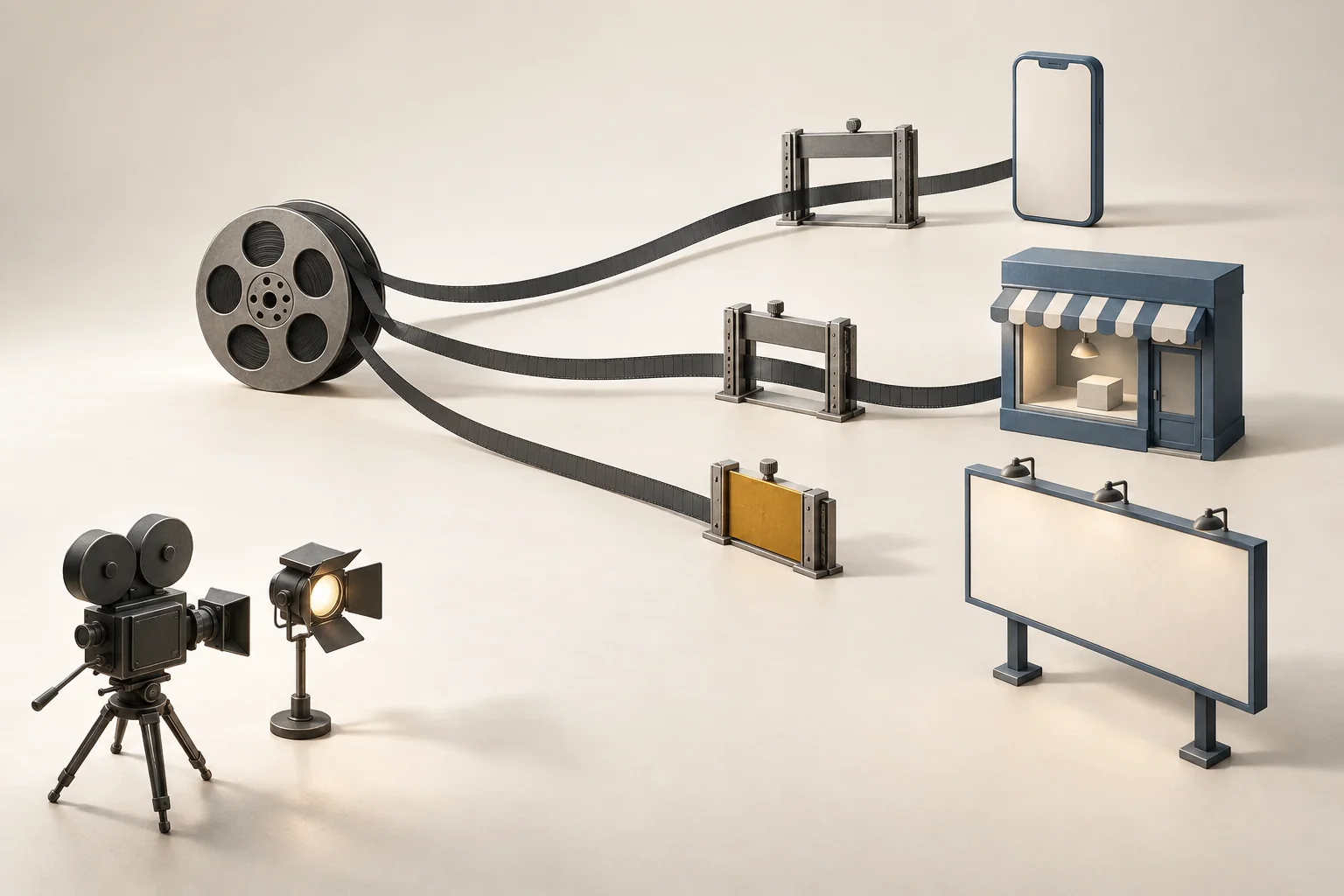





Store each creator asset under a stable ID, then link that ID to its campaign, exact file version, permitted uses and approval evidence. An influencer content library should let someone answer a specific question: "Can we use this version in this placement, in this market, on these dates?" A folder called "approved content" cannot carry that answer on its own.
You can start with shared file storage and linked spreadsheet tabs. The field design below is a recommended operating method, independent of any digital asset management software. It records the basis for a reuse decision; it does not grant rights.
Separate the file from its permission record
Use three linked records:
- Asset: what the file contains, who supplied it, which campaign commissioned it and where the exact version lives.
- Permission: the uses covered by the agreement, its restrictions and the evidence supporting that summary.
- Approval: who accepted a particular version for a particular use, when they accepted it and where that decision is recorded.
An asset may have several permission records. Website use might last longer than paid advertising. An approval may cover one crop while another remains under review. Linking these records avoids copying one broad "yes" across unrelated uses.
The IPTC Photo Metadata Standard makes useful distinctions among creator, copyright owner, credit line, source and usage terms. Its source field can identify a supplier who differs from the creator. Preserve that distinction when an agency sends a file on a creator's behalf. The schema below adapts these ideas to campaign operations; it is not an IPTC implementation specification.
For U.S. copyright context, the Copyright Office distinguishes ownership of a copy from ownership of the work. Receiving a file is therefore insufficient evidence of a reuse license. Have qualified advisers resolve uncertain ownership, license interpretation and jurisdiction-specific questions.
A field schema teams can maintain
Make identity and evidence fields mandatory at intake. Permit an explicit unknown value for unresolved rights, but exclude that use from the ready-to-publish view.
| Record | Fields | Entry rule |
|---|---|---|
| Asset identity | asset_id, version_id, parent_version_id | Assign a stable asset ID; give each changed export its own version. |
| File location | master_file, export_file, file_hash | Keep the original and export separately; a hash helps identify identical files. |
| Origin | creator_id, supplier, source_post_url, received_at | Record who made it and who delivered it; use not posted when relevant. |
| Campaign | campaign_id, deliverable_id, product | Link to the brief and deliverable rather than repeating their full text. |
| Findability | description, format, language, subject_tags | Describe visible content; choose formats and tags from a shared list. |
| Technical fit | dimensions, duration, captions, audio_version | Record the actual export, including whether captions are burned in. |
| Permission identity | permission_id, asset_ids, covered_versions | State which files or defined derivatives the permission covers. |
| Scope | licensee, channel, placement, paid_or_organic, territory | Use one row per distinct scope; name the brand or entity entitled to use it. |
| Term | starts_at, ends_at, timezone, expiry_action | Preserve the agreement's timing and any required removal action. |
| Restrictions | allowed_edits, credit, third_party_elements | Identify permitted crops, audio restrictions and unresolved clearance questions. |
| Evidence | agreement_ref, clause_ref, rights_holder, verified_by, verified_at | Link the source record and identify who checked the summary. |
| Approval | version_id, proposed_use, decision, approver, decided_at, evidence_ref | Tie the decision to the exact version and requested use. |
| Publication | disclosure_instructions, platform_check, destination, published_at | Keep publication requirements and the eventual live location together. |
Use separate fields for territory and language. An English caption does not establish permission for every English-speaking market. Likewise, a vertical video format says nothing about whether paid use is covered.
Choose controlled values for status, format and placement. Keep descriptive tags flexible enough for searches such as "hands demonstrating refill". Avoid tags like "great" or "approved" that conceal the underlying decision.
Where approvals are still arriving in message threads, first track deliverable revisions against exact versions. The library should inherit that version history.
Five illustrative asset records
These are hypothetical records for a fictional refill-product campaign, REFILL-A. The IDs, files, dates and permissions are invented to demonstrate the schema. Evidence references such as AGR-01 represent records that a real team would link to accessible documents.
Asset index
| Asset and version | Creator | File and format | Content and origin |
|---|---|---|---|
| A01 / v2 | Creator A | A01-v2.mp4; vertical video; 20 seconds | English refill demonstration; creator delivery DEL-01; no published source post. |
| A02 / v1 | Creator B | A02-v1.jpg; landscape photo | Refill pack beside dispenser; agency delivery DEL-02; no source post. |
| A03 / v1 | Creator C | A03-v1.mp4; vertical video; 15 seconds | English product endorsement with music; creator delivery DEL-03; source post recorded in POST-03. |
| A04 / v3 | Creator A | A04-v3.mp4; square video; 10 seconds | Shortened edit derived from A01/v2; editor delivery DEL-04. |
| A05 / v1 | Creator D | A05-v1.jpg; portrait photo | Product beside sink; creator delivery DEL-05; no source post. |
Linked permission and approval records
All dates below are hypothetical, inclusive UTC calendar dates. Each row describes only the named use.
| Asset | Scope and term | Evidence and version approval | Reuse decision |
|---|---|---|---|
| A01 / v2 | Brand-owned organic social; U.S.; October 1 through December 31, 2026 | AGR-01, schedule A; creator confirmation AP-01; reviewer accepted v2 on September 29 | Eligible for the named use after the publication check; paid use excluded. |
| A02 / v1 | Brand product page; worldwide; October 1 through December 31, 2026 | AGR-02, clause 4; photographer's grant attached; reviewer accepted v1 in AP-02 | Eligible on the product page with the agreed credit; email use absent. |
| A03 / v1 | Brand-owned organic social proposed; U.S.; October 2026 | AGR-03 covers creator footage; music clearance unresolved; AP-03 records the hold | Hold this export until the audio question is resolved. |
| A04 / v3 | Brand-owned organic social requested; U.S.; October 2026 | AGR-01 requires approval of shortened edits; AP-04 remains pending | Hold v3; A01/v2 approval does not satisfy the separate edit approval. |
| A05 / v1 | Brand product page; worldwide; ended September 30, 2026 | AGR-05, clause 3; AP-05 approved v1 during the term | Exclude from October reuse; follow the agreement's expiry action. |
A03 illustrates why music needs its own evidence field. A04 illustrates why a parent file's approval must remain distinguishable from an edit's approval. These are conditions of the hypothetical agreements, not universal contract terms.
In a real library, each evidence reference must open the underlying record for authorized reviewers. Until those links work, treat these rows as incomplete.
Search by the intended use
Modash's repurposing guide describes requests for creator content across social, websites, email and other placements. Give each request its own scope check instead of treating "digital use" as a complete answer.
Suppose a social manager needs a vertical refill demonstration for a U.S. organic post in October. Filter the hypothetical library by subject, format, territory, organic placement and dates. Then inspect permissions and approval evidence.
A01 is the candidate. A03 remains on hold because of its audio. A04 is square and has a pending edit approval. A02 and A05 are photos with product-page scope. The search identifies a usable candidate without asking someone to remember the original deal.
Before release, the reviewer should confirm:
- The export matches the approved version.
- The requested entity, placement, territory and full publication period fit the permission record.
- Edits, third-party elements, credit and disclosure instructions have no unresolved conditions.
- Any platform authorization required for the planned use has been checked separately.
- The publication owner has recorded the destination and expiry action.
For U.S.-directed endorsements, the FTC's disclosure guidance covers material connections such as payment and free products. It says disclosure should accompany the endorsement, including within video endorsements. Store the instructions for the actual destination so an editor does not accidentally remove them during reuse.
Keep old approvals traceable
Retain prior versions and decisions according to your retention policy, but remove superseded exports from the default publishing view. Restrict rights-field edits to named owners. If a summary conflicts with its source agreement, pause the affected use and ask the owner to resolve it.
Record live destinations so the team can find content when rights end. Use a rights-expiry tracker for reminders and follow-up, and one accountable approval reviewer for unresolved decisions.
Start with one completed campaign. Enter its assets, connect each permitted use to evidence, then ask someone outside the campaign team to find a file for a specific placement and date. Every question they cannot answer identifies a missing field or a broken evidence link.