



A beauty tutorial hygiene brief should specify who may use each product, how tools are prepared, which application areas are allowed, and when filming must stop. Attach the current instructions for every product and tool. For repeat shoots, reuse the shot plan while assigning each participant their own application kit. Never make sharing eye cosmetics or brushes part of the demonstration.
The checklist below is a conservative production recommendation for ordinary cosmetic tutorials. It is not a clinical procedure or a professional salon sanitation protocol. The cited FDA and FTC guidance applies in the United States; check local requirements for shoots and distribution elsewhere.
Set the sharing boundary before the shot list
Modash's beauty marketing guide recommends leaving creators room to choose their creative style. A hygiene brief can preserve that freedom while fixing the handling rules. Creators can choose the story, framing and pacing. The brief should identify any handling step that needs approval before it changes.
Start with these boundaries:
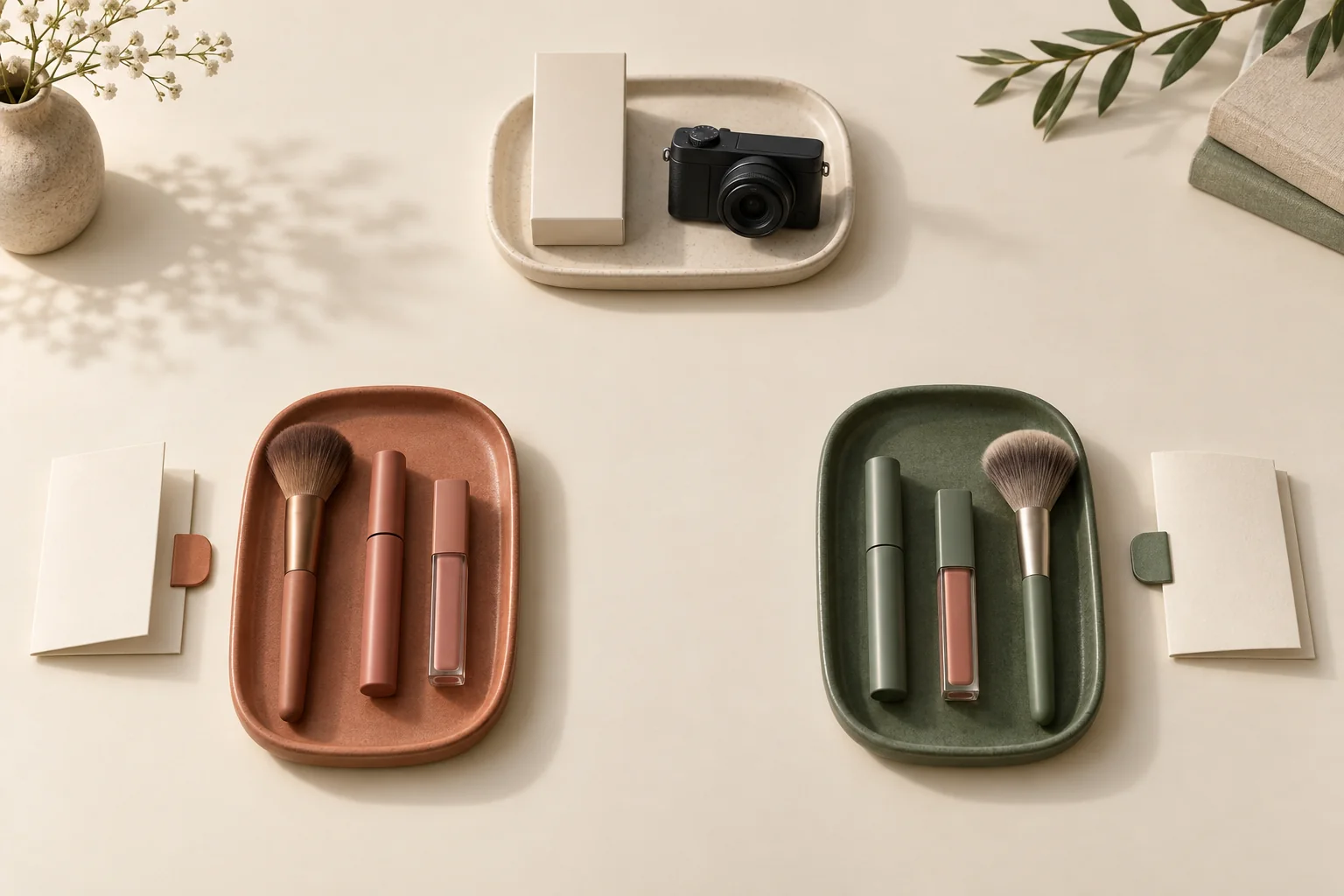
- Assign application products and tools to one person. Do not pass mascara, eyeliner, lip products, sponges or brushes between participants for a shared-product scene.
- Keep a separate display item if the production needs crew members to handle a package repeatedly. Mark it as a filming prop outside the frame.
- Do not invent a cleaning shortcut to make a shared item acceptable. If the planned handling depends on disinfection, obtain product-specific instructions and qualified professional review before filming.
- Remove any shot that uses a product on an area its instructions do not permit.
The FDA's eye cosmetic guidance advises against sharing eye cosmetics and warns about contamination in retail testers. The American Academy of Dermatology Association advises people not to share makeup brushes. The broader single-person kit rule above is a production choice that avoids designing a multi-user handling procedure into a creator brief.
A disposable wand alone should never be treated as permission to share a mascara tube. For this workflow, allocate a separate tube to each participant.
Prepare the shoot with a named owner
Give the producer responsibility for checking the kit before recording. Give the creator permission to stop without needing a usable final take first.
| Preparation check | What the producer confirms |
|---|---|
| Product identity | The physical item matches the product, variant and market listed in the brief. |
| Instructions | The current label and relevant manufacturer instructions are available to the creator. |
| Intended use | Every proposed application area and tool matches those instructions. |
| Participant allocation | Each application item belongs to one named participant; display props stay separate. |
| Hand preparation | The creator can wash their hands before application and after handling unrelated props. |
| Tool preparation | Tools are clean and ready under their own care instructions, with enough drying time. |
| Replacement kit | A dropped, contaminated or questionable item can be removed without pressuring anyone to keep using it. |
| Stop contact | The creator knows who receives a concern and who may authorize a changed shot plan. |
| Edit requirements | Any handling explanation needed to understand the shot stays attached to its footage. |
AAD recommends washing personal makeup brushes every 7 to 10 days and describes rinsing the tips, washing, and laying brushes flat to dry. That consumer schedule does not authorize using a brush on several people between washes. Plan preparation time around the tool's instructions rather than promising a universal cleaning interval for every sponge, brush or device.
Check storage and opening history as part of kit readiness. Use the separate expiry and batch-information guide to organize those records without turning the hygiene brief into a stock ledger.
Keep a product-specific instruction register
Create one row per physical product or tool. Attach a label photo or manufacturer document to each row, with its date and market. A campaign talking-points sheet is not enough to establish how something should be used.
The register should record:
- Product and variant, assigned participant, and the shot that uses it.
- Manufacturer source, version or access date, and relevant instruction section.
- Permitted application area and any stated warnings or exclusions.
- Preparation, cleaning, drying and storage instructions that apply to that item.
- Stop conditions and the person responsible for resolving unanswered questions.
- Status: ready, needs clarification, or removed from the shot plan.
Do not fill gaps from a similar-looking product. If an instruction is unclear, ask the manufacturer or an appropriately qualified professional. Keep that shot on hold until the answer is recorded.
This hypothetical register shows how to turn a creative idea into a handling decision. It does not approve a real product or prescribe a cleaning method.
| Proposed item and shot | Register instruction | Release condition |
|---|---|---|
| Mascara, close-up on participant A | A receives an individual tube. No sharing or adding water to change texture. | Read the actual label; confirm the tube and intended use before recording. |
| Face brush, application by participant B | B receives a separate brush prepared under its care instructions. | Record the care source and confirm preparation is complete. |
| Lip color, repeated shade demonstrations | Each participant receives their own application product. | Replace a shared-tester concept with individually assigned units. |
| Beauty device, optional final step | Do not improvise cleaning, settings or use areas. | Hold the shot until the exact model's instructions and any needed qualified review are available. |
The mascara dilution boundary follows FDA guidance against adding water or saliva to dried mascara. The other allocation choices are production recommendations. None establishes that an item is sterile or suitable for every person.
Define what happens when a take stops
For eye cosmetics, FDA advises stopping use immediately if irritation occurs. A campaign deadline must not override that boundary. Write the stop instruction into the brief and keep a non-application alternative available, such as a closed-package shot.
If a concern arises, pause the affected demonstration and take the item out of the ready kit. Do not ask the creator to repeat the application for continuity. Direct health questions to a healthcare professional rather than asking the producer to diagnose them. The creator reaction-report workflow covers the separate reporting process.
Avoid building treatment demonstrations into an ordinary makeup brief. A device, adhesive or treatment-related claim may need a different reviewer and instructions. Escalate those questions before the booking, when the shot plan can still change.
Preserve the boundaries when footage is reused
Review every shortened version on its own. A crop should not suggest a shared applicator, an unapproved application area or a preparation method that the complete video explains differently. Reshoot an unsafe action; a caption does not make the action acceptable.
Keep commercial disclosures with the reused endorsement. FTC staff guidance says video disclosures belong in the video and that creators cannot invent claims requiring evidence the advertiser lacks. Do not add claims such as infection prevention or suitability for everyone because the kit was handled carefully.
For paid distribution, assign a separate platform-policy check. TikTok's healthcare and pharmaceuticals advertising policy has market-specific requirements, including sections relevant to beauty products and procedures. A completed hygiene checklist does not establish ad eligibility. Record the target market, product category and current policy decision before promotion.
Before sending the brief, complete the instruction register for the first planned application shot. If its handling source or participant allocation is unresolved, replace the shot or hold it out of the filming schedule.