




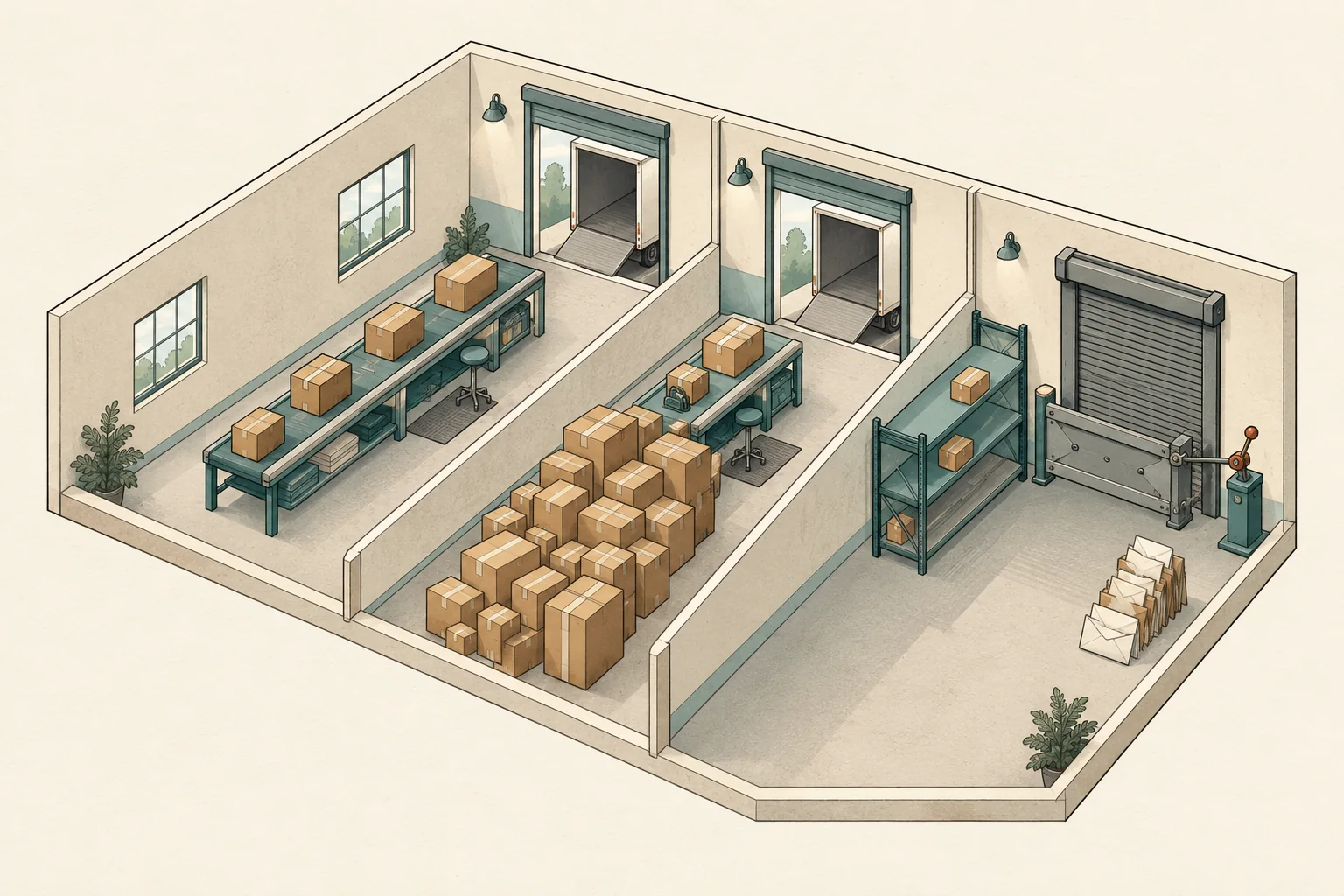
Before a large creator promotion, check how many orders your team can release, pick, pack and hand to a carrier before the promised shipping deadline. Model support capacity separately. Compare normal demand, a larger surge and a stock-constrained surge, then give named people authority to slow promotion or stop accepting orders that the store cannot fulfill as promised.
A follower count cannot tell you how many parcels your warehouse can ship. Start with your operating limits and use demand scenarios to find where they break.
Measure the work behind one shipped order
Choose a planning window that matches your shipping promise, such as one warehouse working day. Record the opening backlog, ordinary orders expected during that window and the extra orders used in each campaign scenario. Keep ordinary business in the model.
Measure a representative mix of orders. A single-item parcel, a gift-wrapped bundle and a split shipment need different amounts of work. Use recent operating records or a timed rehearsal with the actual packing materials. Record productive hours after breaks, meetings and other assigned duties.
Check each stage:
| Stage | Capacity question | Evidence to collect |
|---|---|---|
| Order release | How many orders can clear payment, address and exception review? | Release counts and unresolved exceptions |
| Pick and pack | How many representative orders can the staffed shift finish? | Orders per productive hour, including rework |
| Dispatch | How many parcels can leave before the carrier cutoff? | Pickup confirmation, parcel limits and staging space |
| Support | How many contacts can staff handle within the stated response window? | Handling time, staffed hours and opening queue |
Shopify's fulfillment guidance separates picking, packing, labels and carrier handoff. It also allows merchants to combine self-fulfillment and fulfillment services. If a third-party warehouse handles part of the campaign, get its confirmed capacity and cutoff times. The store's order count alone does not establish its partner's capacity.
Use the smallest compatible stage capacity as the shipping limit. Printing 400 labels does not establish that 400 parcels can leave today. Model split shipments in parcels as well as orders.
Complete the separate product-readiness decision before allocating capacity. Use the mobile offer test to check the purchase path. Neither replaces the warehouse calculation.
Work through three demand scenarios
The following model is hypothetical. These numbers are planning inputs, not industry benchmarks or a prediction of creator performance.
Assume:
- There is no opening order backlog.
- Ordinary business brings 100 orders per working day.
- Four packers each have six productive hours. The representative order takes six minutes to pick and pack.
- Order review can release 300 orders, and the carrier can collect 300 parcels that day.
- Each accepted order needs one parcel. The campaign order contains one unit of the promoted item.
Pick-pack capacity is four people multiplied by six hours multiplied by 60 minutes, divided by six minutes per order: 240 orders per day. That is the limiting stage.
| Input or result | Normal | Surge | Stock-constrained surge |
|---|---|---|---|
| Ordinary orders | 100 | 100 | 100 |
| Potential campaign orders | 100 | 500 | 500 |
| Campaign orders accepted | 100 | 500 | 150 |
| Total orders to handle | 200 | 600 | 250 |
| Orders shipped that day | 200 | 240 | 240 |
| Closing order backlog | 0 | 360 | 10 |
The stock-constrained scenario assumes only 150 campaign units remain sellable, backorders are disabled and ordinary orders use separately available stock. The store accepts 150 campaign orders. The other 350 potential orders remain unmet demand, not paid orders awaiting shipment.
Use this arithmetic for each working day:
Closing backlog = maximum of zero and:
opening backlog + accepted orders - orders shipped
Carry the closing backlog into the next day's opening balance. In the surge scenario, ordinary business leaves only 140 orders of spare daily capacity. With no further campaign orders, clearing the 360-order backlog takes three more working days. That estimate assumes the same staffing, stock and carrier capacity throughout.
Decide whether that queue fits the shipping promises attached to the accepted orders. If it does not, add confirmed capacity or reduce the planned promotion before launch. Moving the same four packers into longer shifts without measuring fatigue and rework is an untested assumption.
Count sellable stock once
Use stock available for the promoted variant at a location that can fulfill it. Do not treat every item physically in the warehouse as available for this campaign.
Shopify distinguishes available, committed, unavailable and incoming inventory. Available inventory excludes committed orders, unavailable stock and incoming shipments. Its help page also says inventory information and tracking must be in place for these states to work.
When starting from an available-stock figure, avoid subtracting committed orders a second time. Reconcile the figure with the warehouse and any connected fulfillment service. Exclude damaged goods and stock held for another purpose through the appropriate inventory controls.
For bundles, calculate how many complete bundles the least-stocked component permits. A replenishment shipment without a confirmed receiving and release time should stay outside the capacity promised for this launch. Use the stockout campaign plan for decisions about affected creator placements and replacement offers.
Give support its own surge model
A stock limit can reduce shipped orders while leaving a large queue of availability questions. Build support demand from both accepted orders and shoppers who could not buy.
Continue the hypothetical example. Two support agents each have five productive hours. At eight minutes per handled contact, combined capacity is 75 contacts per day. Assume no opening queue, 20 ordinary contacts, and campaign-order contacts equal to 15% of accepted campaign orders, rounded up. For the stock-constrained case, add 70 availability inquiries as a separate planning assumption.
| Support result | Normal | Surge | Stock-constrained surge |
|---|---|---|---|
| Ordinary contacts | 20 | 20 | 20 |
| Campaign-order contacts | 15 | 75 | 23 |
| Additional availability inquiries | 0 | 0 | 70 |
| Total contacts | 35 | 95 | 113 |
| Closing queue after handling up to 75 | 0 | 20 | 38 |
Replace these assumptions with your own contact rates and handling times. Count reopened conversations and follow-ups consistently. Separate same-day demand from contacts expected several days after dispatch.
Prepare approved replies for shipping timing, availability, address changes and cancellations. Give agents an escalation route for cases they cannot resolve. Automated acknowledgments should not count as handled contacts in this model.
Assign pause owners before publishing
Modash's Black Friday planning article discusses internal timing mistakes and support teams caught unprepared. Use the creator's scheduled publication time as a shared operational event, with a named contact available on both sides.
The following triggers are recommended operating controls, not platform rules. Set their numeric thresholds from your shipping and support commitments.
| Trigger | Decision owner | Immediate action |
|---|---|---|
| Projected order queue exceeds shipping capacity before promised deadlines | Operations lead | Confirm extra capacity or request a promotion pause |
| Sellable variant stock falls below the agreed reserve | Inventory lead | Stop affected sales through the store's inventory controls |
| Support queue threatens the response commitment | Support lead | Add trained coverage and escalate repeated issues |
| Capacity or stock pause is requested | Campaign lead | Stop controllable paid amplification and contact the creator about pending posts |
| Existing shipment promises cannot be met | Customer-service lead | Start the approved delay and cancellation process |
Assign one named person and a backup to each role. Record who can make each change, how to reach them and what evidence permits restarting. Pausing promotion cannot guarantee that an existing post stops sending shoppers.
For U.S. orders covered by the FTC's merchandise-order rule, sellers need a reasonable basis for shipment promises. FTC guidance explains delay notices, revised shipment dates and cancellation/refund rights when promises cannot be met. Consent requirements depend on the delay. Changing a banner does not resolve obligations to people who already ordered. Have the responsible compliance owner approve the process for your markets.
Before confirming the creator's publication slot, put your real staffing, backlog, stock and cutoff times into these three scenarios. Ask each pause owner to sign off on the resulting workload and the exact trigger they will act on.