



To retire a creator code, stop the customer discount at a stated time, decide which referrals still qualify for commission, and settle unpaid balances separately. Export the records and notify the creator before changing settings. A code becoming invalid at checkout should never be your only record of what you still owe.
Record three separate decisions
Use this retirement sheet before you deactivate an affiliate coupon code. These are recommended operating controls. Your agreement and the software you use determine the applicable terms and available settings.
| Decision | Record before changing anything |
|---|---|
| Promotional validity | Last checkout time that accepts the discount, including time zone; affected products and channels |
| Attribution eligibility | Last qualifying referral and order times; treatment of earlier clicks, repeat orders, and subscriptions |
| Unpaid balances | Approved unpaid commission, pending orders, disputes, expected release dates, and payment owner |
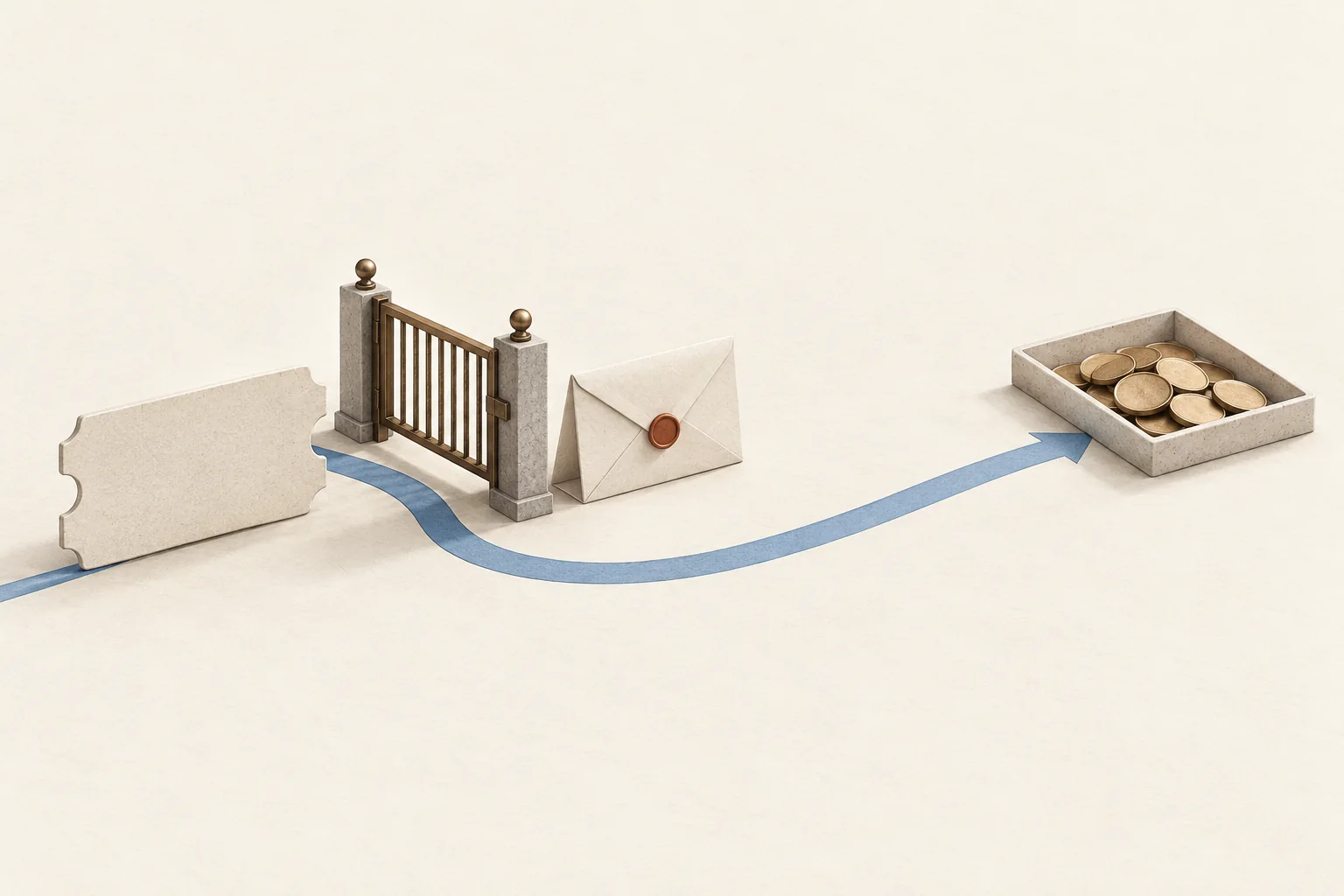
A customer discount can end while a commission remains payable. A referral can also qualify under agreed terms after the customer-facing promotion ends. That depends on the agreement and tracking behavior; it is not a universal affiliate-platform rule.
Shopify documents the separation in its controls. Deactivating a discount changes checkout behavior. Pausing a Collabs connection deactivates creator links and codes and cancels unclaimed gifts. The same documentation directs merchants to Payments separately to cancel pending payouts. Ending promotion and canceling commission are distinct actions.
Review the accepted terms and any later written promises. Check notice requirements, commission rates, refund deductions, payout thresholds, and renewal commissions. If terms conflict or the amount is disputed, get advice for the governing jurisdiction before treating a platform button as permission to cancel payment. This is an operating procedure, not legal advice.
Set the retirement timeline
Choose dates from the existing agreement. Do not invent a shorter attribution window because you want to close the account this month.
| Stage | Owner and action | Evidence to keep |
|---|---|---|
| Before notice | Program manager checks terms and open offers | Accepted terms, amendments, code and link mapping |
| Notice sent | Program manager states the discount cutoff and commission treatment | Delivered notice and creator reply |
| Immediately before cutoff | Operations exports sales, commission, and payment records | Timestamped exports and unresolved-order list |
| At cutoff | Store operator disables the intended promotion | Setting record and checkout test |
| During remaining eligibility | Analyst reviews eligible late orders and refunds | Order-level decisions with reasons |
| At each payment date | Finance releases amounts due and tracks failures | Statement and payment reference |
| After settlement | Program manager archives the relationship | Reconciled balance and named owner for later issues |
If only the discount is ending, avoid an account-wide action that also disables links or cancels gifts. In Shopify's discount admin, the documented desktop path is Discounts, select the unexpired discount, then Deactivate and confirm. For a full Collabs relationship pause, the documented path is Apps > Collabs > Connections, select the creator, then Pause connection.
Before using either path, check how your affiliate integration responds. Shopify's cited connection documentation does not explain what happens to referral cookies set before a pause. If earlier clicks remain eligible under your terms, confirm support with the platform and preserve the evidence needed to reconcile those orders. Do not promise automatic tracking that you have not verified.
Use the attribution-window guide to define eligible click and order times before writing the notice. If subscription renewals are involved, list them separately rather than assuming the first-order cutoff covers them.
After deactivation, test a new cart and a cart prepared before the cutoff. Record the result for the code, any shareable discount link, and the affiliate link. A checkout test proves discount behavior; it does not prove a commission was recorded. Check the affiliate record separately through an authorized test workflow.
Preserve the commission record
Keep the creator ID, code, affiliate links, order IDs, order times, qualifying referral evidence, applicable rate, commission basis, refunds, and payment references. Preserve the original record alongside later adjustments.
Shopify's Collabs reporting documentation describes an exportable Sales report with sales and commission values. Add the order and payment records you need; do not assume one summary export contains every field.
Separate approved unpaid money from amounts still awaiting validation. Under Collabs automatic payments, canceled and fully refunded orders have their commissions canceled during the holding period. After that period, commission enters Shopify billing. Payment to the creator depends on the merchant paying the bill and the creator activating automatic payouts. A holding-period end is therefore different from a guaranteed bank-arrival date.
Do not reject all pending orders because the relationship ended. Review each against its applicable terms. Keep partial refunds and disputed attribution visible, with a reason and review date. For the refund calculation itself, use reconciling commissions after returns.
Worked retirement balance
The following order data and terms are hypothetical. They illustrate a settlement worksheet, not Shopify's calculation rules. Assume all amounts are USD, commission is 10% of eligible merchandise revenue after discounts and merchandise refunds, and tax and shipping are excluded. Round each order's commission to the nearest cent, with half-cents rounded up.
In this example, the agreed promotion cutoff is October 31, 2026 at 23:59 UTC. The agreement preserves qualifying earlier-click referrals for a defined period after that cutoff. Order H103 has verified evidence that meets those terms. All listed orders have completed validation by the settlement date.
| Order | Eligibility evidence | Revenue after discounts | Merchandise refund | Commission | Already paid |
|---|---|---|---|---|---|
| H101 | Valid code before cutoff | $120.00 | $0.00 | $12.00 | $12.00 |
| H102 | Valid code before cutoff | $80.00 | $20.00 | $6.00 | $0.00 |
| H103 | Eligible earlier click, order after cutoff | $90.00 | $0.00 | $9.00 | $0.00 |
| H104 | New referral after eligibility ended | $70.00 | $0.00 | $0.00 | $0.00 |
For each eligible order, commission equals the rounded result of (revenue after discounts - eligible merchandise refunds) × commission rate. An ineligible order contributes zero.
The approved commission total is $27.00. Subtract $12.00 already paid to get $15.00 remaining. H104 is excluded because its referral is ineligible, not because every order after code retirement is automatically excluded. No fees, currency conversion, taxes on services, or unresolved claims are included in this example.
Send a notice that separates the dates
Modash's affiliate-management article discusses reliable tracking, payment schedules, and creator communication. For retirement, put those details in a direct notice rather than relying on a status-change email alone.
Use the following structure. Replace the illustrative facts with checked terms and dates before sending. This is a hypothetical completed notice, not a message sent to a real creator.
Subject: SAMPLE10 retirement and remaining commission
We are ending the SAMPLE10 promotion on October 31, 2026 at 23:59 UTC. Please stop promoting the discount after that time and update editable captions, descriptions, and profile links that still advertise it.
Commission on qualifying orders placed before the cutoff remains subject to our existing terms. Qualifying clicks recorded before the cutoff remain eligible for orders through November 7, 2026 at 23:59 UTC under our agreed retirement terms. New referrals after the cutoff are excluded.
Your order statement will identify approved, pending, and disputed amounts separately. We will send it on November 10. Approved amounts due on November 15 will follow the existing payment schedule; that date is not a guarantee of bank arrival. Orders still in their agreed return-review period will appear with their expected release date.
Please reply to this email with any missing order or conflicting promise. Our affiliate program manager owns this review. We will acknowledge each query within two business days. This notice does not cancel earned commission.
Only include a response commitment your team can meet. State any payout threshold issue directly and agree how the closing balance will be handled. Do not silently leave a small balance unpaid because the creator can no longer generate new sales.
Update the offer without erasing its history
Ask creators to mark editable discount claims as expired. Do not ask them to remove disclosures from a paid endorsement merely because its code stopped working. That is an editorial recommendation based on the fact that the original material connection still explains the endorsement.
For endorsements affecting U.S. consumers, FTC guidance calls for noticeable disclosures with the endorsement. Material connections include payment and free products. Other jurisdictions may impose different requirements.
Before scheduling deactivation, give finance the unpaid-order list and give the creator the cutoff notice. Keep the retirement open until each balance is paid, resolved, or assigned a documented next action and owner.