



Turn consented interview notes into a creator search brief by separating what customers said, what you think it means, and what a creator must demonstrate. Group the notes into anonymized themes. Translate each theme into a search query and an observable content requirement. Keep audience assumptions marked as unknown until you have evidence.
This gives you a shortlist with a traceable reason for each candidate. A creator belongs because their work addresses a documented customer situation, rather than because someone on the team likes their feed.
Check which notes you can use
Before copying anything into a search sheet, check the research purpose and sharing permissions. Did participants agree that their answers would inform marketing research? Who may see the notes? Does the planned use fit what they were told?
The GOV.UK guide to informed consent asks government researchers to explain data use, sharing and retention, and to stay within the consent obtained. That guidance concerns UK government research. Use it as a practical reference, and ask your privacy lead about the rules and permissions that apply to your organization.
For this workflow, keep two documents:
- A restricted research record with the original notes, consent record and participant reference.
- A discovery brief containing anonymized themes, search terms and selection requirements.
Remove names, contact details, employers, precise locations and distinctive combinations of personal details from the discovery brief. Replacing a name with a code alone does not establish that nobody can identify the participant. The GOV.UK privacy guide recommends fully anonymized extracts where possible and restricted sharing when participants remain identifiable.
Do not paste interview transcripts into a creator database or an unapproved AI tool. Give the researcher doing discovery only the information needed to judge creator fit. If you cannot confirm the permitted use, leave those notes out until your research owner resolves it.
Extract situations before assigning creator categories
Read each usable interview for a sequence: what happened, what the customer needed, what they searched for, and what helped them decide. Keep the original wording in the restricted record. Put a short paraphrase in the discovery worksheet.
Useful follow-up questions include:
- What were you trying to do when you started looking?
- What did you type or say when searching for help?
- Which part of a demonstration answered your question?
- What information was still missing when you bought?
Modash's ICP research article connects customer behavior and content preferences to creator selection. The worksheet below makes that connection explicit: each theme needs a search route and evidence you can inspect.
Avoid turning every statement into a requirement. A participant mentioning camping does not establish that all customers follow outdoor creators. Record whether a theme appeared repeatedly, appeared once, or contradicted another participant's account. If you count mentions, include the number of interviews reviewed and how participants were recruited. A count from interviews does not establish a market-wide percentage.
A theme-to-query worksheet
Everything in this example is fictional. The excerpts were written to demonstrate the method; they are not customer quotes or findings. The hypothetical product is a compact lunch container for people who carry meals to work.
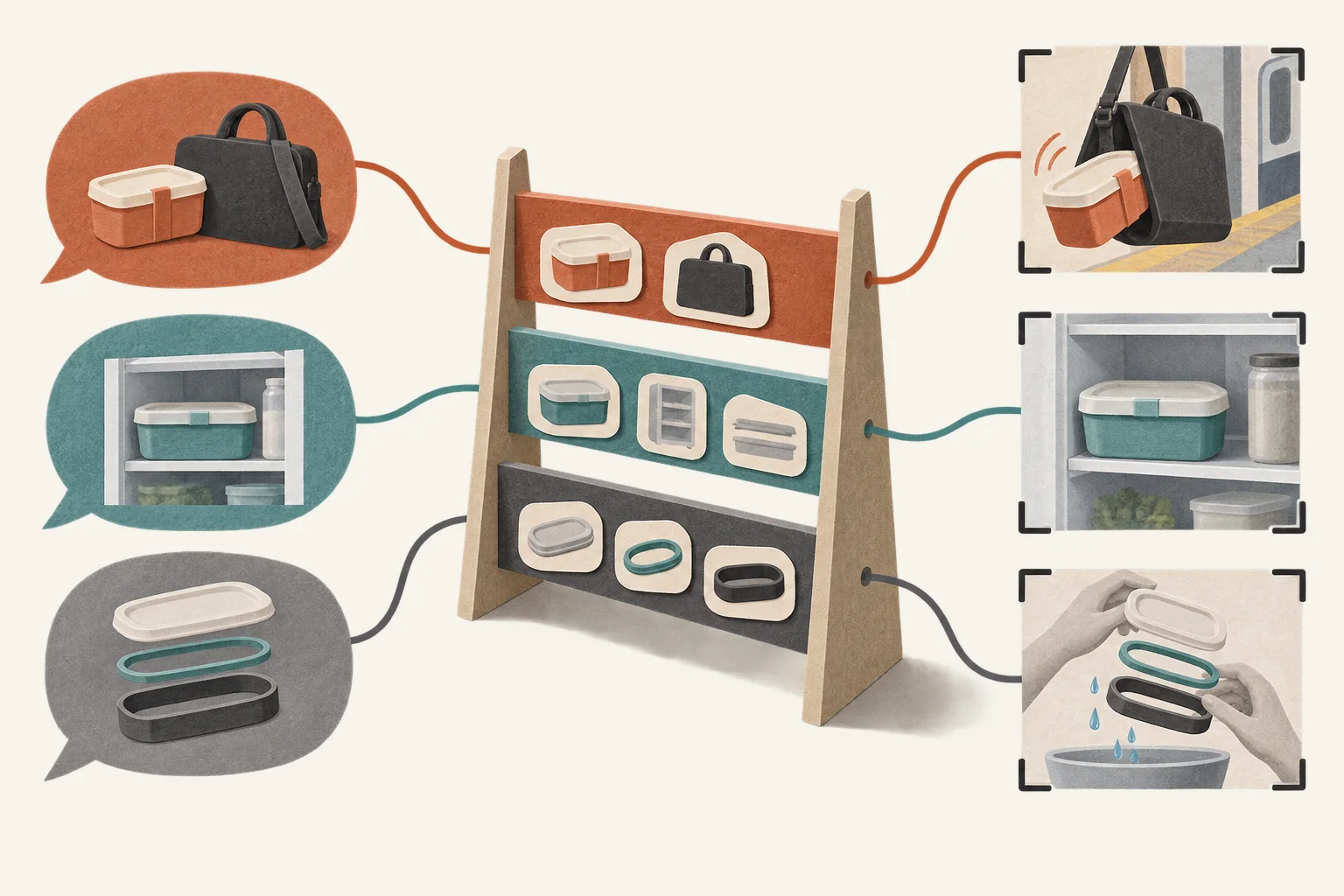
| Illustrative excerpt | Theme | Query to try | Evidence to inspect |
|---|---|---|---|
| "I carry lunch beside my laptop and worry about spills." | Confidence during transport | leak test lunch container commute | A demonstration of packing, carrying and opening the container |
| "The office fridge is packed by lunchtime." | Limited storage space | compact packed lunch small fridge | Content showing container dimensions in a realistic storage setting |
| "I want to see how the lid gets cleaned." | Cleaning effort before purchase | lunch container lid cleaning | A close demonstration of taking apart and cleaning the lid |
| "Meal-prep videos make more food than I need." | Smaller preparation routines | meal prep one person work lunch | Repeat content built around individual portions |
These queries are starting phrases, not a promise about how every platform's search works. Try them separately and record what each returns. For more ways to expand a phrase without losing its meaning, use the customer-problem search-term worksheet.
Add two columns to your working copy: evidence strength and disconfirming notes. A repeated theme may deserve a dedicated search. A single unusual comment may deserve a small exploratory search. A contradiction deserves a separate segment or an unresolved question.
For example, customers who cook in batches and customers who prepare one meal at a time may need different demonstrations. Do not merge those needs into a vague preference for "convenient food content."
Turn one theme into a selection rule
Take the fictional cleaning theme. A useful selection rule would be:
Candidate should have recent content showing how food-storage products come apart, get cleaned and go back together. Save the relevant post links and explain what each demonstrates.
That rule lets two reviewers inspect the same evidence. "Authentic lifestyle creator" leaves them guessing.
A hypothetical candidate with detailed cleaning demonstrations could advance to review. A candidate with attractive lunch photos but no demonstrations would remain unconfirmed for this theme. Neither judgment establishes whether their audience buys lunch containers.
Keep the post sample consistent when comparing candidates. The guide to reviewing recent posts with a fixed sample covers that review step. Here, the output is the requirement derived from the interview, plus the evidence needed to test it.
Separate content fit from audience fit
Use three evidence labels in the shortlist:
| Label | What belongs here | What it permits you to say |
|---|---|---|
| Observed | Linked public content showing a relevant demonstration | The creator has made this type of content |
| Inferred | Your interpretation that the format could answer the research theme | The creator may suit this brief; test the assumption |
| Unavailable | Audience information you have not obtained | Audience fit remains unconfirmed |
Do not infer follower occupations, purchasing power or location from the creator's appearance or posting setting.
If geography matters for a YouTube campaign, ask a prospective creator for an appropriately dated audience report. YouTube's audience documentation places these reports inside YouTube Studio. Its Top geographies report describes where channel watch time comes from, and YouTube warns that some data can be limited. Record the metric and period as supplied. Do not relabel watch time as a percentage of customers or followers.
Missing data should remain missing. Use the guide to evaluating a creator without demographic data when a promising content match lacks audience evidence.
Hand off a brief that someone can act on
For the fictional lunch-container example, a completed brief could read:
- Research theme. Buyers need to understand lid cleaning before choosing a container. This is an illustrative theme, not a research finding.
- Product context: compact containers used for work lunches.
- Search phrases: lunch container lid cleaning; food storage seal cleaning; packed lunch container review.
- Required content evidence: recent demonstrations of disassembly, cleaning and reassembly.
- Open question: whether the creator reaches buyers in the campaign's shipping markets.
- Shortlist record: creator URL, theme matched, post evidence, reviewer interpretation and unanswered question.
With real research, add the internal theme reference and its evidence strength. Keep participant identities and raw excerpts in the restricted research record.
Start with one permitted theme. Write the query, define what a matching post would show, and find a candidate whose work you can evaluate against that requirement.