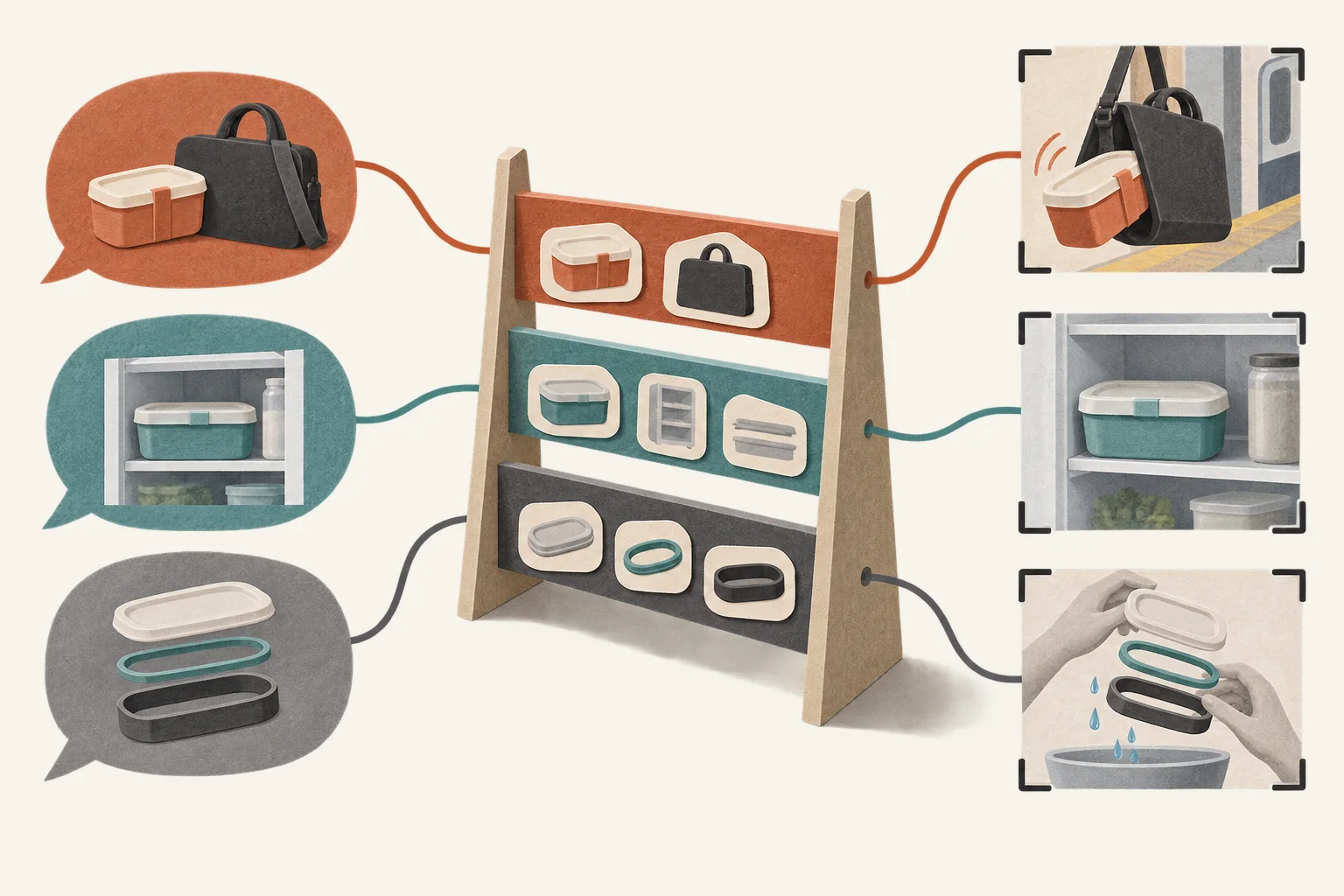





When your product category is too broad, build influencer search keywords around the moment a customer needs help. Describe the situation, the problem in everyday words, and the related activity where it occurs. Search those phrases separately, then open the resulting posts to see who regularly covers that situation.
For a lunch container, "food influencers" leaves much of the brief unstated. "Lunch without a microwave" gives you a particular problem to investigate. It may lead you toward creators discussing work lunches, commuting or meal preparation. Those are search hypotheses, not proof that their viewers will buy your product.
Write the customer situation before the keyword list
Google's keyword-list guidance recommends starting with the language customers use and refining broad categories into relevant phrases. That guidance concerns paid search. This worksheet adapts the vocabulary exercise to creator discovery; it does not assume ad matching rules apply to social search.
Use this sentence to define one search direction:
A person doing this activity wants this outcome, despite this constraint.
Keep it tied to a task your product can support. Avoid starting with an imagined demographic when the practical situation is clearer. "A commuter carrying lunch on the train" gives you more language to test than "busy professionals."
Pull wording from customer questions, support messages, product reviews and sales conversations you have permission to use. Record where each phrase came from. Remove names and other personal details from the search worksheet. Preserve the useful vocabulary without treating one comment as evidence of widespread demand.
If you do not have customer language yet, label your phrases as hypotheses. The examples below follow that rule. None are customer quotes, measured search trends or validated product claims.
A worksheet for three unrelated products
These are hypothetical products and search directions. Each product column connects a customer task to terms you could test. The adjacent interest needs a reason to belong in the same search.
| Worksheet field | Lunch container | Removable cable clips | Invoicing software for freelancers |
|---|---|---|---|
| Broad category to move beyond | Food | Home organization | Business |
| Customer situation | Packing lunch for a workplace with no microwave | Arranging a desk without drilling into furniture | Sending the first invoice after a freelance project |
| Problem wording to test | lunch without a microwave; packed lunch leaks | cables falling behind desk; desk cables without drilling | what to put on an invoice; how to invoice a client |
| Related activity | Commuting with a packed bag | Setting up a desk in a rented room | Starting a freelance design practice |
| Adjacent search terms | commuter lunch bag; cold meal prep | renter desk setup; small desk organization | freelance designer admin; first freelance client |
| Content worth opening | A demonstration of packing and carrying lunch | A desk setup that shows cable routing | A walkthrough of the creator's invoicing process |
| Common mismatch to watch for | Restaurant recommendations with no packed-lunch content | Permanent built-in desks with no relevance to removable fittings | Accounting advice aimed only at large companies |
The product names alone do not establish their capabilities. For the hypothetical lunch container, only pursue a leak-related demonstration if the real product supports that use. For cable clips, confirm surface compatibility before planning content. For software, check the actual invoicing workflow before asking a creator to teach it.
An adjacent interest is useful when you can finish this sentence:
This creator might discuss our customer's problem because their content includes this activity.
"Commuting" has a possible connection to carrying lunch. "Luxury travel" needs more evidence. Keep a term when the connection is specific enough to check in a post.
Run short phrases as separate searches
Start with one problem phrase and one activity phrase. Search them independently before combining them. This helps you see which part is attracting irrelevant results.
For the hypothetical cable clips, try this sequence:
- Search "cables falling behind desk" to find content about the frustration.
- Search "renter desk setup" to find the setting where the product might fit.
- Try "desk cables without drilling" to test the constraint more directly.
- Open promising posts and inspect the creator's other relevant work.
- Keep the terms that lead to creators who could demonstrate the intended use.
The quotation marks here identify phrases for the reader. They do not promise exact-match behavior in a platform's search box. Use ordinary text unless the service documents a search operator you need.
Modash's guide to bio and topic searches distinguishes self-description from the subjects creators discuss. That distinction helps when choosing terms, even if you use another search method.
A role term and a content term answer different questions. "Freelance designer" describes a possible creator identity. "First client invoice" describes a topic. A person may cover the topic without using that role in their profile. Try both, and record whether you found the match in a profile or a post.
Use a local-language version when that is how your intended customers discuss the task. Translate the situation and check the resulting language with a fluent speaker. A literal translation of a niche label may miss the phrase people use for the problem.
For another source of wording, TikTok's Creator Search Insights lets users explore searched topics and related videos and topics. Its help page says some topics are AI-generated and may be inaccurate. Use suggestions as leads to inspect, rather than proof of customer demand. The "Searches by followers" filter requires more than 1,000 followers; it is not a report on any creator whose profile you find.
Keep a search log that explains the next edit
Do a small review before expanding your list. Ten results per phrase is a workable starting batch for this exercise. It is a suggested workload, not a benchmark for search quality.
Record these fields for each search:
| Field | What to record |
|---|---|
| Phrase and search location | The words entered, platform or tool, and date |
| Relevant result | A profile or post URL with a brief reason to keep it |
| Repeated mismatch | The kind of irrelevant result that keeps appearing |
| Next revision | One word or constraint to add, remove or replace |
| Unknowns | Audience fit, product suitability or other facts still unverified |
Revise based on the mismatch:
- If you find stores selling the product, try a task or demonstration phrase.
- If you find broad inspiration posts, add the practical constraint.
- If you find one unrelated meaning of a word, add the activity that disambiguates it.
- If you find almost nothing, remove one constraint or try an everyday synonym.
- If every phrase returns the same creators, try a different customer situation before adding more near-identical terms.
For the hypothetical invoicing tool, "invoice" could bring up software companies and templates. "Freelance designer admin" tests whether creators discuss the surrounding work. If those results only discuss finding clients, try "freelance invoice walkthrough." Keep a note of why you changed it.
Separate a useful search result from a qualified creator
A relevant post gives you evidence that a creator has addressed a topic. It does not establish their audience's purchasing needs, location or willingness to buy. Leave those fields unknown until you have evidence.
Use the audience-fit guide when you need to evaluate who a creator reaches. Use the defensible shortlist process to record why a candidate advances or drops out. If location becomes a requirement, check a creator's local connection before treating a place reference as proof of residence.
Choose one customer situation from your own brief. Write one problem phrase, one activity phrase and one constraint phrase. Run them separately, save relevant post links, and make your next keyword change from the mismatches you observe.