



Review comparable videos for the steps a viewer can understand and repeat. Then, if product-specific questions remain, commission a small paid demonstration with the scoring criteria shared in advance. Judge accuracy, visible actions and explanation separately from production polish. A confident delivery alone gives you too little evidence to commission a full video.
Define what the viewer must learn
Write one sentence before opening creator profiles: "After watching, a first-time user should be able to..." Finish it with a task you can observe, such as fitting an attachment, choosing a setting or completing a setup step.
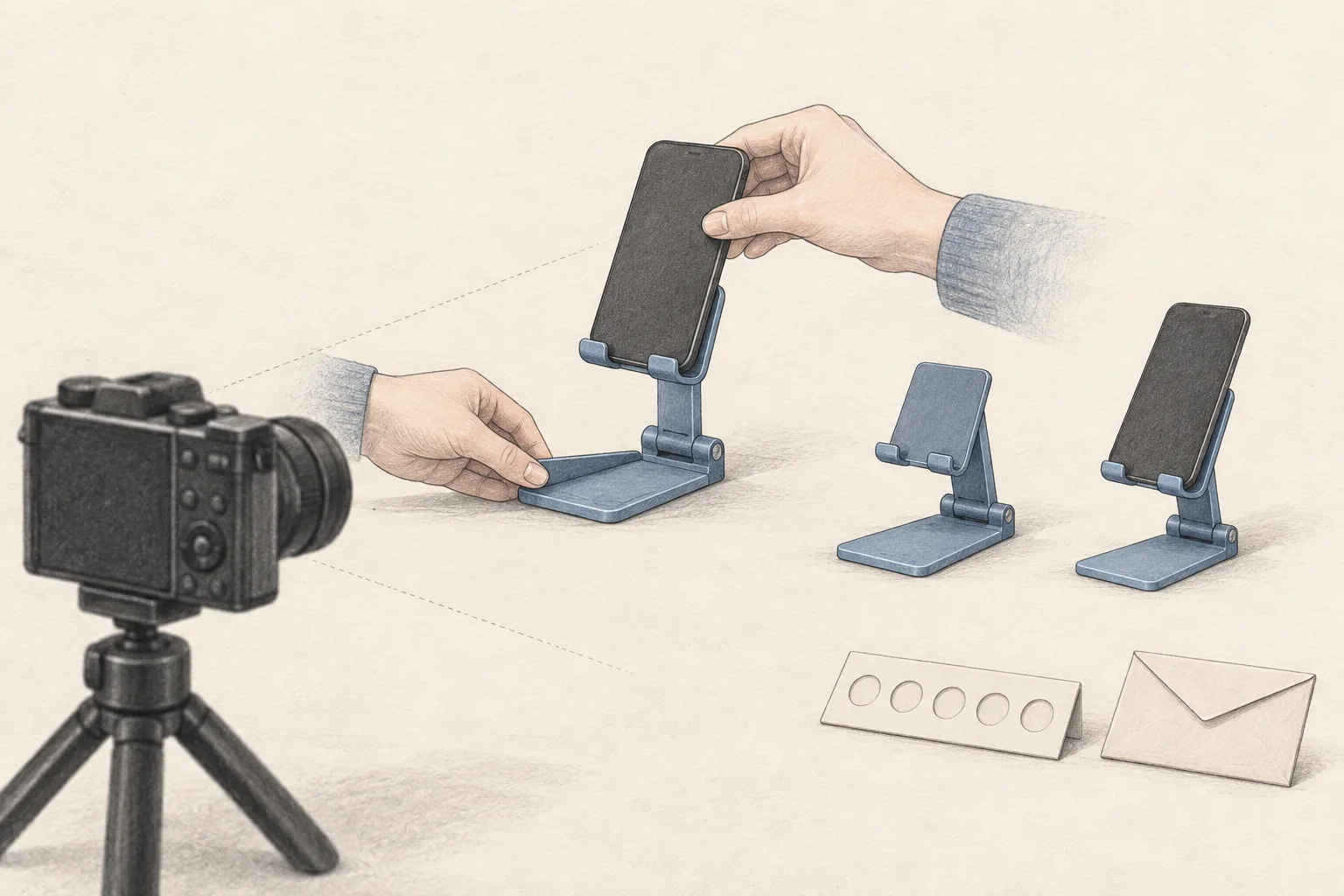
For a hypothetical adjustable phone stand, the task might be opening the base, securing a phone and changing the viewing angle. Naming materials or saying the stand looks good would leave that task unanswered.
Choose the intended format too. A narrated close-up, a talking-head explanation and a live demonstration require different evidence. Modash's discussion of creator fit recommends looking at which content formats a creator handles well, including speaking to camera. Use that as a reason to inspect relevant work. An unrelated polished montage need not disqualify someone, but it cannot answer your demonstration question.
This assessment covers one part of selection. Use the creator shortlist guide to weigh demonstration ability alongside the rest of the campaign brief.
Review a small set of comparable explanations
As a starting recommendation, review three relevant videos per creator. Include a recent explanation and a sponsored demonstration if one is available. Ask the creator to nominate an example when their public portfolio does not show the work you need.
Watch each video once without pausing. Write down the action you believe you could now perform. Watch again and record timestamps for missing steps, useful close-ups and claims that need checking.
Look for these distinctions:
- Visible action. Can you see the control, part or movement while the creator explains it?
- Ordered explanation. Does the viewer receive the information before needing it?
- Accurate result. Does the demonstration show what happened under the stated conditions?
- Useful language. Does the creator explain unfamiliar terms and avoid assuming prior knowledge?
A cut between setup and result may leave an important step unproven. Record the gap rather than guessing what happened off camera. Likewise, label accuracy "unverified" when you lack the product instructions or other reliable documentation. You can still assess whether the action is visible.
Keep judgments about accents, personality and your preferred editing style out of the score unless they affect an explicit brief requirement. Ask whether the intended viewer can follow the explanation.
Use a demonstration scoring sheet
The following is a recommended editorial rubric, not a platform rule or a validated predictor of sales. Score each criterion from 0 to 2. Use "not observed" when the available video does not let you judge it; do not silently turn missing evidence into a failure.
| Criterion | 0: missing or wrong | 1: partly usable | 2: clear evidence |
|---|---|---|---|
| Task framing | Viewer cannot identify the task | Task emerges late or vaguely | Intended user and task are clear |
| Step order | Essential step omitted or out of order | Viewer must infer a transition | Required steps follow a usable order |
| Demonstration visibility | Key action hidden | Action visible but hard to inspect | Relevant movement and result are visible |
| Explanation | Speech contradicts action or leaves it unexplained | Some terms or actions need clarification | Words explain the action as it happens |
| Accuracy and limits | Verified error or unsupported promise | Important condition left unclear | Instructions, conditions and claims match supplied evidence |
For each row, record the video URL, timestamp, score and one sentence explaining the score. Do not calculate a total until you have evidence for every row.
Set the decision rule before comparing creators. One suggested rule is to require full marks for visibility and accuracy, then discuss the remaining weaknesses individually. A high total must never cancel an unsafe action or unsupported claim.
A hypothetical review
The following scores are illustrative, with accuracy judged against instructions supplied for the hypothetical product.
| Criterion | Creator A | Creator B |
|---|---|---|
| Task framing | 2 | 1 |
| Step order | 1 | 2 |
| Demonstration visibility | 1 | 2 |
| Explanation | 2 | 2 |
| Accuracy and limits | 2 | 2 |
| Total | 8/10 | 9/10 |
Creator A speaks fluently, but a cut hides how the phone locks into the stand. Creator B has a weaker opening yet shows the whole action. Under the suggested rule, B clears the demonstration requirements. A needs evidence that they can make the locking step visible.
The next decision is specific: ask A whether an existing video shows that skill, or commission a paid test of that step. Do not request a complete unpaid campaign concept to fill the gap.
Commission a bounded paid test
Agree the fee, delivery date and allowed use before work begins. Pay for the agreed test work regardless of whether you commission the larger project. This is a recommended working arrangement, not a statement of legal requirements.
Send the product, current instructions, supported claims and relevant safety limits. Allow time to try it. Ask the creator to report any product fault or missing information before filming; those problems should not become unexplained deductions from their score.
Here is a hypothetical paid-test brief for the phone stand:
| Brief item | Test instruction |
|---|---|
| Viewer | A first-time owner setting up a phone for a desk call |
| Task | Show opening the base, securing the phone and adjusting its angle |
| Deliverable | One private 45–60 second video, with spoken explanation and close-ups |
| Product facts | Use the supplied instructions; flag any mismatch with the sample |
| Creative freedom | Choose your own wording, setting and opening |
| Evaluation | Use the five-row rubric above; visibility and accuracy must each score 2 |
| Feedback | One consolidated note; one agreed revision of the same demonstration |
| Payment | Agree the fixed fee and payment date before starting; selection does not determine payment |
| Use | Internal evaluation only; discuss any publication or advertising use separately |
Share the full rubric with the brief. A surprise demand for a new location, extra scenes or a different concept changes the assignment. Discuss that work separately. The creator brief guide can help you carry these requirements into the larger commission without scripting every sentence.
For endorsements reaching U.S. consumers, the FTC's influencer guidance says creators cannot describe experience with an untried product or invent claims requiring evidence the advertiser lacks. If the video will be published as an endorsement, plan the brand-relationship disclosure too. The FTC says video disclosures belong in the video, beyond the description. Other jurisdictions may have different requirements.
Make the decision from the demonstrated task
Review the paid test against the same rubric. A second reviewer can score it independently, then compare timestamps where scores differ. Ask someone unfamiliar with the product to describe the steps after watching. Treat that response as an additional comprehension check, without claiming it represents the whole audience.
If a creator volunteers YouTube retention data for a past video, use it to identify sections worth reviewing. YouTube's help page places retention in video-level Analytics within Studio. Dips can reflect skipping or abandonment; spikes can involve rewatching or sharing. These patterns do not establish that viewers understood a demonstration. Record data the creator has not supplied as unavailable.
Choose one outcome: commission the larger video, request the agreed revision for a named gap, or decline further work while paying for the test as agreed. Attach your timestamped scoring sheet to that decision so the creator knows which demonstrated skill determined the next step.