



A bundle makes a creator promotion more useful when its products solve one audience need together, the store can ship every component, and the discounted order leaves enough contribution to fund the campaign. Choose the smallest set that passes those checks. A larger basket can produce less money after costs.
Here, an influencer product bundle strategy means choosing merchandise for customers to buy together. Modash's bundling guide covers a separate decision: negotiating several creator deliverables in one agreement. Keep the merchandise decision separate from the content fee negotiation.
Start with the task the creator will demonstrate
Write one sentence describing the buyer and the task. For example: "A viewer who owns a kettle and mug wants to try pour-over coffee."
That sentence gives each proposed item a reason to be included. A dripper and matching filters help this buyer start. Extra filters suit someone who already owns the dripper. A serving jug needs a further reason, such as brewing for several people.
Check compatibility at the variant level. Hario's size-02 V60 filter page identifies the intended dripper size and lists different filter pack counts. "Dripper plus filters" is therefore an incomplete buying instruction. The store and creator need the matching size and the stated quantity.
The worksheet below uses invented, unbranded coffee products. Its prices, costs, stock and campaign assumptions are hypothetical. They describe no Hario offer or results.
Ask the creator to explain how the proposed set fits the demonstration. If an item never appears in the routine, remove it or make it an optional purchase. Slow-moving inventory alone is a weak reason to require a customer to buy an extra product.
Compare three options on the same worksheet
Assume the merchant sells a dripper for $30, a pack of matching filters for $10, and a serving jug for $30. Product costs are $12, $3 and $18 respectively. The proposed offer prices below already include the bundle discount; do not subtract that discount again.
| Worksheet row | Starter pair | Filter refill | Serving set |
|---|---|---|---|
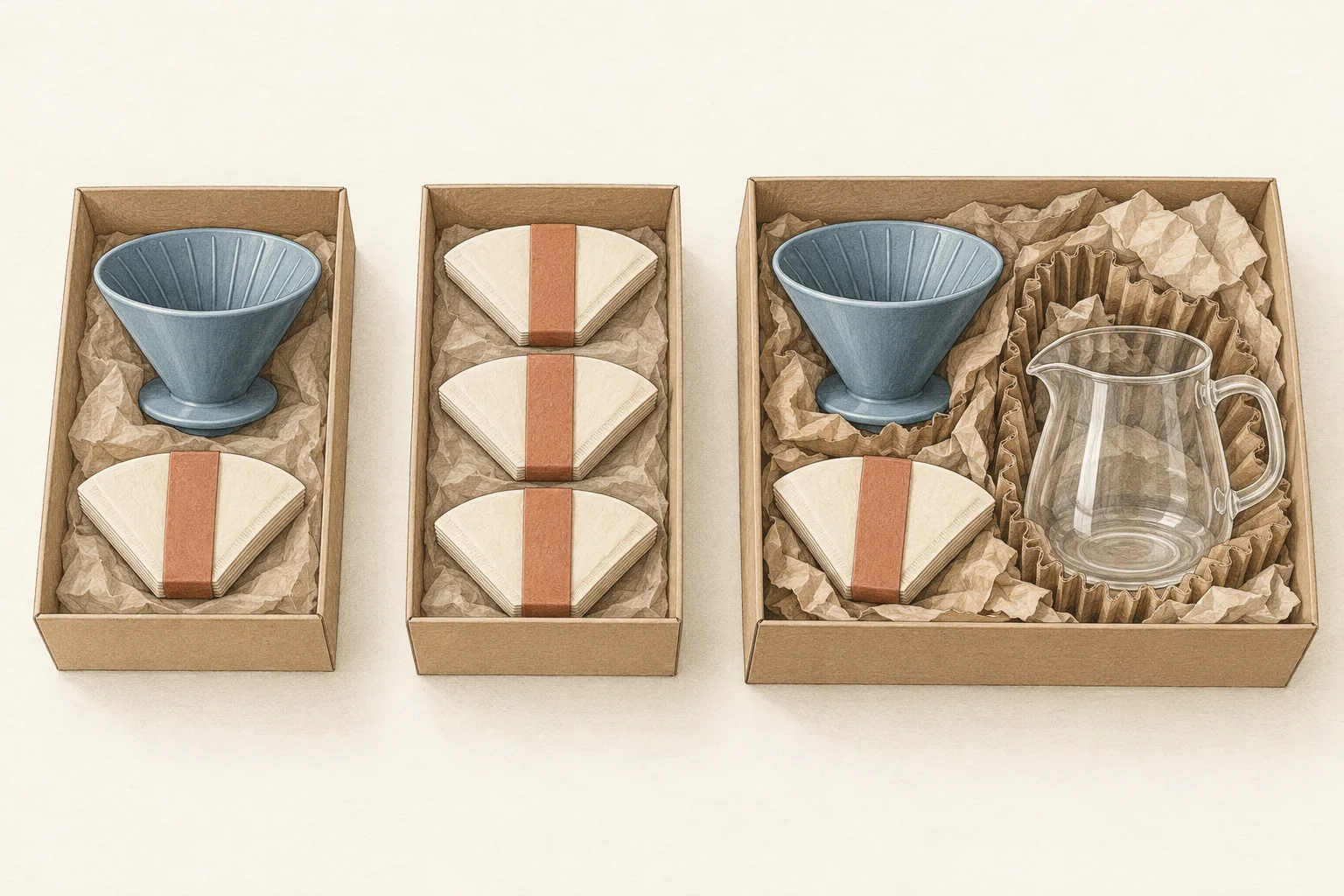
| Contents | 1 dripper, 1 filter pack | 3 filter packs | 1 dripper, 1 filter pack, 1 jug |
| Buyer need | Start brewing | Restock an existing setup | Brew and serve together |
| Separate-item total | $40 | $30 | $70 |
| Offer price | $35 | $25 | $55 |
| Product cost | $15 | $9 | $33 |
| Packing, handling and merchant-paid shipping | $7 | $5 | $10 |
| Payment fees | $1.40 | $1 | $2 |
| Creator commission | $3.50 | $2.50 | $5.50 |
| Expected return-related loss allowance | $1 | $0.50 | $2 |
| Contribution per order | $7.10 | $7 | $2.50 |
For this example, commission is 10% of the offer price. The payment fees and loss allowances are planning inputs, not provider rates or observed return data. The loss allowance estimates refunds and extra return handling, less recoverable stock value and any fee or commission reversals. Replace it with the merchant's own estimate without counting the same loss twice.
Use this calculation for each option:
Contribution per order = merchandise revenue after discounts
  - product cost
  - packing, handling and merchant-paid shipping
  - payment fees
  - creator commission
  - expected return-related losses
Taxes collected for remittance are outside this example. Customers pay no separate shipping charge. If they do in your store, include that revenue alongside the shipping expense. Fixed creator fees, production costs and business overhead still need funding after the per-order calculation.
Starter pair. The $35 order leaves $7.10: $35 minus $15, $7, $1.40, $3.50 and $1. It fits the novice brewing demonstration. It also avoids requiring a jug that the viewer may not need.
Filter refill. The $25 order leaves $7. It suits existing dripper owners, but fails the stated beginner task because the buyer still lacks the dripper. Save this option for a creator whose demonstration addresses restocking. Use offers for customers who already bought to separate that audience from first-time buyers.
Serving set. The $55 order leaves $2.50. It has the highest sale price and the largest hypothetical dollar discount, yet the lowest contribution. The added jug consumes most of the extra revenue through product and fulfillment costs.
Shopify lists higher average order value and product curation among possible bundle benefits. Neither proves profitability. If each order contained only one of these sets, average order value would be $35, $25 or $55 before any later adjustments. Keep that basket-size comparison beside the contribution calculation, rather than using it to choose the winner.
Let the scarce component limit the offer
Assume the merchant has allocated 180 drippers, 240 filter packs and 40 jugs to this promotion after protecting other sales and replacements. Evaluate each option separately against that same pool.
| Option | Calculation | Maximum complete sets |
|---|---|---|
| Starter pair | Smaller of 180 drippers and 240 filter packs | 180 |
| Filter refill | 240 filter packs divided by 3 | 80 |
| Serving set | Smallest of 180 drippers, 240 filter packs and 40 jugs | 40 |
This follows the component arithmetic in Shopify's bundle inventory guidance. Divide each component's available units by the quantity required, round down, then take the smallest result.
These ceilings overlap. Launching all three offers would make them compete for the same filters and drippers. Allocate stock across offers before adding their order targets together.
For Shopify stores, check two exceptions before trusting the displayed quantity. Shopify excludes components whose inventory is untracked or whose settings permit selling after stock runs out. A displayed bundle quantity therefore needs comparison with physical stock and fulfillment capacity.
Suppose this hypothetical campaign aims to support 60 orders and has a $300 fixed creator fee. The starter pair could leave $426 before that fee, or $126 after it, before other campaign costs and overhead. The serving set can supply only 40 orders. Even if all 40 sell, its $100 contribution would not cover the fee.
That supports choosing the starter pair for this brief. It does not predict 60 sales. For a broader spending decision, match the creator offer to unit economics before setting the campaign budget.
Check the offer customers will receive
Before sending the final bundle to the creator, record the following in the worksheet:
- Exact component SKUs, sizes and quantities, including anything shown in the video that customers must supply themselves.
- Final payable price, code requirements and permitted discount combinations.
- Component stock allocated to the campaign, replenishment dates and the person who can pause the offer.
- Shipping cost and timing for the packed set, including any split shipment.
- What happens if a customer returns one component.
For Shopify Bundles, product-specific discounts must include the parent bundle product. Selecting only its components does not apply that discount. The same documentation says component price changes do not automatically update the bundle price. Recalculate the worksheet after a component price or offer change.
Treat those as Shopify-specific mechanics. Validate your own app and store using the mobile checkout offer test.
For US-directed advertising, the FTC's advertising guidance requires truthful, supported claims and disclosure of material endorsement connections. Give the creator accurate quantities, genuine price comparisons and clear offer limits. Do not turn a planning stock cap into an unsupported scarcity claim. A savings statement and a sponsorship disclosure address different information the buyer needs.
Fill in the three candidate columns with your merchant's costs and allocated stock. Then approve one bundle only after the creator can explain its use, operations can supply it, and the contribution calculation covers the planned spend.