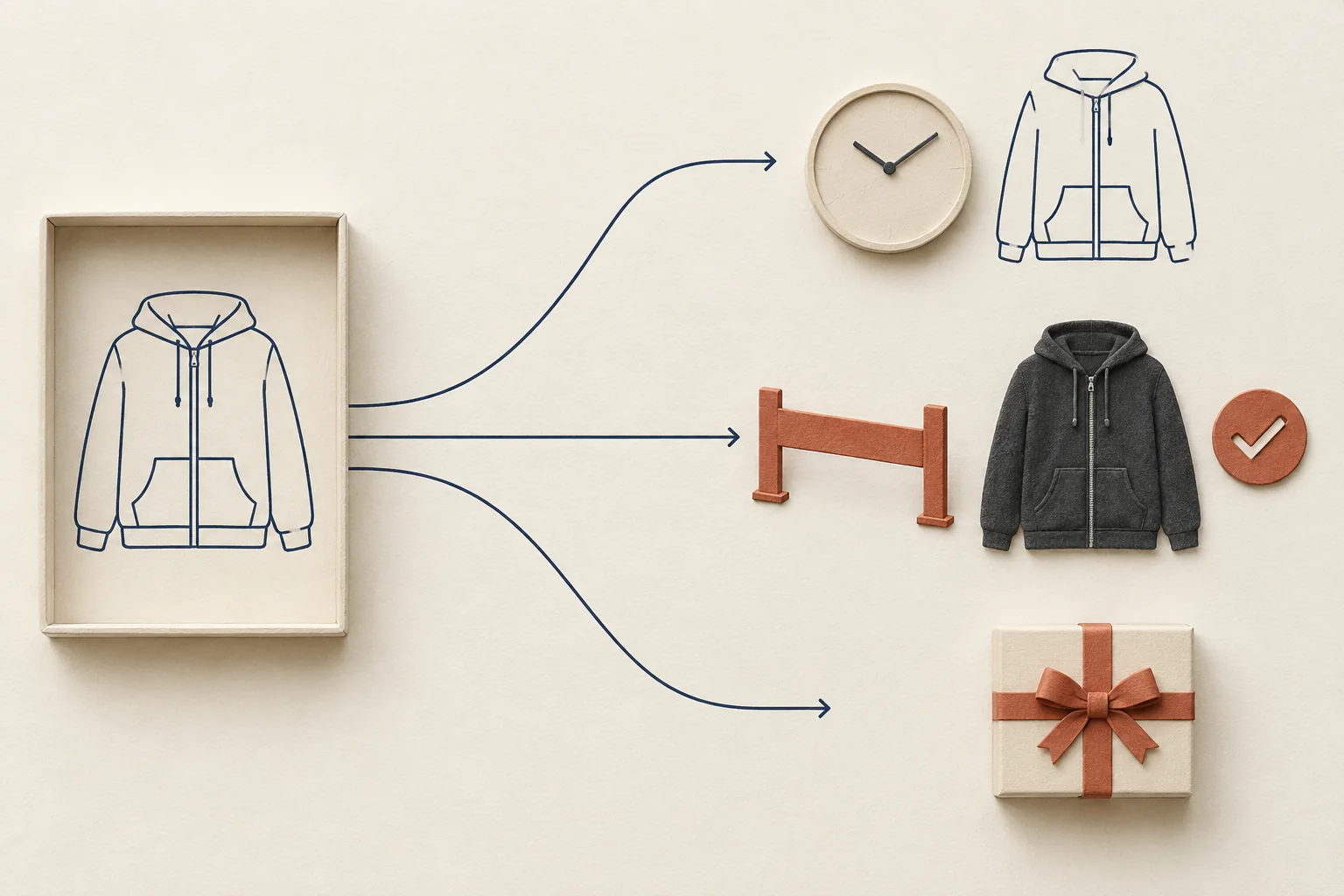




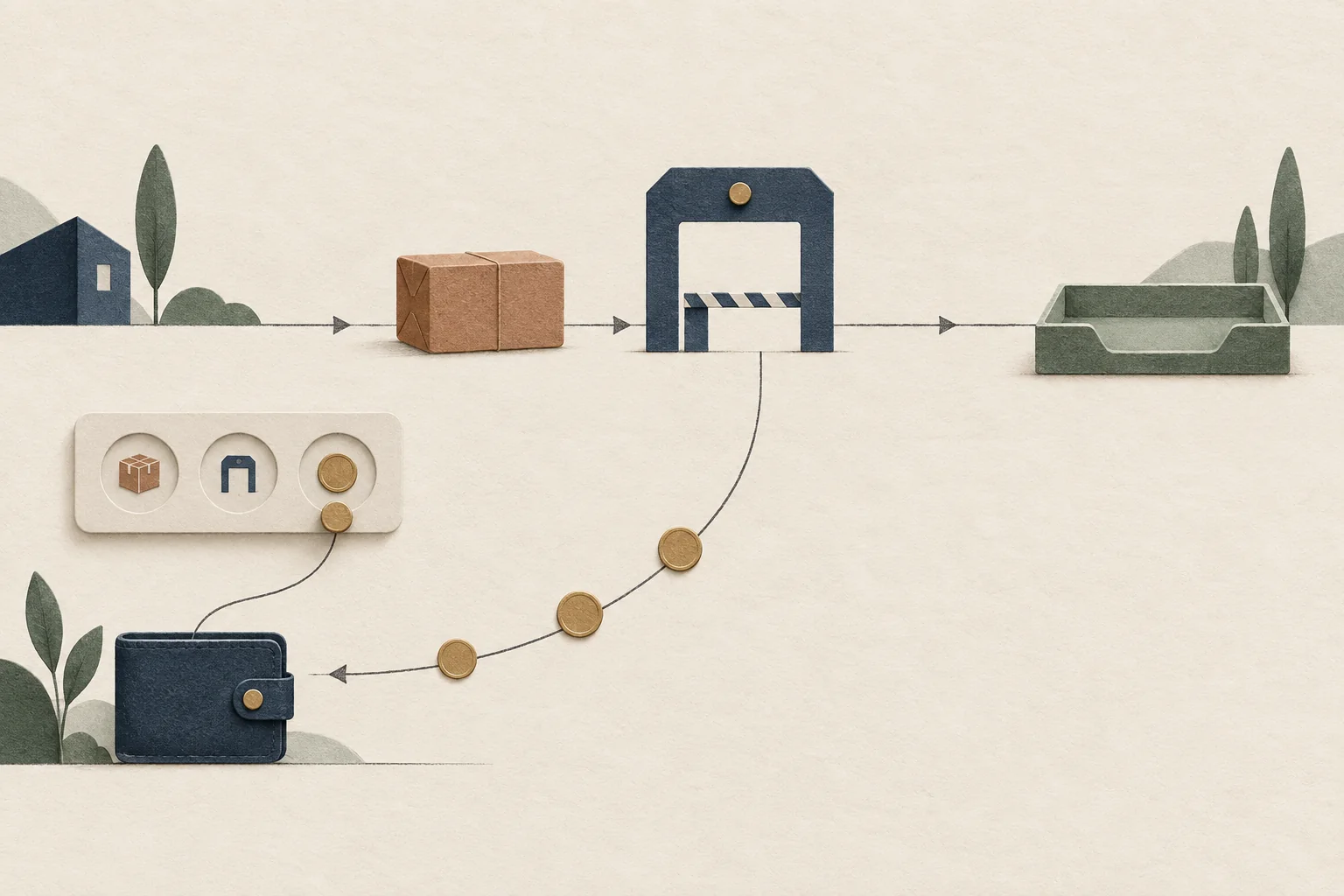
To prevent surprise import charges for a creator, agree who pays before booking, check the destination's customs rules, and set the carrier's duty-and-tax billing instruction to match. If you promise the creator a gift with no charges, the practical default is for the brand to fund import charges and carrier clearance fees. Hold the shipment if you cannot confirm how that will work. Calling the parcel a gift does not remove commercial shipment obligations.
That default is an editorial recommendation. The customs treatment, permitted payer arrangements and final charges depend on the shipment. This decision sheet uses UK customs and FedEx UK guidance as concrete examples, not rules for every destination.
Separate the promise from the carrier setting
A creator can hear "we cover shipping" and reasonably wonder whether that includes the bill arriving at the border. Make your promise explicit about four costs:
- Transport to the destination.
- Import duty, where assessed.
- Import tax, such as VAT, where assessed.
- Carrier clearance or advancement fees.
FedEx's UK guide says it may pay duties and taxes to customs on a customer's behalf and charge a disbursement fee. That fee is a separate budget item from the government charge.
The same guide says the FedEx Express air waybill can assign duties and taxes to the shipper, receiver or a third party. If no payer is selected, the receiver is the default. Paying for the transport label therefore does not establish that your brand will receive the import bill.
Ask fulfillment to show the completed billing selection before dispatch. If a broker or fulfillment partner books the shipment, require the same evidence from them.
FedEx also distinguishes its billing settings from Incoterms, the terms allocating responsibilities between sender and receiver. A term on the commercial invoice and a carrier account setting perform different jobs. Have the booking partner confirm both match the arrangement you intend.
Check whether "gift" means the same thing at customs
A free product in an influencer program does not automatically meet a destination's customs definition of a gift.
For example, GOV.UK's gift guidance requires qualifying goods to be bought and sent between individuals, rather than companies. It also lists personal use and an occasion among the conditions. A company sending its product to a creator does not satisfy that individual-to-individual condition merely because the creator pays nothing.
Use an accurate description of the goods and purpose. Ask your carrier or customs adviser which declaration treatment applies to a promotional shipment with no sale. Do not select personal-gift relief because it appears cheaper.
Free to the recipient also does not establish a zero customs value. FedEx's valuation guidance describes declared value as the selling price or fair market value, including goods that were not sold. Have the person preparing the declaration document the correct valuation basis for the destination. Avoid inventing a token value or copying a value from a previous shipment without checking it.
Complete one decision sheet for each route and kit
Create a new sheet when the destination, product mix, fulfillment origin or carrier service changes. Link each shipment to the version used for booking.
| Field | What to record before release |
|---|---|
| Route | Dispatch country, destination country or territory, and carrier service |
| Contents | Product names, quantities, materials or composition needed for classification |
| Customs classification | Commodity code and who checked it |
| Origin and value | Country of manufacture, declared value, currency and valuation basis |
| Import purpose | Accurate reason for sending goods without a sale; declaration treatment confirmed by the booking partner |
| Destination check | Customs authority guidance URL, date checked and any unresolved questions |
| Product admissibility | Confirmation that this product and quantity can enter through the selected service; required paperwork identified |
| Importer arrangements | Who acts as importer and any information or action the recipient must supply, confirmed for this route |
| Government-charge payer | Brand, creator or named third party, with written agreement |
| Carrier-fee payer | Who covers clearance, advancement and other quoted fees |
| Billing instruction | Carrier setting and authorized account reference, verified by fulfillment |
| Budget approval | Estimate, assumptions, contingency and person authorized to approve extra cost |
| Exception owner | Who handles a payment request, hold, refusal or return decision |
| Release decision | Ship or hold, approver and date |
This is a release checklist, not a customs declaration. Have a qualified shipping partner resolve classification, valuation or importer questions before using it to approve a parcel.
A successful shipment to one country does not establish permission or costs elsewhere. FedEx lists product value, manufacture country, description, HS code and country-specific rules among the factors affecting assessment. Check the current destination authority's guidance alongside the current carrier guidance for the chosen route.
Use the restricted-item check before international seeding when product admissibility is unresolved. This article does not determine whether any particular product can enter a country.
Choose a payment arrangement you can deliver
For a gift the brand wants the creator to receive without paying, use this order:
- Ask the carrier or fulfillment partner whether it can bill the brand for both government charges and its own fees on this route.
- Confirm whether the creator still has to supply information or complete an import step. Explain that before dispatch.
- Approve the estimated total and the process for extra charges.
- Check the booking record against the promise sent to the creator.
If brand billing is unavailable, pause. You might use a different service, an approved local fulfillment route, or an explicitly agreed reimbursement arrangement. Verify those alternatives before offering them.
Reimbursement leaves the creator funding the charge until repayment. If you choose it, agree the cost categories, approval process, payment method and repayment timing before shipping. If the creator declines, keep the parcel on hold.
Modash's market-expansion article discusses shipping costs and product feasibility as inputs to the products a brand promotes in a new market. Apply that operational lesson here: resolve delivery economics before committing a cross-border seeding batch. Add the approved charges to your full seeding-batch cost calculation.
Work through one parcel before releasing the batch
Consider a hypothetical brand outside the UK sending a no-sale clothing gift to a creator in England. The marketer promises that the creator will pay nothing. Fulfillment books transport, but leaves the duty-and-tax payer field blank.
The release review should stop that parcel. Under the FedEx UK guidance described above, leaving that field blank makes the receiver the default payer. The marketer's email does not change that setting.
Fulfillment must confirm the brand's billing arrangement, record the accurate customs value and resolve the destination checks. The brand must also avoid relying on personal-gift treatment under the UK individual-to-individual rule. No duty rate or total cost can be inferred from this hypothetical example.
Once those questions are resolved, send the creator a message such as:
We will cover the shipment's import duties, import taxes and carrier clearance fees. If you receive a payment request, contact our shipping coordinator before paying so we can check it with the carrier. We will tell you before dispatch if the carrier needs information from you.
Use that wording only when your booking and budget support it.
Give payment requests an owner
Assign someone to verify unexpected requests through the carrier's official tracking or support channel. That person should check the shipment reference, billing selection, charge type and payment deadline, then arrange correction or payment with the carrier.
Do not leave a disputed bill with the creator. FedEx's UK guide warns that a receiver without an account may need to pay before delivery release. It also says the shipper remains ultimately liable under its carriage terms if the receiver or third-party payer refuses to pay.
Record the exception beside the shipment's approval-to-delivery tracking record. Before releasing the next parcel on that route, fix the payer instruction or keep the route paused.