




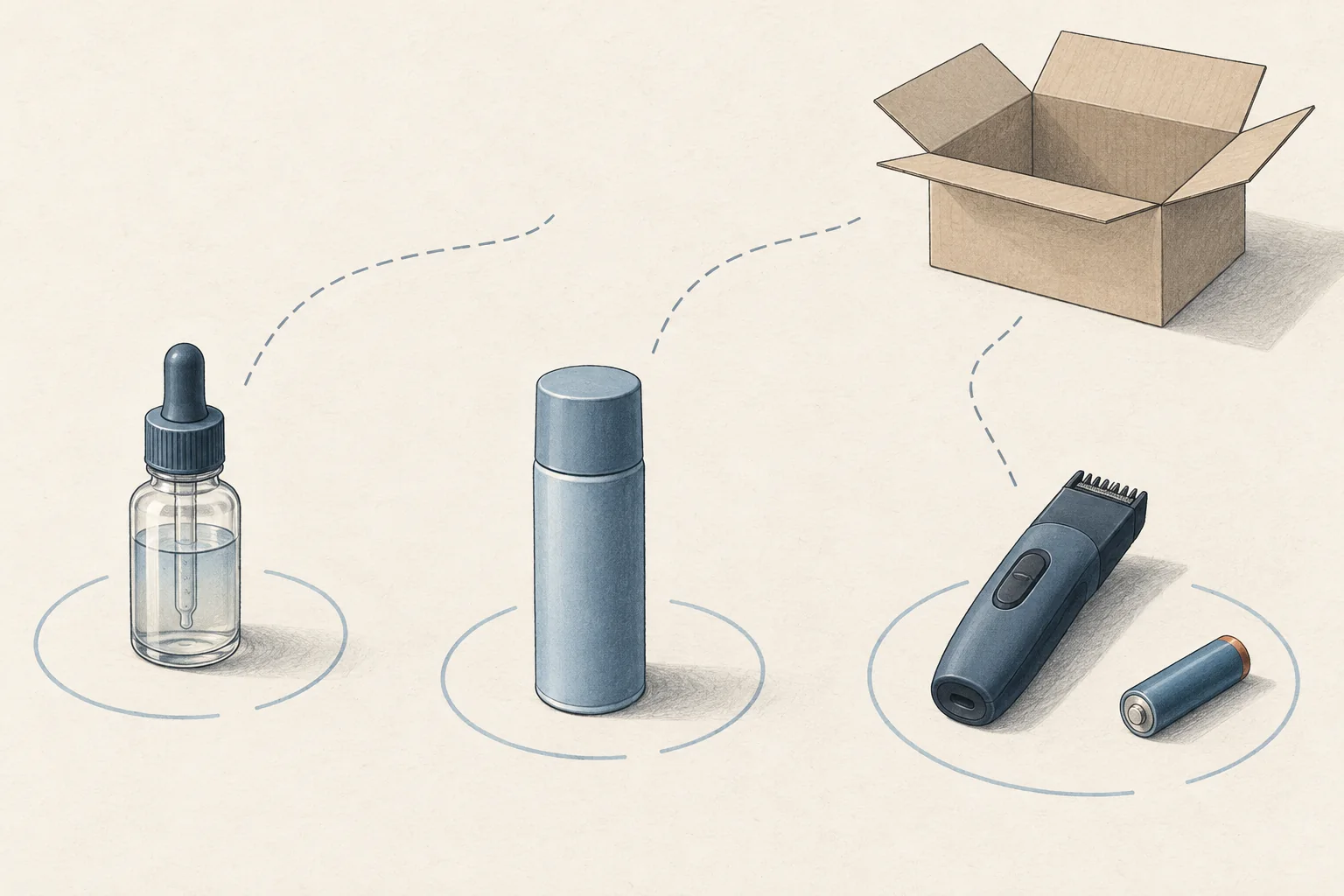
You can send a product to a creator abroad only after checking the exact item against the carrier's rules and the destination's import requirements. Review the product, quantity, packaging, origin, destination and delivery service together. A country name or a label such as "beauty kit" is too broad to approve a shipment.
USPS makes this distinction explicit: international mail must meet both its shipping rules and the destination country's rules. The checklist below is a recommended review process. The USPS and UK examples are scoped to those authorities; they are not a worldwide list of permitted products.
Create one record for each product and route
Before offering an international shipment, ask your fulfillment team to record:
- The exact SKU, formulation or model, and manufacturer.
- Each item in the parcel, including extras and accessories.
- Quantity per item and size per container.
- Dispatch country, destination country and relevant territory.
- Carrier, named service and intended shipping date.
- Product documents used to identify the contents, such as the ingredient list, battery specifications and manufacturer safety data sheet where applicable.
Ask the manufacturer or supplier for missing technical details. Do not guess a transport classification from a product photo or retail category. The review owner should send unresolved classification questions to the carrier's dangerous-goods team or a qualified shipping specialist.
Modash's discussion of gifting challenges treats product selection, shipping and tracking as separate tasks in a larger workflow. Add the restriction review before those tasks reach the warehouse. Otherwise, the team can choose a kit and promise delivery before knowing whether the route accepts its contents.
For help narrowing the kit itself, use the guide to deciding which products belong in a creator seeding kit. Shipping approval should apply to that final selection.
Review liquids, batteries and aerosols separately
These questions identify what needs checking. They do not establish permission to ship.
| Item | Details to collect | Question for the carrier |
|---|---|---|
| Liquid | Exact formulation, container volume, quantity, relevant safety data | Does this formulation qualify for this service, and what conditions apply? |
| Battery-powered item | Battery chemistry, manufacturer specifications, condition, installation and any spares | Does this battery configuration qualify on this route? |
| Aerosol | Exact product, pressurized container details, propellant information and quantity | Does the service accept this aerosol at all? |
Liquids need an identity beyond their volume
A smaller bottle is not evidence that a liquid is accepted. For example, USPS lists alcohol-containing perfume and nail polish as prohibited in international mail. Those are carrier-specific restrictions relevant to common beauty gifts.
Record what the liquid is before choosing packaging. If the manufacturer cannot identify the formulation or supply the information the carrier requests, mark the shipment as held. Do not substitute a generic description such as "cosmetics" for missing product details.
Batteries need a configuration check
The USPS international lithium-battery guidance allows only qualifying cells and batteries properly installed in the equipment they operate, where the destination permits them. It prohibits batteries sent separately or packed alongside equipment without installation. The page also prohibits damaged or recalled batteries and pre-owned, damaged or defective electronic devices containing or packaged with lithium batteries.
Installation alone therefore does not establish approval. Record the device's condition and check the detailed requirements linked by the carrier. Treat an added spare battery as a change to the shipment that requires another review.
Aerosols need a service decision before packing
USPS prohibits aerosols in international mail. For that carrier, a smaller can or more protective packing does not answer the prohibition.
If the chosen service rejects the aerosol, remove it from the proposed kit or investigate another service's documented acceptance conditions. Do not assume another carrier accepts it. If a substitute changes what the creator agreed to receive, ask before substituting the gift.
Check the destination independently
Carrier acceptance answers only part of the question. Read the destination customs authority's guidance and follow its links to the relevant product regulator where needed. Record whether the exact item needs a permit, certificate or another import step.
For a UK destination, GOV.UK explains that goods sent by post or courier pass through customs checks, including goods received as gifts. Its linked banned and restricted goods guidance identifies categories requiring further checks, including some goods protected by CITES. That page is framed around personal imports. Do not treat it as a complete assessment of a company's promotional shipment.
Also separate your campaign's use of "gift" from the customs category. The UK gift guidance requires qualifying gifts to be bought and sent between individuals, rather than companies, among other conditions. A brand's free product therefore should not be assumed to qualify under those gift rules.
Once the item and route pass review, decide who pays customs charges on the creator gift. Keep that cost decision separate from permission to import.
Worked example: a proposed US-to-UK kit
This is a hypothetical review, not approval for real products. A brand plans to use USPS to send a creator a kit containing a liquid serum, an aerosol hair product and a rechargeable device with a spare lithium battery.
| Proposed contents | Review outcome at this stage | Next action |
|---|---|---|
| Serum with formulation details missing | Hold | Obtain product details and check carrier and destination requirements. |
| Aerosol hair product | Rejected for USPS international mail | Remove it or investigate a different eligible service. |
| Device plus loose spare lithium battery | Rejected in this configuration | Remove the spare from the proposal; review the device against all applicable conditions. |
The team cannot release the whole kit because one item looks familiar or another has shipped domestically. Nor does removing the two prohibited elements automatically approve the remainder. The serum and device still need their own completed reviews.
Give the warehouse a release decision
Use three internal statuses: hold, rejected for this route, and ready to release. These are recommended workflow labels, not customs classifications.
Before selecting ready to release, confirm that the record contains:
- Product details matching every packed item.
- Carrier guidance for the named service and destination, with the date checked.
- Destination import requirements and any required documents.
- Resolved technical questions, including any written carrier clarification.
- The required packing, marking and declaration instructions.
- A named reviewer and the approved kit version.
USPS places responsibility for compliant packing, required markings and accurate customs forms on the mailer. Its guidance also calls for detailed contents descriptions. Keep the warehouse instructions tied to that reviewed contents list.
Reopen the review when the formulation, battery configuration, kit contents, carrier, service or destination changes. Before the next international batch, choose one proposed kit and complete its product-and-route record before promising shipment to creators.
Sources
- International Shipping Restrictions, Prohibitions, & HAZMAT
- Tax and customs for goods sent from abroad: Overview
- Bringing goods into the UK for personal use: Banned and restricted goods
- Tax and customs for goods sent from abroad: Gifts
- 6 Common Influencer Gifting Challenges (And How to Overcome Them)