




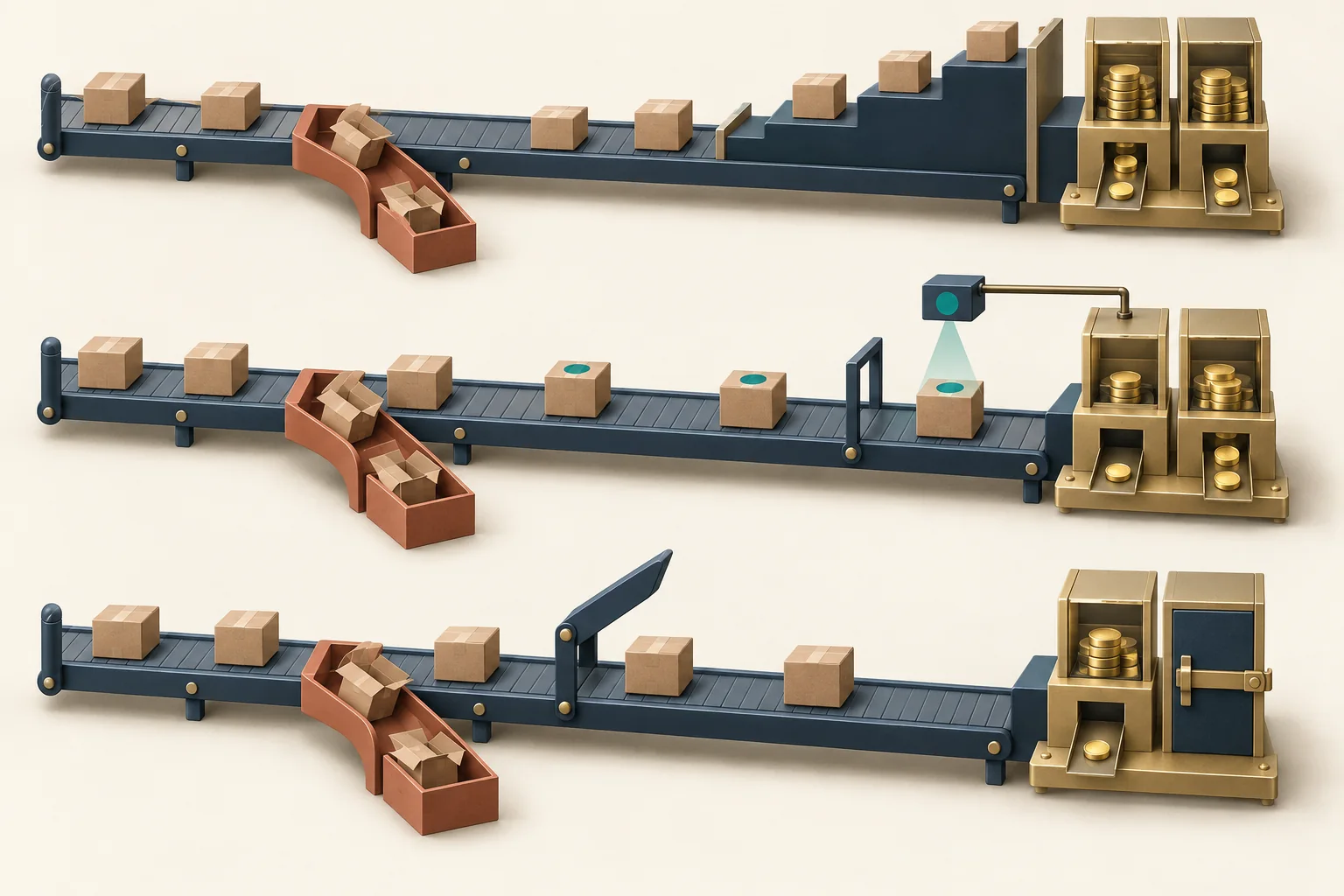
Make tier thresholds depend on paid, attributed sales that remain after refunds, and calculate commission on the same retained value. Add a new-customer condition only when you can verify customer history. Use return quality as a defined condition for extra commission, with time for returns to arrive and a review process for merchant-caused problems.
A tiered affiliate commission plan needs two separate rules: what unlocks a rate, and which dollars receive that rate. Deducting refunds from payouts still rewards inflated volume if gross sales unlock the higher rate.
Define the dollars before the tiers
Modash's affiliate-sales guide discusses sales thresholds and low refund rates as reasons to promote affiliates. To apply those ideas, write an order-level definition that finance and creators can both reproduce.
Use these recommended definitions:
- Eligible sales. Paid orders attributed under your published link/code rules, excluding test, duplicate and disallowed orders.
- Retained sales. Eligible merchandise value after discounts, less merchandise refunds and other agreed reversals. Exclude shipping, taxes and duties for this model.
- Qualification period. A named group of orders, with a closing date after its return observation window.
These are proposed program terms. Your commerce dashboard may use different definitions. Shopify's sales reports include pending, unpaid and canceled orders in gross sales. Its net sales subtract discounts and sales reversals, and reversals appear when processed. Chargebacks are absent from those reports.
Therefore, join adjustments to original order IDs before deciding a tier. A current-month sales total can include refunds for an earlier month's orders. Check payment and chargeback records separately, and avoid subtracting the same loss twice.
Before choosing percentages, work out the program's contribution margin. Retained revenue still has product, fulfillment, payment and return-handling costs.
One hypothetical order cohort
Every number below is invented to compare formulas. Amounts are USD. Assume six paid orders belong to one affiliate and one qualification period. Attribution is undisputed, all return windows have ended, and no chargebacks, exchanges or late adjustments remain. The refund column contains merchandise refunds after allocated discounts.
For this example, a new customer has no earlier paid order in the available customer record. Each row belongs to a different customer. A qualifying new customer must retain at least $50 of merchandise from their first order.
| Order | Customer | Gross | Discount | Refund | Retained |
|---|---|---|---|---|---|
| A | New | $300 | $30 | $0 | $270 |
| B | New | $200 | $20 | $180 | $0 |
| C | Returning | $200 | $20 | $90 | $90 |
| D | New | $100 | $10 | $0 | $90 |
| E | Returning | $100 | $10 | $0 | $90 |
| F | New | $100 | $10 | $30 | $60 |
| Total | $1,000 | $100 | $300 | $600 |
Retained sales equal $1,000 minus $100 minus $300, or $600. New-customer retained sales equal $270 plus $90 plus $60, or $420. Three new customers qualify; fully refunded order B contributes neither sales nor a qualifying customer.
The merchandise refund-value rate is $300 divided by $900 after-discount sales, or 33.33%. This measures refunded dollars, not the percentage of orders or units returned. Compare unrounded rates with thresholds; round displayed percentages to two decimals.
Three hypothetical tier structures
These are alternative plans, not benefits to stack. Each calculation uses the same cohort and rounds the final payout to cents.
1. Marginal retained-sales bands
Pay 8% on the first $500 of retained sales, 12% on the next $500, and 15% above $1,000. Each rate applies only to dollars within its band.
For this cohort, commission is $500 × 8% plus $100 × 12%, or $52.00.
Choose this structure when the goal is more retained merchandise revenue and customer-history data is incomplete. Marginal bands avoid repricing an entire period when an affiliate crosses a threshold by one dollar.
The limitation is margin. Two affiliates can retain the same revenue while selling products with different costs. Use product exclusions or separate product groups where your economics require them, and disclose those distinctions before promotion starts.
2. Base commission with a new-customer tier
Pay 8% on all retained sales. Add two percentage points on retained first-order sales once three qualifying new customers remain. Add four percentage points instead once six qualify. Neither bonus applies to returning-customer orders.
This cohort earns $600 × 8% plus $420 × 2%, or $56.40. Order B's full refund removes it from the count before qualification.
Choose this structure when acquisition matters and historical customer records cover the relevant sales channels. Publish the minimum retained order value to limit incentives to split purchases into small orders.
A new record does not prove a new person. Duplicate profiles, guest checkouts and missing store history can misclassify customers. Keep uncertain cases separate until reviewed. Also, a first recorded purchase does not prove the affiliate caused it. Read how attributed revenue differs from incremental sales before treating acquisition bonuses as proof of growth.
3. Retained-sales tier with a refund condition
Pay an 8% base. Raise it to 12% on the whole period's retained sales when retained sales reach $500 and the refund-value rate is at most 20%.
Here, retained sales clear the threshold, but the 33.33% refund-value rate fails the quality condition. Commission remains $600 × 8%, or $48.00.
This structure makes the quality condition visible. It also creates a sharp payout change around the cutoff. Six orders illustrate arithmetic; they are too few to establish stable creator quality. For a live plan, define a minimum mature order count and use a longer period when volume is low. Leave affiliates on the base rate while evidence is insufficient.
Review return reasons before attributing the result to a creator. Product defects and fulfillment failures need separate treatment under published rules. Keep all refunds in retained sales even if merchant-caused returns are excluded from the bonus-quality test.
Payout comparison
The provisional column below assumes no refunds have arrived yet. It is a calculation preview, not money already paid. Plan 2 initially counts four qualifying new customers and $630 of new-customer sales.
| Hypothetical plan | Before refunds | After refunds |
|---|---|---|
| Marginal bands | $88.00 | $52.00 |
| New-customer tier | $84.60 | $56.40 |
| Refund-conditioned tier | $108.00 | $48.00 |
The third plan has the largest adjustment because refunds reduce both the payable base and the applicable rate. Show that possibility in the creator's worked example before enrollment.
Make qualification and payment agree
A tracker may record sales without supporting your custom formula. Shopify Collabs tracks commissions through its affiliate links and codes. Its default holding period is 30 days, configurable from 1 to 90 days. During the hold, it automatically cancels commission for canceled and fully refunded orders.
That documentation does not establish automatic recalculation for every partial refund or any of the three formulas above. Verify those cases in your chosen system before offering the terms. Specify whether an adjustment changes the original period's qualification or appears as a later correction. Reconcile commissions after returns for the order-level process.
Publish the qualification window, payment date, late-return treatment, dispute route and prospective rule-change date. Keep provisional progress visibly separate from finalized earnings. Never make a creator discover an unpublished deduction on payout day.
For endorsements affecting U.S. consumers, commission incentives create a financial relationship covered by FTC disclosure guidance. Disclosures belong with the endorsement where people can notice them. Require truthful product claims at every tier; disclosure should not depend on reaching a sales threshold. Other jurisdictions may impose additional duties.
Take one completed order cohort from your own program and calculate all three plans. Choose the one whose qualification rule you can explain, whose data you can verify, and whose payout fits the margin left after returns.