




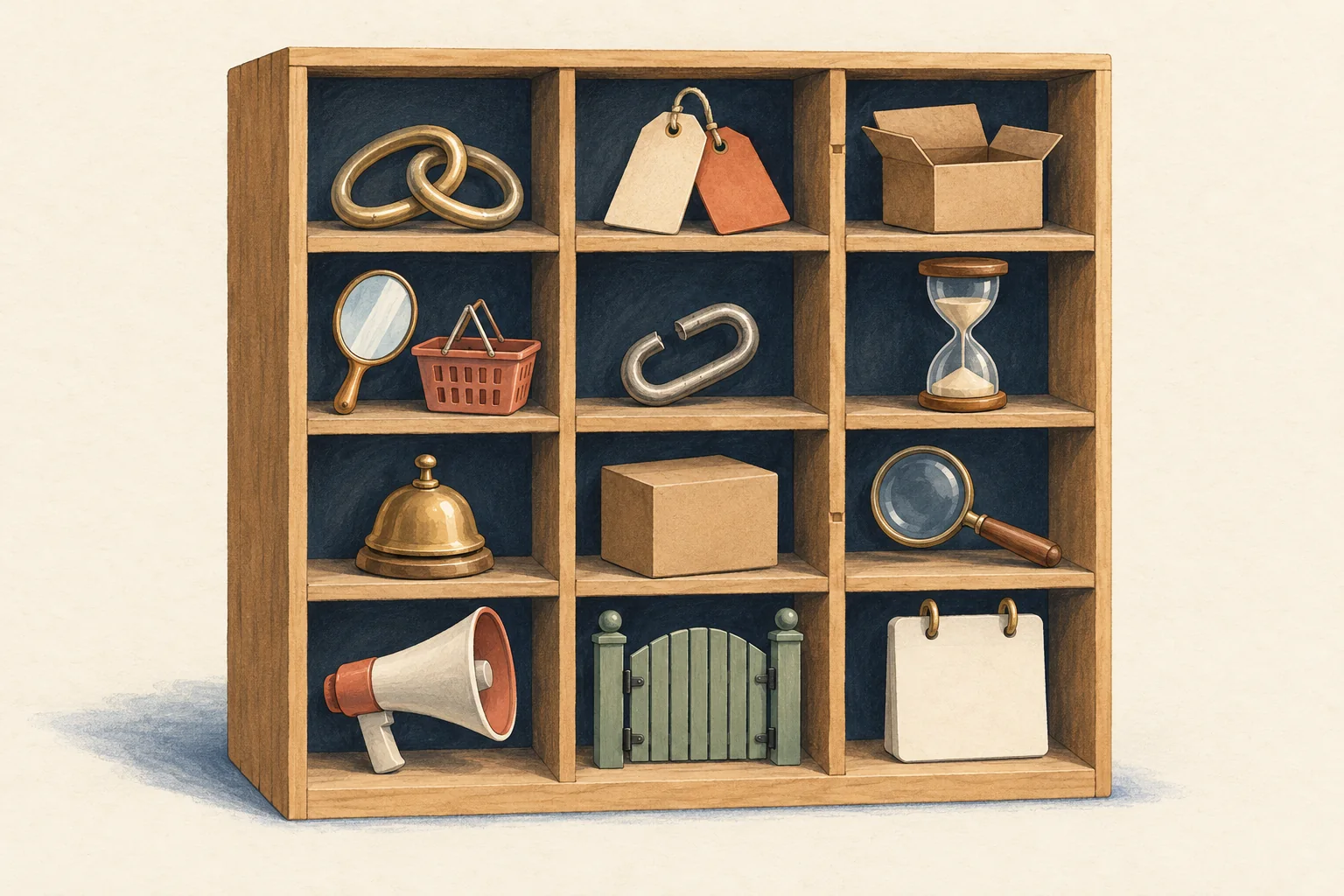
Creators should be able to answer twelve questions without contacting support: whether their own purchases qualify, which orders earn commission, how codes combine, how sales receive credit, how to recover links, and what happens to returns and payments. Write each answer from the program's approved terms and tested settings. Where those disagree, resolve the disagreement before publishing the FAQ.
A creator affiliate FAQ should let someone decide what to do while a customer is at checkout. "Contact your manager for details" leaves that job unfinished.
Gather the rules before writing the answers
Collect the current creator terms, discount settings, attribution settings, payout process and support route. Give the FAQ an owner and an effective date. Link to the terms it explains, and arrange a review whenever those terms or settings change.
Modash's affiliate onboarding guide recommends supplying links, codes, commission terms and payout timing at the start. The FAQ below adds the exceptions creators need after that first message.
Keep platform rules separate from merchant choices. For example, Collabs community rules apply to creators using that platform. A brand FAQ cannot waive them. Personal-purchase eligibility, meanwhile, needs an explicit answer from the applicable program terms; do not invent an industry-wide rule.
Twelve editable FAQ answers
The bracketed fields below are deliberate template fields. Replace each with an approved rule, working URL or named contact before sharing the FAQ with creators. Delete choices that do not apply. These are answer patterns, not a ready-made policy.
1. Can I buy through my own link or code?
Answer pattern: "You [may/may not] use your code for a personal discount. Your own orders [do/do not] earn commission. Purchases by household members follow [household rule]. For product testing, use [approved sample or test-order process]."
Discount eligibility and commission eligibility need separate answers. Also state whether buying gifts for other people counts as a personal purchase. If your terms say only "no self-referrals," define what that means before asking creators to follow it.
2. Which products and customers qualify?
Answer pattern: "Commission applies to [eligible products, customer types and regions]. It excludes [specific exclusions]. Subscription orders follow [first-order and renewal rule]. Your rate is [rate or tier], calculated on [defined commission base]."
Explain whether the base includes discounts, tax, shipping and gift cards. Avoid "net sales" without a definition. Link to the current eligible-product list if it changes too often to repeat here.
3. Can customers combine my code with another offer?
Answer pattern: "Your code combines with [named offers or discount classes]. It does not combine with [named exclusions]. If another offer replaces it, [state the verified commission outcome]. Check [promotion page] for dates and exclusions."
On Shopify, ordinary discount combinations depend on both discounts' settings and eligibility. Custom discounts applied manually to an order are an exception. When discounts cannot combine, Shopify applies the best eligible discount or combination for the cart. Its discount documentation does not establish who earns affiliate credit. Test that separately.
4. What gives me credit for a sale?
Answer pattern: "We track eligible purchases using [link, code or both]. A qualifying link visit can receive credit for [window and start event]. If another creator's link or code appears, [priority rule]. Purchases on another device follow [verified limitation or supported behavior]."
Do not promise that every click produces a credited sale. Shopify's Collabs reports distinguish visits from orders and commission. If your priority rule is unresolved, first decide how links and codes share credit.
5. Where do I find a lost or broken link?
Answer pattern: "Retrieve your current link and code from [exact portal location or welcome-message location]. If the destination fails, report it through [support route] with the URL and error. Use [approved replacement process] before publishing again."
Give the real navigation path. Do not assume every platform has a creator portal. Also explain expired or paused links. In Collabs, pausing a connection can invalidate links and codes, so re-copying the same URL may not fix the problem.
6. What if a buyer forgets my code or the sale is missing?
Answer pattern: "Orders normally appear within [tested reporting delay]. After that, submit a missing-sale request within [claim deadline]. We [allow/do not allow] later attribution under [evidence and eligibility rule]. Submitting a request does not guarantee commission."
Name the evidence support needs, such as a permitted order reference, approximate purchase time and the link used. As an operational precaution, ask creators to remove customer addresses and payment details from screenshots. Do not promise recovery of tracking data your system never collected.
7. What happens after a return, cancellation or exchange?
Answer pattern: "Canceled orders follow [cancellation rule]. Full refunds follow [full-refund rule]. Partial refunds and exchanges follow [item-level rule]. If commission was already paid, [adjustment process and notice]."
Collabs payment documentation says canceled and fully refunded orders have their commissions canceled automatically during the holding period. That statement does not settle partial returns or refunds after payment. Confirm those cases in your own setup. Use an order-level example, then link to the returns reconciliation procedure for disputed calculations.
8. When will I receive the money?
Answer pattern: "An order stays pending for [hold and start event]. Approved commission enters [payment schedule], subject to [minimum balance, if any]. Complete [payout setup]. Funds arrive through [method], with [currency, fees and expected transfer time]."
A hold ending is not necessarily the payment date. In Collabs, payment also depends on merchant billing and the creator activating automatic payouts. Show creators where to distinguish pending, approved and paid amounts, using your system's actual labels.
9. What disclosure should I include?
Answer pattern: "Tell viewers that you can earn commission when they buy through your link or code. Use clear wording with the recommendation, such as: 'I earn a commission if you buy through this link.' Follow [format-specific instructions] and applicable platform rules."
For endorsements affecting U.S. consumers, FTC guidance calls for visible, understandable disclosure of material connections. Put video disclosures in the video; repeat them during livestreams. A profile-only disclosure is insufficient. Other jurisdictions may impose additional duties. Treat this FAQ as operating guidance, not legal advice.
10. Where may I share the link or code?
Answer pattern: "You may share it through [permitted channels]. [Paid search, coupon sites, email, private groups and sub-affiliates] follow these rules: [specific permissions or prohibitions]. Request approval through [route] before using a channel that is not listed."
Write the restrictions creators will encounter. If coupon-site distribution is prohibited, say so explicitly. Avoid a vague instruction to use "approved marketing methods" without naming them.
11. What happens when terms change or I leave?
Answer pattern: "We announce changes through [channel], with [notice rule and effective time zone]. Existing orders follow [transition rule]. Your link and code stop working at [defined event]. Pending eligible earnings follow [final review and payment process]."
Explain how creators remove outdated offers and where they can read earlier terms. A changed rate needs a clear event that decides whether the old or new rate applies.
12. Who handles a problem, and what should I send?
Answer pattern: "For tracking or commission questions, use [affiliate support route]. Customers should use [customer-service route] for delivery, refunds and product issues. Include your creator ID, issue type, relevant link or permitted order reference, date and expected result. We aim to respond within [staffed response target and time zone]."
Separate acknowledgement from resolution. For a disputed decision, name the review route and any deadline. Promise only response times the team can staff.
Add one calculation creators can check
Here is a hypothetical partial-return example for question 7. It assumes commission is 12% of eligible merchandise after discounts and refunds. Tax and shipping are excluded. The returned item's refund is already net of its allocated discount. All amounts are USD.
| Order input or result | Hypothetical amount |
|---|---|
| Eligible merchandise before discounts | $150.00 |
| Merchandise discount | $15.00 |
| Initial commission base | $135.00 |
| Initial commission: $135.00 × 12% | $16.20 |
| Refunded eligible merchandise | $45.00 |
| Remaining base: $135.00 − $45.00 | $90.00 |
| Revised commission: $90.00 × 12% | $10.80 |
| Commission reduction: $16.20 − $10.80 | $5.40 |
Round the final order-level commission to the nearest cent in this example. Your platform may round differently. This illustrates a stated policy; it does not claim every platform performs that adjustment automatically.
Test the FAQ against one awkward order
Before sending it, ask someone outside the affiliate team to answer this scenario: a creator buys a gift, stacks a seasonal discount, loses the order credit, then returns one item. Can they determine eligibility, expected commission and the support route using the FAQ alone?
Mark every answer that requires a guess. Resolve those policy fields with the program owner, then test the links and checkout behavior before the FAQ goes into the next welcome message.
Sources
- Affiliate Onboarding: How to Set Up New Affiliates So They Actually Start Posting
- Managing creators in Collabs
- Disclosures 101 for Social Media Influencers
- Pay creators on Collabs
- Combining discounts
- Understanding the Collabs Community Guidelines
- Collabs Community Guidelines for creators
- Shopify Scripts API reference