




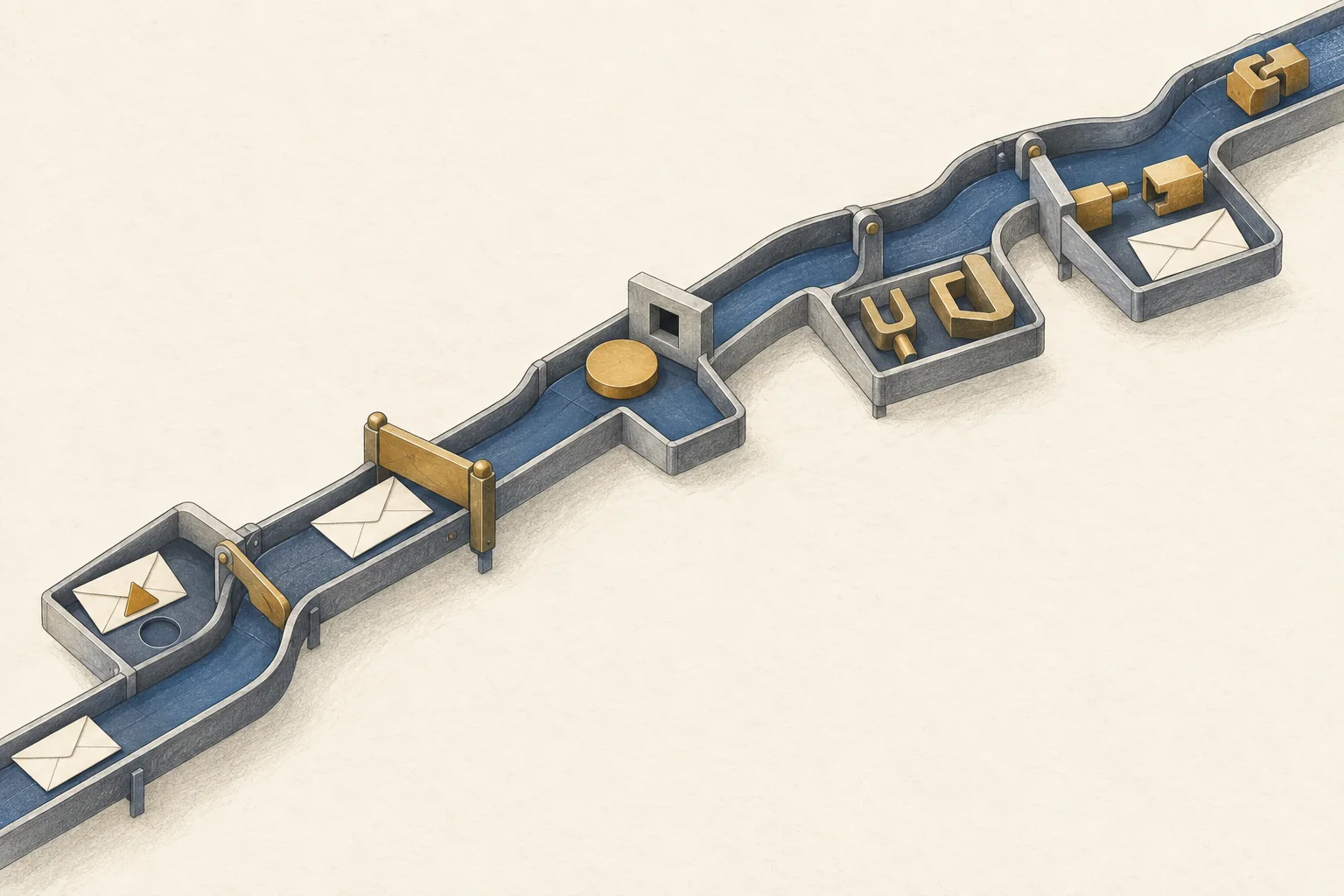
Creator messages can stall at five different points: the contact address, delivery, creator fit, the offer, or your team's handling of replies. Find the earliest point with evidence of a problem, then change that part. Rewriting every email at once hides which change helped and leaves broken addresses or unanswered counteroffers untouched.
The method below is an operational recommendation. Provider requirements and U.S. regulatory guidance are identified separately. It does not assume that every silent creator saw your message or rejected your price.
Build a record you can diagnose
Choose one campaign and one first-contact date range. Give every creator the same observation window before comparing results. A thread started yesterday should not count as a failed partnership beside a thread that has had several weeks to progress.
Use one row per creator-campaign pair. Keep individual message events underneath that row so a follow-up does not become another prospect. Record:
- Contact source, date checked, intended recipient and any contact restrictions.
- First-send time, provider message ID, latest delivery event and full error reason.
- Fit evidence, such as relevant recent content and the campaign's required market or format.
- Offer version, compensation model, requested work, timing and rights.
- First human reply, reply category, thread owner, next action and due date.
- Written commercial acceptance, unresolved conditions and final outcome.
For this diagnostic, an agreed partnership means both sides have recorded acceptance of the defined commercial scope. Keep any required signature or onboarding step visible. An expression of interest does not meet that reporting definition.
Follow the diagnosis tree
Start at the top. A failed check sends you to the action in that row. A passed check moves you to the next row. Several problems can coexist, so rerun the checks after a repair.
| Check | Evidence needed | If the check fails | If it passes |
|---|---|---|---|
| Is this the current, appropriate business contact? | Creator-published route, research date, manager or creator identity, restrictions | Correct the record or stop contact | Check delivery |
| Did the receiving server accept the message? | Provider event, error reason, timestamp, receiving domain | Separate address errors from sender or temporary failures | Review fit and replies |
| Does the creator match the actual brief? | Relevant content, required market, format and availability evidence | Revise selection criteria | Review offer clarity |
| Can the creator evaluate the offer? | Sent offer, questions and stated objections | Clarify or change the commercial proposal | Review thread handling |
| Did your team move the reply toward a decision? | Reply time, owner, pending question, next action | Answer, assign or close the thread | Record acceptance or the remaining blocker |
A missing field is an unknown, not a passed check. In particular, server acceptance does not establish that a creator read the offer.
Separate contact errors from delivery failures
Inspect the route before the prose. Is the address still on the creator's business page? Does it reach the manager named there? Did your team contact both people and create duplicate conversations?
Use the business-contact route guide when the address source is unclear. A public address or available DM button does not establish permission to market. Limit any alternative route to creator-welcomed business inquiries that applicable rules permit. Silence does not supply permission.
For U.S. commercial email, the FTC's CAN-SPAM guide says business-to-business messages are covered too. Among its requirements are accurate sender information, nondeceptive subjects and an opt-out route. That is not a complete compliance checklist, and other jurisdictions require their own review.
Next, read your provider's event definitions. For example, Resend defines delivery as delivery to the recipient's mail server. Its delayed event indicates a temporary problem; its suppressed event means the message was not sent because the recipient was on a suppression list. A bounce is a server rejection, which requires reading the reason before calling the address invalid.
Keep those states separate. Do not remove a suppression to make a campaign's sent count look better. Use the opt-out handling guide to carry a stop request across lists.
When failures cluster by sending identity or receiving domain, have the email administrator inspect authentication and error logs. Google's sender guidelines require SPF or DKIM for all senders to personal Gmail accounts, and SPF, DKIM and DMARC for bulk senders. Yahoo's requirements make the same authentication distinction between all senders and bulk senders. These are only part of each provider's requirements.
Ask the administrator to verify the sending service you actually used. A configured domain is insufficient evidence that this message passed authentication. Successful authentication also does not prove inbox placement.
Avoid using low opens as the deciding test. Google says low open rates do not necessarily indicate delivery or spam-classification problems.
Use replies to separate fit from offer problems
Read replies in context and assign a reason only when the creator states it. Useful categories include wrong contact, category mismatch, unavailable timing, compensation mismatch, rights concern, interested with questions, and declined without a reason. Keep no response separate from all of them.
A fit problem changes who belongs on the list. An offer problem changes what you are asking that creator to accept. If a creator likes the product but cannot grant exclusivity, the issue belongs with the requested terms. If their content does not serve the campaign's intended audience, a higher fee would leave that selection problem unresolved.
Modash's outreach examples distinguish exploratory relationship messages from recruitment for a defined campaign. Use that distinction to audit your ask. If you need a decision on a scheduled campaign, can the creator identify the work, compensation model, timing and requested rights from the information supplied?
Repeated questions about those details are evidence that your message left them unclear. A clear refusal after those details arrive points toward the terms themselves. For that branch, use scope-based negotiation rather than repeatedly changing the opening sentence.
Keep disclosure and truthful endorsement expectations in the proposal. For endorsements affecting U.S. consumers, the FTC's influencer guidance covers material connections such as payment or free products. It also says endorsers cannot describe product experience they have not had or falsely praise a product they disliked. Do not offer undisclosed promotion or guaranteed praise as a concession to close a stalled deal.
Audit what happened after interest
Review every interested reply that has no recorded next step. Check whether your team answered the actual question, obtained a budget decision, or left a counterproposal waiting for an owner.
For each open thread, write one sentence naming the blocker and who can remove it. For example, this hypothetical note is actionable: "Creator asked whether paid ad use is included; campaign owner must confirm the rights scope before the coordinator replies." Set an internal due date based on the campaign schedule. Do not present an arbitrary response deadline as an industry rule.
Keep pending threads distinct from lost ones. A creator waiting for your answer has not rejected the partnership.
Work through a hypothetical campaign
The numbers below are invented to demonstrate the method. They are not performance benchmarks. All creators have the same observation window, and each reply is counted once.
| Recorded stage | Hypothetical count | Diagnostic meaning |
|---|---|---|
| First messages attempted | 80 | Starting group |
| Delivered to receiving server | 72 | Eight attempts need event-level review |
| Human replies | 18 | Replies include interest and refusals |
| Interested replies | 10 | Eight other replies need separate reason codes |
| Agreed partnerships | 3 | Seven interested threads remain to inspect |
Human reply rate among server-delivered contacts is 18 / 72 = 25%. Agreement rate among interested replies is 3 / 10 = 30%. Neither number explains the cause by itself.
Suppose the seven remaining interested threads contain four unanswered rights questions, two fee mismatches and one unresolved schedule. Your first commercial action is to answer the four rights questions. Your delivery investigation still examines the eight failed or pending attempts separately. A new subject line would address neither known problem.
Before the next send, select one observed failure point and name the evidence that would show improvement. Keep the audience criteria, offer and observation window stable where possible. Compare the relevant stage and the final partnership count, while treating small groups as directional evidence. Start today by classifying the unresolved threads in one campaign and assigning an owner to the first fix.