



Name the paying brand at the start, identify the sponsored product when it appears, and record the relationship behind every other product shown. Build the application sequence from the actual products' instructions. Review any claim about the combined routine separately from claims about one formula. This keeps viewers from mistaking a sponsored step for an endorsement of an entire bundle.
The workflow below is for a recorded beauty routine aimed at US consumers, with TikTok as the platform example. It is a production recommendation, not legal or medical advice. Other markets and paid-ad placements need their own review.
Map the relationships before writing the script
One paying sponsor does not necessarily mean one commercial relationship. A creator may have bought the cleanser, received the serum free, and earn commission from the moisturizer link.
Modash's beauty marketing guide describes paid posts, affiliate commissions and product seeding as related partnership formats. For this video, ask about each separately. Under FTC influencer guidance, payment and free or discounted products can create relationships that need disclosure. An unpaid appearance can still require one.
Make a product list with these fields:
- Exact product, formula version and market.
- Who supplied it and whether the creator paid for it.
- Current payment, gifting, affiliate or other brand relationship.
- Why it appears in this routine.
- What the creator will say and show.
- Where viewers will see its relationship disclosure.
Do not describe the remaining products as independent purchases until the creator confirms that. FTC guidance does not require a declaration of no relationship for a product someone bought and likes. A brief explanation can still help viewers understand a mixed routine when it is accurate.
If the team has not settled whether a gifted item involves a commissioned demonstration, resolve that using the distinction between gifted reviews and commissioned tutorials before assigning scenes.
Separate screen time from application order
A sponsor can receive the opening introduction and the longest explanation without being applied first. Write two plans: the order viewers hear about the products, and the order the creator uses them.
For each application step, attach the package directions and current manufacturer instructions for the exact product sold in that market. Record relevant amounts, rinse-off instructions, timing, warnings and any stated combination restrictions. Do not invent these details to fit a short video.
Manufacturer regimens can help locate instructions. The Ordinary's beginner regimen page, for example, presents named products with AM and PM options. Treat a regimen like that as guidance for the listed formulas. It does not establish compatibility for a substitute from another brand.
When instructions leave a cross-brand combination unresolved, ask the manufacturers for clarification. Refer safety questions to a qualified clinician and regulated claims to an appropriate regulatory reviewer. Until the question is resolved, omit the uncertain combination or narrow the video to a supported demonstration.
Avoid presenting a filmed sequence as a universal skincare prescription. A creator's personal routine does not establish suitability for every viewer.
Use a storyboard that identifies the sponsor
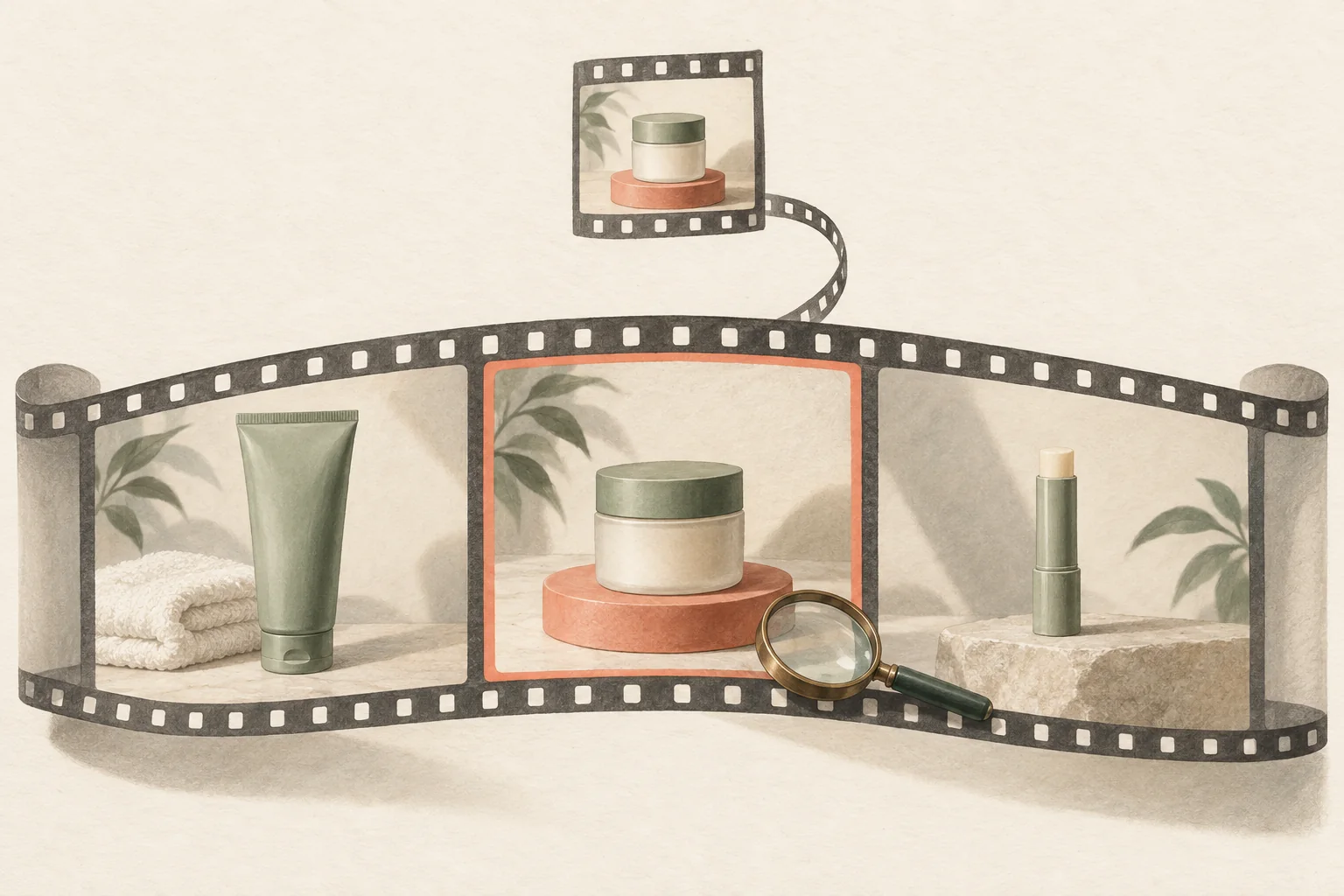
This hypothetical storyboard has three products: a personally purchased cleanser, a sponsored moisturizer from fictional Brand A, and a personally purchased lip balm. Assume there are no other material relationships. The sequence remains conditional on the actual products' directions and review; it is not an application recommendation.
| Scene | What viewers see or hear | Disclosure note | Factual-review note |
|---|---|---|---|
| Opening | The creator names the routine and holds the moisturizer | Spoken and visible: Brand A paid for this video to feature its moisturizer | Confirm who paid and what the agreement covers |
| Cleanser step | The creator identifies the cleanser and demonstrates its use | Opening disclosure remains clear; no suggestion that this brand sponsored the video | Check directions, including rinsing, against the filmed action |
| Moisturizer step | A clear product shot, application and the creator's actual observations | Name Brand A again and keep a readable sponsorship label near this segment | Tie each objective claim to evidence for this formula |
| Lip balm step | The creator identifies the separate product | Add any relevant relationship if the original assumption changes | Check that the script adds no unsupported combined benefit |
| Closing product list | Each product appears with its correct name and relationship | Keep sponsor identification and label any commission-bearing links | Avoid calling the group a tested system without supporting evidence |
For this hypothetical case, an opening could say: "Brand A paid for this video to feature its moisturizer. I bought the cleanser and lip balm myself." That wording is a starting point for review, not a guarantee of compliance.
The FTC recommends disclosures within the video, rather than only in its description. Both audio and visible text help reach viewers who miss one form. Keep the text readable and away from interface overlays. Repeat the sponsor identification when returning to its product after a long separate segment.
Calling one product sponsored should not imply that the paid video as a whole is commercially independent. Name the payment relationship clearly while identifying which product it concerns.
Review the claims between the steps
The most consequential sentence may be the transition: "These work better together." That is a claim about a combination. Evidence for one moisturizer does not, by itself, support a claim about a three-product routine.
Review every transition, caption and closing summary with this question: what would a viewer conclude about using these products together?
| Proposed line | Review decision |
|---|---|
| "I use these in this order" | Confirm it reflects the creator's real practice and the documented instructions |
| "This serum makes the moisturizer absorb better" | Require evidence for that combination and claimed effect; otherwise remove |
| "Together they cure breakouts" | Stop for qualified regulatory review; do not publish as an ordinary cosmetic claim |
| "Everyone with sensitive skin can use this routine" | Remove the broad suitability assurance without adequate support |
The FDA explains that disease-treatment and body structure or function claims can make a product a drug under US law. FDA also distinguishes its cosmetic-labeling role from the FTC's advertising oversight. Use the cosmetic-versus-treatment briefing guide when the script crosses that boundary.
A sentence about personal experience must still be true. FTC guidance says creators cannot describe experiences they have not had or invent claims requiring proof the advertiser lacks. Adding "for me" does not supply missing evidence for a scientific claim.
Check the finished edit and each placement
For TikTok, the commercial-content disclosure setting is required; third-party branded content receives a Paid partnership label. Use that setting alongside the video's own disclosure. A platform label does not explain which of several products paid for the video.
If the brand will turn the routine into an ad, review it again for the target market and product category. TikTok's healthcare and pharmaceuticals advertising policy contains market-specific restrictions, including cosmetics and beauty provisions in multiple markets. Organic publication does not settle paid-ad eligibility.
Watch the export once with sound off and once without looking at the caption. Can a viewer identify the sponsor in both cases? Check that cropped versions retain disclosure, application edits preserve the instructions, and the closing product list does not imply a tested bundle.
Before filming, complete one storyboard row per product and give every unresolved order or combination claim a named reviewer. Remove unresolved steps from the shoot list.