



Support a creator's environmental claim with current documents tied to the exact garment, material or production step the claim describes. A fibre specification can support a composition statement. A claim about lower water use needs evidence about that process and its comparison. Neither automatically supports calling the whole garment "sustainable." Review the words, pictures and implied message before the creator records them.
Use the claim-evidence register below to decide what can enter a brief, what needs narrower wording and what must wait. It is a recommended review process informed by UK and US regulator guidance, not legal advice or a guarantee of compliance in any market.
Start with the sentence the audience will hear
Fashion influencer sustainability claims often expand between a product document and a spoken introduction. "The outer fabric contains recycled polyester" becomes "This is an eco-friendly jacket." The second sentence makes a much broader promise.
The UK's CMA guidance on environmental claims asks businesses to consider wording, imagery, omitted information and the overall impression. Its principles include substantiation, meaningful comparisons and consideration of the product's life cycle. A true statement about one component can still create a misleading impression of the whole product.
For US marketing, the FTC's Green Guides summary warns against broad, unqualified environmental benefit claims. It also says that a third-party certification does not remove the need to substantiate explicit and implied claims.
Start each review by writing down:
- The exact spoken line, caption, on-screen text or hashtag.
- The garment identifier, colourway and version being shown.
- Whether the claim covers a component, a process, the whole garment or the company.
- The intended market and the person responsible for checking local requirements.
Include visual claims. A factory clip can imply that the featured garment came from that facility. An invented seal can suggest independent certification. Ask what viewers could reasonably take from the complete edit, even if the caption is narrower.
Ask for documents that match the claim
A brand press release can help locate the evidence owner. It should not end the review when it repeats the same claim without showing its basis.
Request the primary document behind each proposed statement. The exact documents will vary, but these are useful starting points:
| Proposed claim | Request first | Check before using it |
|---|---|---|
| A material percentage | Product specification and supporting sourcing records | Which component the percentage covers; whether trims, lining and fill differ |
| Recycled material | Records connecting the material's recycled status to the garment | Percentage, material type and whether records cover this product version |
| Certified material or product | Certificate, scope details and relevant scheme requirements | Named holder, covered products or facilities, validity and the permitted claim |
| Reduced water or energy use | Process report, method and comparison data | Factory, production step, measurement period, unit and baseline |
| Lower total environmental impact | Assessment covering the claimed impacts and boundaries | Excluded stages, assumptions, comparison basis and independent scrutiny |
This table is a document-request checklist, not a universal legal evidence standard. The CMA's substantiation guidance says evidence should be credible, relevant and current. It also asks businesses to consider whether evidence reflects real-world conditions and whether they need records from their supply chain.
Do not treat a certificate for a supplier as proof that every garment in a collection meets the same standard. Ask the evidence owner to explain the connection in writing. If they cannot, keep the claim on hold.
For ordinary composition and care statements, use the separate guide to briefing creators on fabric and care facts. Care instructions alone do not establish a measured environmental saving.
Keep a claim-evidence register
Give each claim its own row. Attach the source file and record its version or date, so a later reviewer can see what the decision relied on.
The following register is hypothetical. The garment, percentages, documents and decisions illustrate the method; they describe no real brand.
| Claim ID | Proposed wording | Evidence available | Decision and owner |
|---|---|---|---|
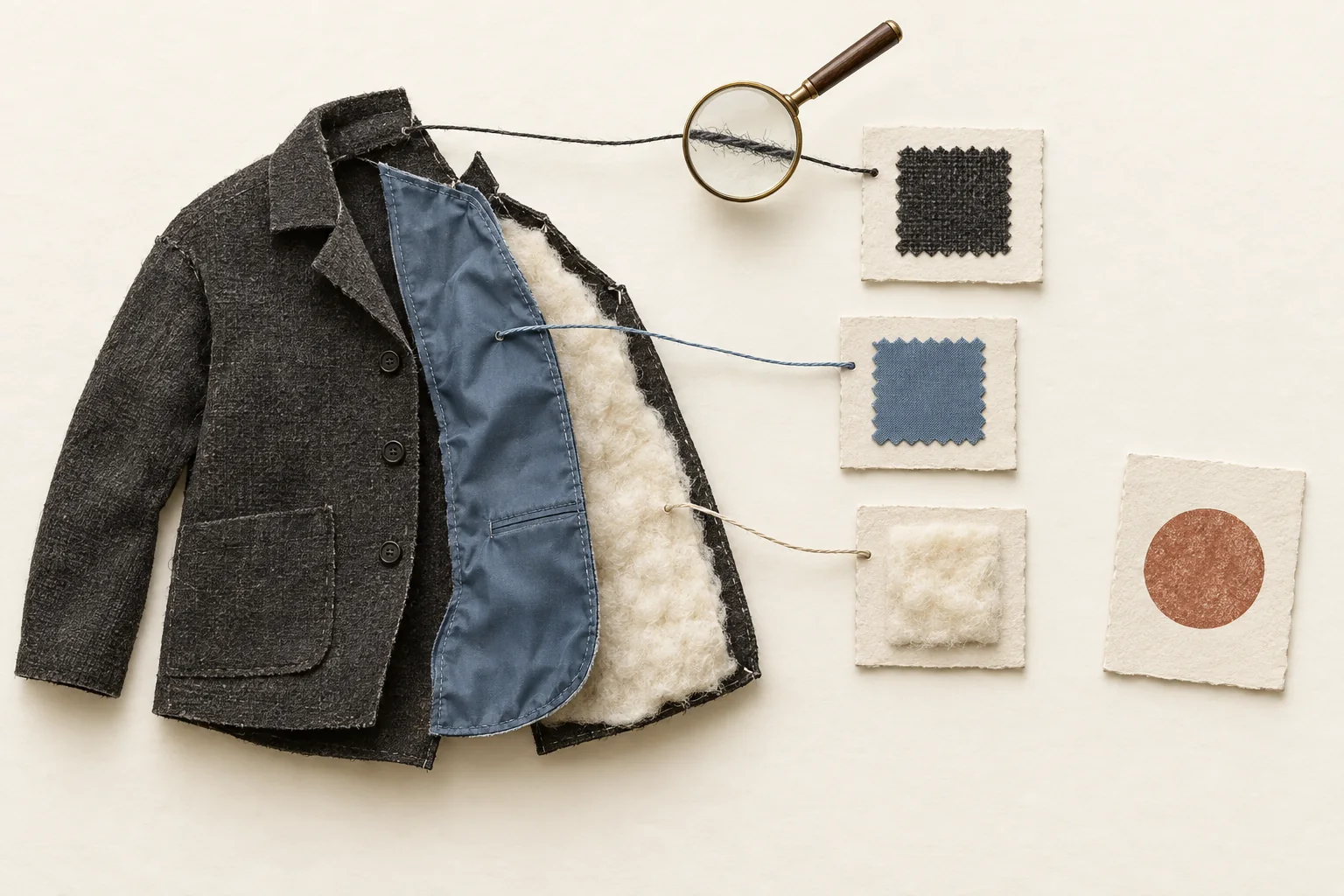
| C01 | "This jacket is 80% recycled." | Specification says only the outer fabric is 80% recycled polyester and 20% virgin polyester; lining and fill differ | Revise scope. Product owner must confirm the supporting records match the sample |
| C02 | "Made using less water." | Supplier presentation gives no baseline or product connection | Hold. Sourcing owner must provide the process report and comparison |
| C03 | "A sustainable jacket." | Same material specification as C01 | Remove. Available evidence does not support the whole-product claim |
| C04 | "Certified sustainable." | Certificate names a supplier but does not identify this jacket | Hold. Compliance reviewer must establish scope and allowed wording |
For a working register, also record:
- Evidence file, issuer, date and relevant page.
- Exact wording proposed after review, including any qualification.
- Where the qualification will appear or be spoken.
- Reviewer, decision date and unresolved question.
- Recheck trigger, such as a material change, new supplier or reused campaign asset.
Use specific decisions such as "ready for final content review," "revise," "hold for evidence" and "remove." Avoid a single green tick that could mean either document received or claim reviewed.
Assign one person to collect the decisions before production. The guide to an approval process with one accountable reviewer covers that handoff.
Narrow the wording without hiding its limits
These hypothetical rewrites require review against the actual evidence. They are not pre-approved advertising copy.
Material claim. Replace "This jacket is 80% recycled" with "The outer fabric is 80% recycled polyester and 20% virgin polyester." Use that sentence only after verifying both the composition and recycled status. Do not shorten it to "80% recycled" in the thumbnail while leaving the component limit in the caption.
Process claim. Suppose a report shows that one dyeing process used 12 litres of water per kilogram of fabric, compared with 15 previously. That is a hypothetical 20% reduction for the measured step. It does not establish 20% less water across the garment's full production or life cycle. A reviewer could consider wording that names the dyeing step and comparison, provided the report applies to this fabric and explains its conditions. If that explanation cannot fit the proposed content, omit the number.
Certification claim. Replace "Certified sustainable" with a proposal that names the actual scheme and what it covers. Do not fill that sentence from memory. Obtain the scheme's current requirements and confirm that the garment qualifies before drafting the final line.
Adding "the brand says" does not resolve missing evidence. Treat attribution as an explanation of where information came from, rather than permission to repeat an unsupported promise.
Review the finished post and the relationship disclosure
Creator selection and content substantiation need separate records. Modash's fashion influencer marketing guide discusses audience fit and collaboration formats, including sponsored posts and product seeding. Those choices do not establish whether a material or process claim is supported.
For US endorsements, the FTC's disclosure guidance covers material relationships such as payment and free products. It says disclosures should accompany the endorsement and appear in the video for video endorsements. It also warns creators against making claims that require proof the advertiser lacks.
Check disclosure and environmental evidence separately. A visible sponsorship label does not supply the missing product evidence.
Before release, compare the final edit with the register. Listen for ad-libbed terms such as "zero impact" or "planet-friendly." Check captions, hashtags, thumbnails and cutdowns for qualifications lost during editing. Confirm that the shown garment matches the documented version.
Send the creator the reviewed facts and unresolved limits through a brief that leaves room for judgment. Preserve their freedom to describe their own experience without asking them to invent environmental conclusions.
For the next garment awaiting content review, enter its strongest environmental claim in the register. Ask the product or sourcing owner for the underlying document. Keep that line out of the recording brief until someone can connect the evidence to the product and the words the audience will hear.