



A KOL (key opinion leader) is a person whose opinion on one subject is trusted enough to change what other people buy or believe. A dermatologist who reviews sunscreen, a chef who reviews knives and a makeup artist who tests lipstick are KOLs. Every KOL with a social following can be called an influencer, but a brand picks a KOL for what they know about one topic, and picks an influencer for the size and fit of their audience.
The term is most common in China, and it travels with Chinese, Korean and Japanese marketing work. Asian marketers also use a second word, KOC (key opinion consumer), for small accounts that review products as ordinary buyers. Most pages that rank for "what is a KOL" define these words and stop there. This page measures them. We sorted 334,469 Instagram creators in Korea, Japan, the United States and all other markets into five KOL tiers, and read their engagement and their sponsored posts.
19.1%
Korean nano posts
34.9%
Paid in product
26.2%
Japan mid-tier
What KOL means
KOL stands for key opinion leader. The idea is older than social media. In the 1940s and 1950s, the sociologists Paul Lazarsfeld and Elihu Katz found that most people form views on products and politics through a few trusted people around them, whom they called opinion leaders. Drug companies later used "key opinion leader" for the doctors whose views other doctors follow, and they still use it that way.
Social platforms widened the term. Today a KOL is anyone whose posts on one subject move their audience, such as a nutritionist on TikTok, a skincare chemist on Xiaohongshu or a camera reviewer on YouTube. What makes them a KOL is trust on one topic, not follower count. A dermatologist with 40,000 followers is a KOL for sunscreen, and a lifestyle account with 2 million followers may not be.
Two related terms come up with it:
- A KOC (key opinion consumer) is an ordinary buyer with a small account who reviews products they use, and brands usually pay KOCs with free product.
- A KOS (key opinion sales) is a creator who sells live, mostly through livestream shopping, and is paid on the sales they make.
KOL vs influencer
The two words overlap, and many marketers use them for the same people. The difference is in why a brand picks the person and how the deal works.
| KOL | Influencer | |
|---|---|---|
| Picked for | Expertise or authority on one topic | Audience size, style and fit |
| Typical people | Doctors, chefs, makeup artists, engineers, critics | Lifestyle, fashion, travel and entertainment creators |
| Where the term is used | China most of all, also Korea, Japan, Southeast Asia, and pharma everywhere | US and Europe, and as a general word everywhere |
| What the brand buys | A trusted opinion, often a review or a demo | Reach and content |
| Small-account version | KOC (key opinion consumer) | Nano or micro influencer |
So the plain answer to "KOL vs influencer" is that a KOL is a kind of influencer. All KOLs influence, but not every influencer is a KOL. If a creator's audience follows them for what they know, they are a KOL. If it follows them for who they are, they are an influencer.
Why Asian marketers say KOL
In China, KOL is the default industry word. Brands plan budgets in KOL and KOC lines, and agencies sell KOL lists by tier. Korean and Japanese marketers use KOL most in beauty, medical aesthetics and pharma, and in work aimed at Chinese buyers. At home they also say influencer (인플루언서 in Korea, インフルエンサー in Japan).
Korea had KOC-style marketing before the word. Brands and review platforms run 체험단 (reviewer groups): they send free product to many small accounts, and each one posts a review. CJ Olive Young, Korea's largest health and beauty store chain, runs its own reviewer crew called Shutterbrity. Its May 2026 press release says it picks 300 creators per round, twice a year, and that any Olive Young member can apply. They get product sponsorship and activity points.
Japan has a legal reason to care about every tier. Since October 1, 2023, Japan's stealth marketing rule counts a post as an ad when a business had a hand in it, whether the creator got cash or a free sample, and the post must say it is an ad. Korea's Fair Trade Commission has a similar rule for sponsored posts. In both countries a KOC post is an ad in the eyes of the law.
Engagement by KOL tier in Korea, Japan and the US
There is no official KOL scale. We used five follower bands that most agencies use in some form, and named them in KOL terms. Then we took the median engagement rate in each band, in each market.
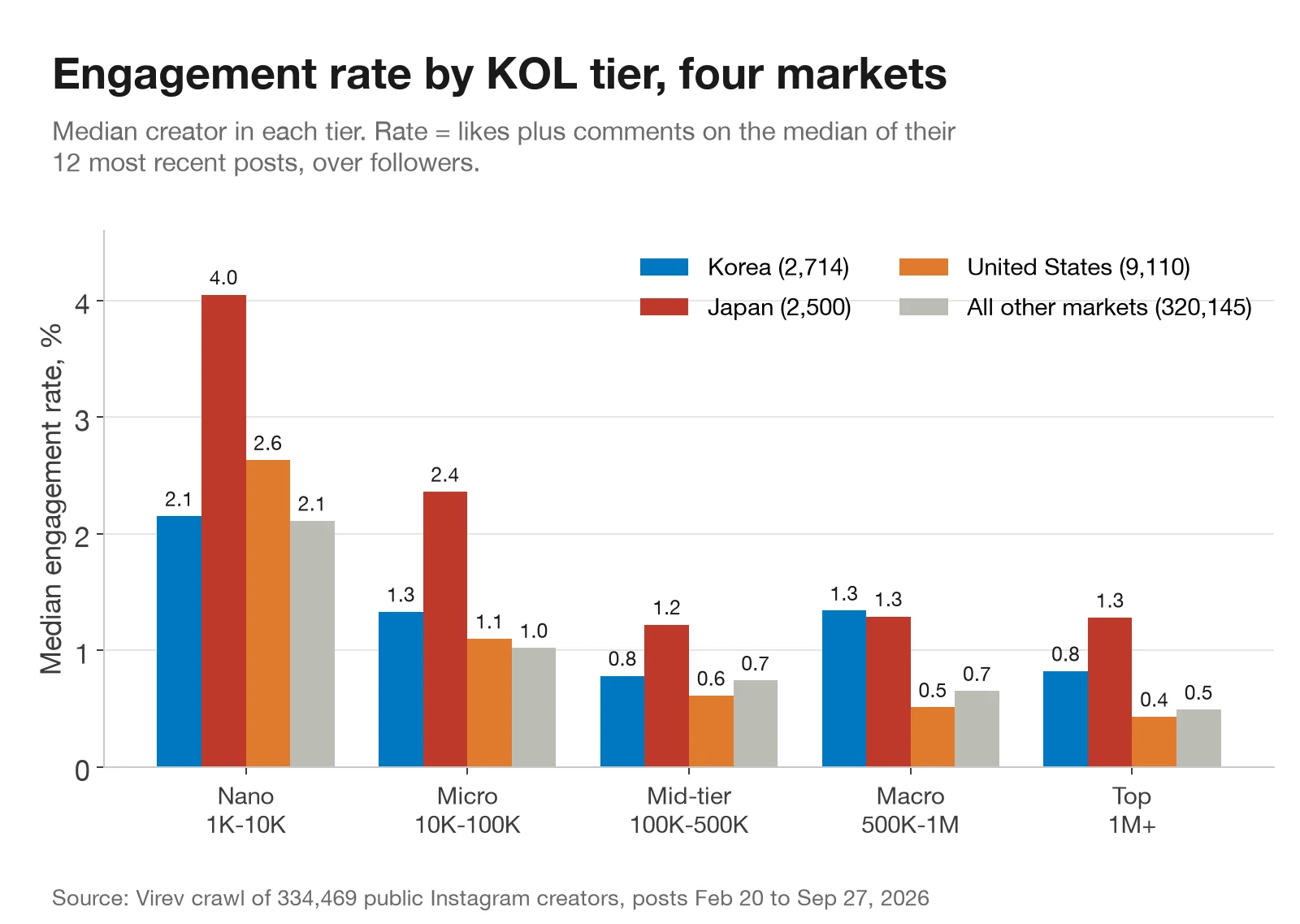
| KOL tier | Korea | Japan | US | Other markets |
|---|---|---|---|---|
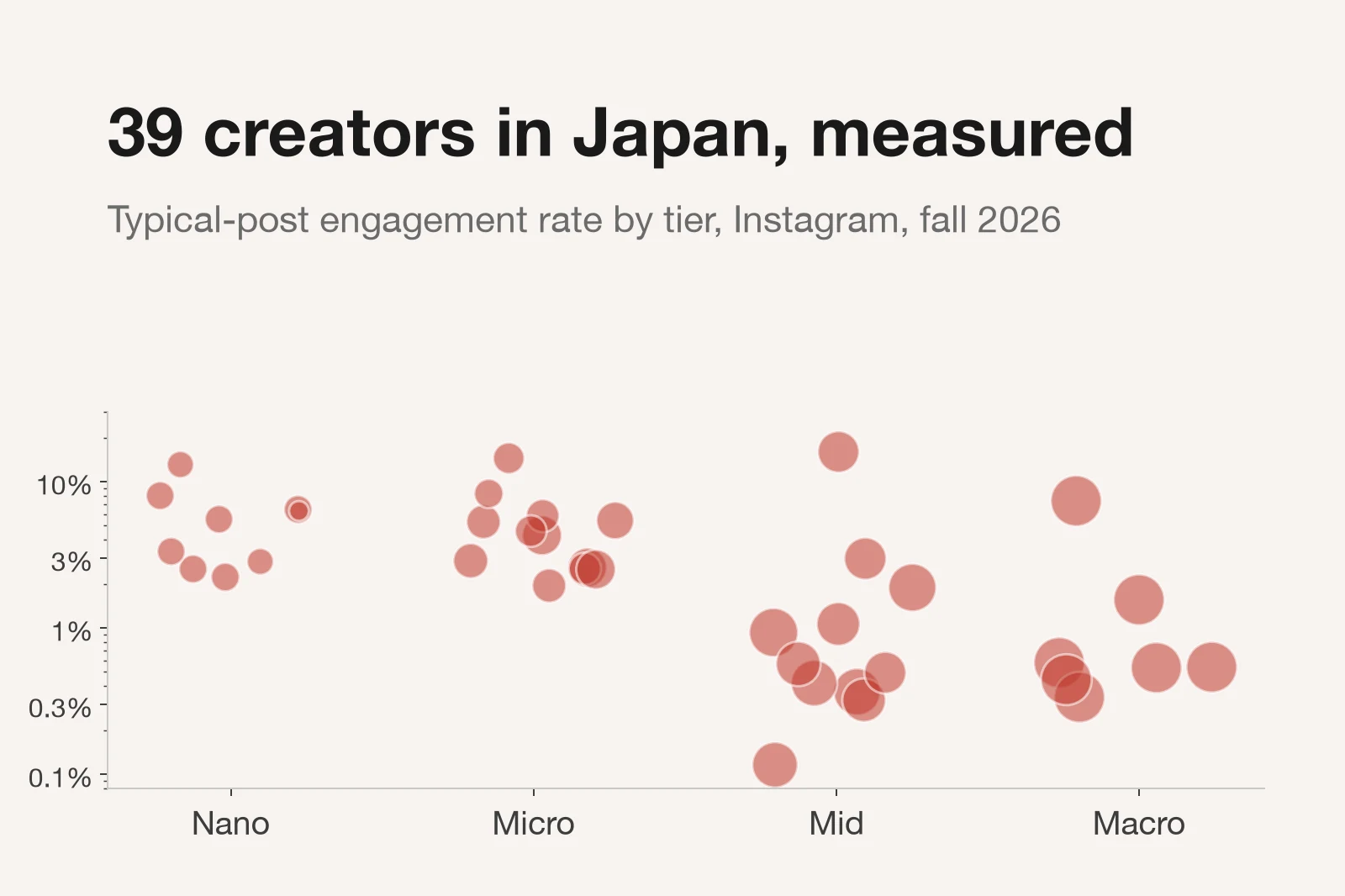
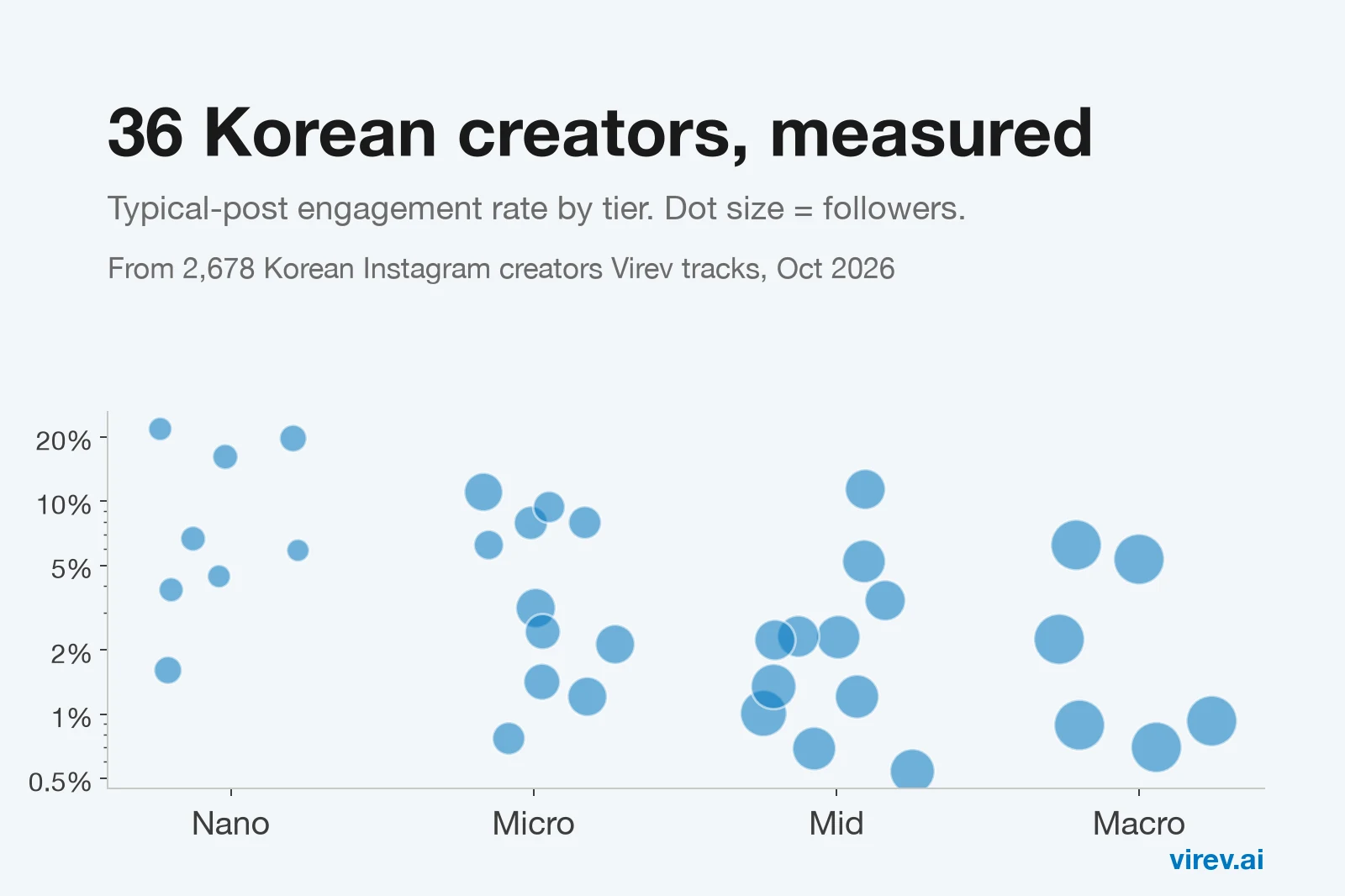
| Nano, 1K-10K | 2.15% | 4.05% | 2.63% | 2.11% |
| Micro, 10K-100K | 1.33% | 2.36% | 1.10% | 1.02% |
| Mid-tier, 100K-500K | 0.78% | 1.22% | 0.61% | 0.74% |
| Macro, 500K-1M | 1.34% | 1.29% | 0.51% | 0.65% |
| Top, 1M+ | 0.82% | 1.28% | 0.43% | 0.49% |
What the table shows:
- Japanese creators had the highest median engagement rate in four of the five tiers, and their 1M+ accounts held 1.28%, about three times the 0.43% of US accounts that size.
- Korean creators beat the US from 10,000 followers up, and Korean macro KOLs (500K-1M) held 1.34%, more than double the US 0.51%.
- Below 10,000 followers, US creators (2.63%) beat Korean creators (2.15%), and only Japan was higher.
- In every market, nano accounts had the highest rate, and the rate at 100K-500K followers was less than half of it, so a top KOL buys reach and a nano account buys more attention per follower.
Creators in each cell:
| KOL tier | Korea | Japan | US | Other markets |
|---|---|---|---|---|
| Nano, 1K-10K | 730 | 495 | 4,662 | 112,128 |
| Micro, 10K-100K | 1,338 | 1,304 | 3,069 | 128,603 |
| Mid-tier, 100K-500K | 493 | 534 | 1,044 | 50,254 |
| Macro, 500K-1M | 93 | 112 | 178 | 14,653 |
| Top, 1M+ | 60 | 55 | 157 | 14,507 |
Korea and Japan have fewer than 120 creators in each of the two top tiers, so read those rows as rough. For engagement by follower count on all of Instagram, see our Instagram engagement rate benchmarks.
Who carries the Paid partnership label, by tier
Instagram's Paid partnership label is the one sponsorship marker we can read the same way in every market. We counted the creators in each tier with the label on at least one of their last 12 posts.
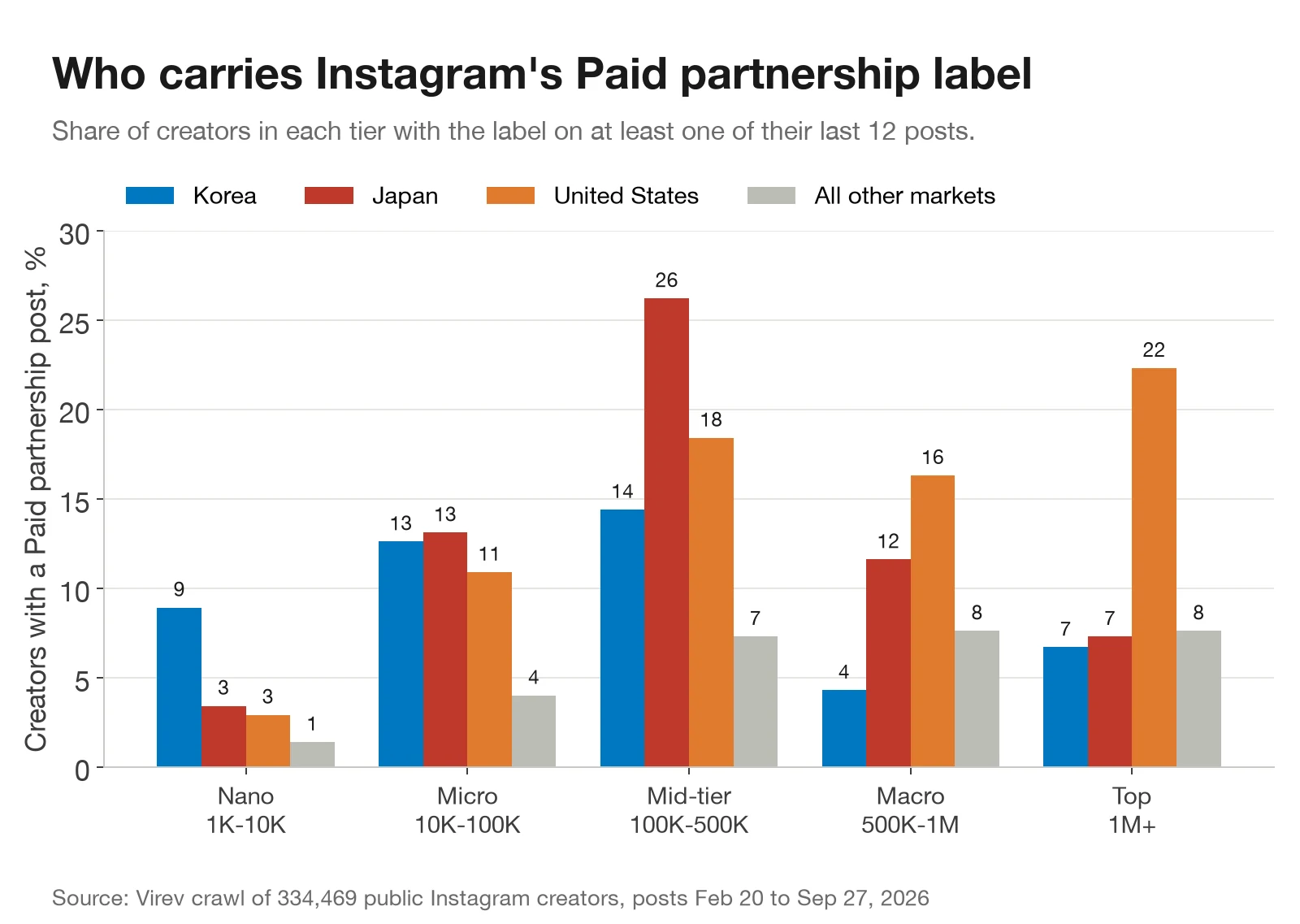
| KOL tier | Korea | Japan | US | Other markets |
|---|---|---|---|---|
| Nano, 1K-10K | 8.9% | 3.4% | 2.9% | 1.4% |
| Micro, 10K-100K | 12.6% | 13.1% | 10.9% | 4.0% |
| Mid-tier, 100K-500K | 14.4% | 26.2% | 18.4% | 7.3% |
| Macro, 500K-1M | 4.3% | 11.6% | 16.3% | 7.6% |
| Top, 1M+ | 6.7% | 7.3% | 22.3% | 7.6% |
The US and Asia split at the top. US creators carry the label more as they grow, from 2.9% of nano accounts to 22.3% of 1M+ accounts. In Korea and Japan the label peaks in the mid-tier, at 14.4% and 26.2% of 100K-500K accounts, and drops to about 7% for 1M+ accounts. Our data shows where the label sits, not why the biggest Asian accounts use it less.
The label also undercounts Asia. Korean and Japanese creators often disclose in the caption instead, with 광고 (ad) or 협찬 (sponsored) in Korea and PR in Japan. When we count those too, the gap between the two countries opens up. In the table, "creators" is the share of creators with at least one disclosed post among their last 12, and "posts" is the share of all their posts that were disclosed.
| KOL tier | Korea, creators | Korea, posts | Japan, creators | Japan, posts |
|---|---|---|---|---|
| Nano, 1K-10K | 34.0% | 19.1% | 7.1% | 2.1% |
| Micro, 10K-100K | 34.0% | 13.3% | 21.1% | 5.6% |
| Mid-tier, 100K-500K | 41.8% | 17.6% | 34.6% | 8.8% |
| Macro, 500K-1M | 23.7% | 4.8% | 33.0% | 6.5% |
| Top, 1M+ | 38.3% | 8.8% | 25.5% | 4.3% |
One in five recent posts by Korean nano accounts was a disclosed sponsored post (1,501 of 7,871). In Japan it was one in fifty (2.1%). Japanese brands spend on mid-tier and bigger KOLs. Korean brands also spend at the bottom of the scale, where the KOCs are.
KOL vs KOC, measured in Korea
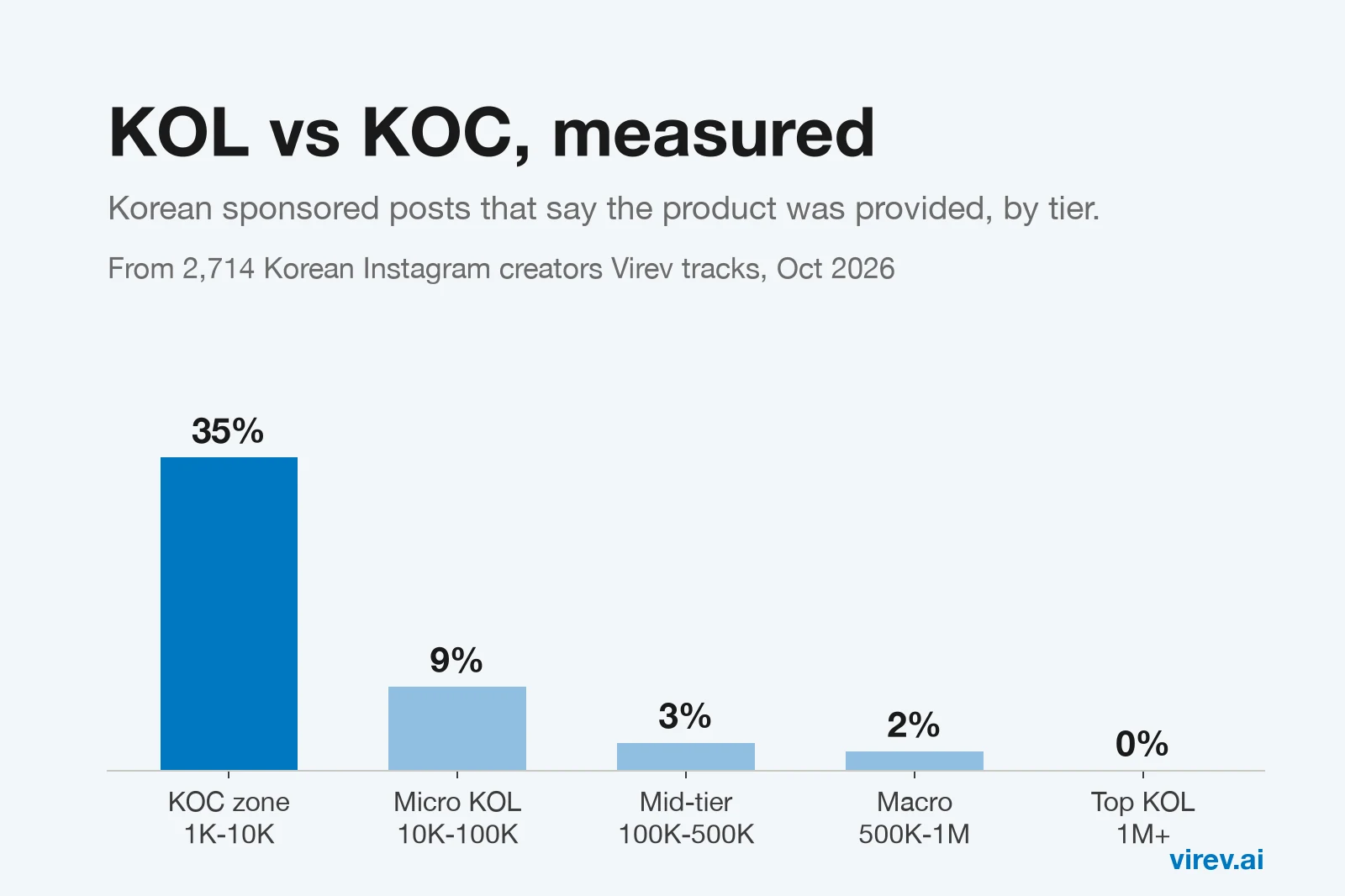
A KOC is usually paid in product, not cash. Korean captions let us test that, because Korean creators tend to say what they got. 제품 제공 and 제공받아 mean "product provided", 제품협찬 means "product sponsorship", and 체험단 means a reviewer group. We read the 4,504 disclosed posts by Korean creators and counted the ones that say the product was provided.
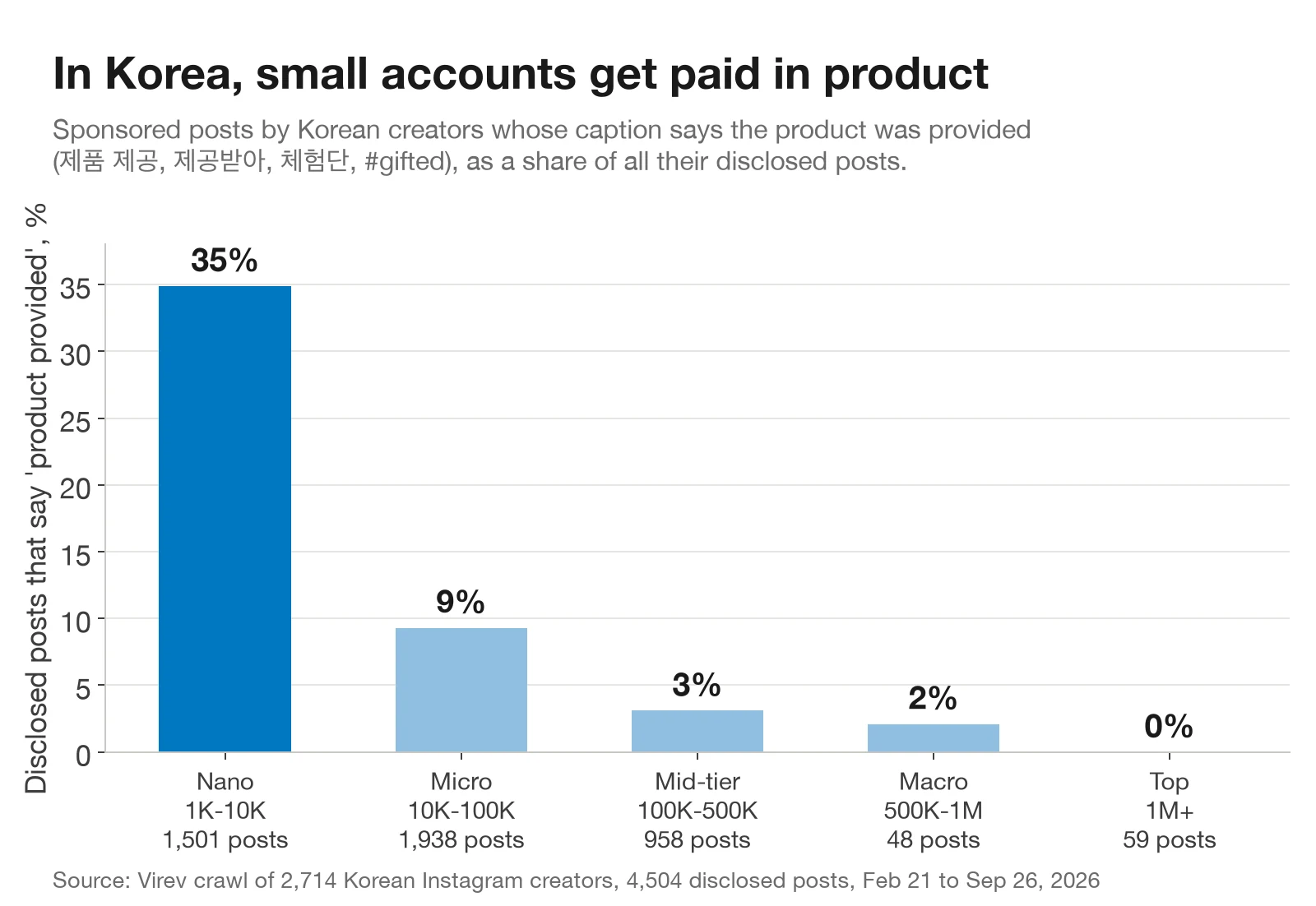
| KOL tier | Disclosed posts | Creators | Product provided | Paid label |
|---|---|---|---|---|
| Nano, 1K-10K | 1,501 | 248 | 34.9% | 8.5% |
| Micro, 10K-100K | 1,938 | 455 | 9.3% | 20.9% |
| Mid-tier, 100K-500K | 958 | 206 | 3.1% | 16.3% |
| Macro, 500K-1M | 48 | 22 | 2.1% | 10.4% |
| Top, 1M+ | 59 | 23 | 0.0% | 8.5% |
- At 1,000 to 10,000 followers, 34.9% of disclosed posts say the product was provided, and 142 of the 248 nano creators who disclosed a deal had at least one such post.
- From 10,000 followers up, product-provided posts fall to 9.3%, and the Paid partnership label rises to 20.9%, so the deal looks more like a paid KOL post.
- The rest of the disclosed posts say only 광고 or 협찬, which do not tell cash from product, so 34.9% is a floor for product-only deals, not a ceiling.
So the KOL vs KOC line in Korea sits near 10,000 followers. Below it, most deals are free product sent to many accounts at once. Above it, deals carry the label and, more often, a fee. For posting rates by tier in Korea, see our Korean report on influencer seeding in Korea, and for prices see influencer rates in Korea.
Five beauty brands, two models
The brands tagged in these posts show the same split. We counted the Korean creators who tagged each brand in a disclosed post, by tier.
| Brand | Creators (1K-10K / 10K-100K / 100K+) | Say product provided | Say 유료광고 (paid ad) |
|---|---|---|---|
| Olive Young (@oliveyoung_official) | 17 (14 / 3 / 0) | 10 of 18 | 0 of 18 |
| Powder Room (@parumi_magazine) | 13 (13 / 0 / 0) | 16 of 16 | 0 of 16 |
| Lilybyred (@lilybyred_official) | 9 (7 / 2 / 0) | 10 of 10 | 0 of 10 |
| YSL Beauty (@yslbeauty) | 14 (3 / 11 / 0) | 23 of 23 | 0 of 23 |
| Dior Beauty (@diorbeauty) | 19 (0 / 14 / 5) | 3 of 22 | 17 of 22 |
- Olive Young, the review community Powder Room and the makeup brand Lilybyred work at the KOC end, and most of their creators had fewer than 10,000 followers (14 of 17, 13 of 13 and 7 of 9). One of the Olive Young posts comes from a member of its Shutterbrity crew, who writes that she joined for a second round.
- YSL Beauty sends product to micro KOLs, and all 23 of its posts say 제품협찬 (product sponsorship).
- Dior Beauty works with no nano accounts in our data, and 17 of its 22 posts say 유료광고, which means a paid ad.
Our earlier study of Korean influencers found that none of Dior Beauty's Korean posts used Instagram's Paid partnership label, which matches this table.
Why we cannot split KOL and KOC in Japan
Japanese captions do not let us run the same test. Japanese creators mark posts with PR, which does not say whether cash or product changed hands. Phrases such as ご提供いただきました (it was provided to me) are rare in our data, and they often sit at the end of a long caption, past the 400 characters we store. In our earlier Japanese influencers study, 532 of 1,370 PR marks came after character 400. We do not report a Japanese KOC share.
How to pick KOLs and KOCs with this data
- Decide what you are buying. Pick KOLs for authority on one topic and a few strong posts, and pick KOCs for many honest reviews from real buyers.
- Pick the tier by market. In Japan, the mid-tier is where most Paid partnership work happens, and engagement holds up well into the top tiers. In Korea, a KOC program reaches a crowded field, since one in five posts by nano accounts there is already sponsored.
- Expect to pay KOCs in product and KOLs in cash. In Korea, 34.9% of sponsored nano posts say the product was provided, and the share falls to 3.1% at 100K-500K. Our influencer rates study has cash prices by tier.
- Check that the account is real before you send anything. Small accounts are cheap to fake, and our fake follower checker compares an account's likes and comments with its size.
- Write disclosure into the brief. Korea and Japan treat a free-product post as an ad, so the KOC must say so in Korean or Japanese, where readers see it first.
For how small accounts compare on reach and cost, see are micro and nano influencers worth it. For what happens to engagement on a sponsored post, see do sponsored posts perform worse.
Find KOLs by country on Virev
Virev indexes 180M+ creators on Instagram, TikTok and YouTube. You can filter them by country, niche, follower count and engagement rate, and see each creator's recent posts and business contact.
- Search Korean KOLs and KOCs to filter the Korean pool by tier and niche.
- Search Japanese KOLs to find mid-tier creators who already run PR posts.
- Start a 3-day trial to run your first search.
How we measured, and what can be wrong
- The sample is public Instagram accounts with 1,000 or more followers whose profile Virev's crawler read from July 2026 on, with 6 or more measurable posts. Each account's last 12 posts that were not pinned, had likes visible, were at least 3 days old at the read and were posted within 180 days of it count.
- Korea is 2,714 creators whose captions are at least half in Korean, read August 18 to September 30, 2026. Japan is 2,500 creators whose captions are at least half in Japanese (3 or more hiragana), or whose profile says Japan, read August 10 to September 30, 2026.
- The United States is 9,110 creators that our profile model labels as individual creators based in the US. All other markets is 320,145 creators from the same export, minus the Korean and Japanese sets. Language marks Korea and Japan, but the US set needs the profile label, so it holds fewer small accounts than the US has.
- We dropped brands, shops, media, clinics and fan pages by the profile label, Instagram's category and name patterns. Some business accounts can remain.
- Engagement rate is likes plus comments on the creator's median post of the 12, over followers. We report the median creator in each tier.
- The Paid partnership label is read from Instagram. Korean caption disclosure is #광고, [광고], 광고 포함, 유료광고, 원고료, 협찬, 제품 제공, 제공받아, 체험단, #ad, #sponsored or #gifted, read from the first 400 characters of the caption. In our earlier Korean study, 94.7% of Korean caption disclosures sat in the first 100 characters. Posts that recruit reviewers (체험단 모집) are left out.
- Japanese caption disclosure is #PR, 【PR】, (PR), PR表記, #プロモーション, #タイアップ, #提供, #広告, 広告を含む, #ad or #sponsored, read from the full caption.
- Brand counts use @mentions in disclosed Korean posts. A creator who tags a brand without disclosing is not counted.
- Our crawler collects accounts for creator marketing, so the sample holds more active creators than Instagram as a whole. Compare tiers and markets with each other, and do not quote a share as a figure for all of Instagram.
- Every gap here compares different groups of creators at one time, so it is a correlation and not a cause.
- True KOCs with fewer than 1,000 followers are below our floor, so this page does not measure them.
Download the data
The tables behind every chart are in one CSV: kol-tiers-2026.csv. Each row has a table name. The tables are kol_tiers_by_market (creators, engagement quartiles, Paid partnership share and Korean and Japanese disclosure by tier), korea_disclosed_posts_by_tier and korea_brand_cases. Please cite "Virev, October 2026" and link this page.
Sources
- Opinion leadership
- KOL vs KOC: KOL, KOC & KOS Meaning
- Key Opinion Leaders (KOL): Your guide to Who, What & Why!
- CJ올리브영, K뷰티 크리에이터 '셔터브리티' 7기 모집
- 인플루언서는 광고주에게 대가를 받았다는 사실을 이렇게 알리세요 (추천·보증 심사지침 안내서)
- 令和5年10月1日からステルスマーケティングは景品表示法違反となります。
- 올리브영 OLIVE YOUNG (@oliveyoung_official)
- Dior Beauty Official (@diorbeauty)
- YSL Beauty Official (@yslbeauty)
- 릴리바이레드 (lilybyred) (@lilybyred_official)
- 파우더룸 2호점 (@parumi_magazine)