



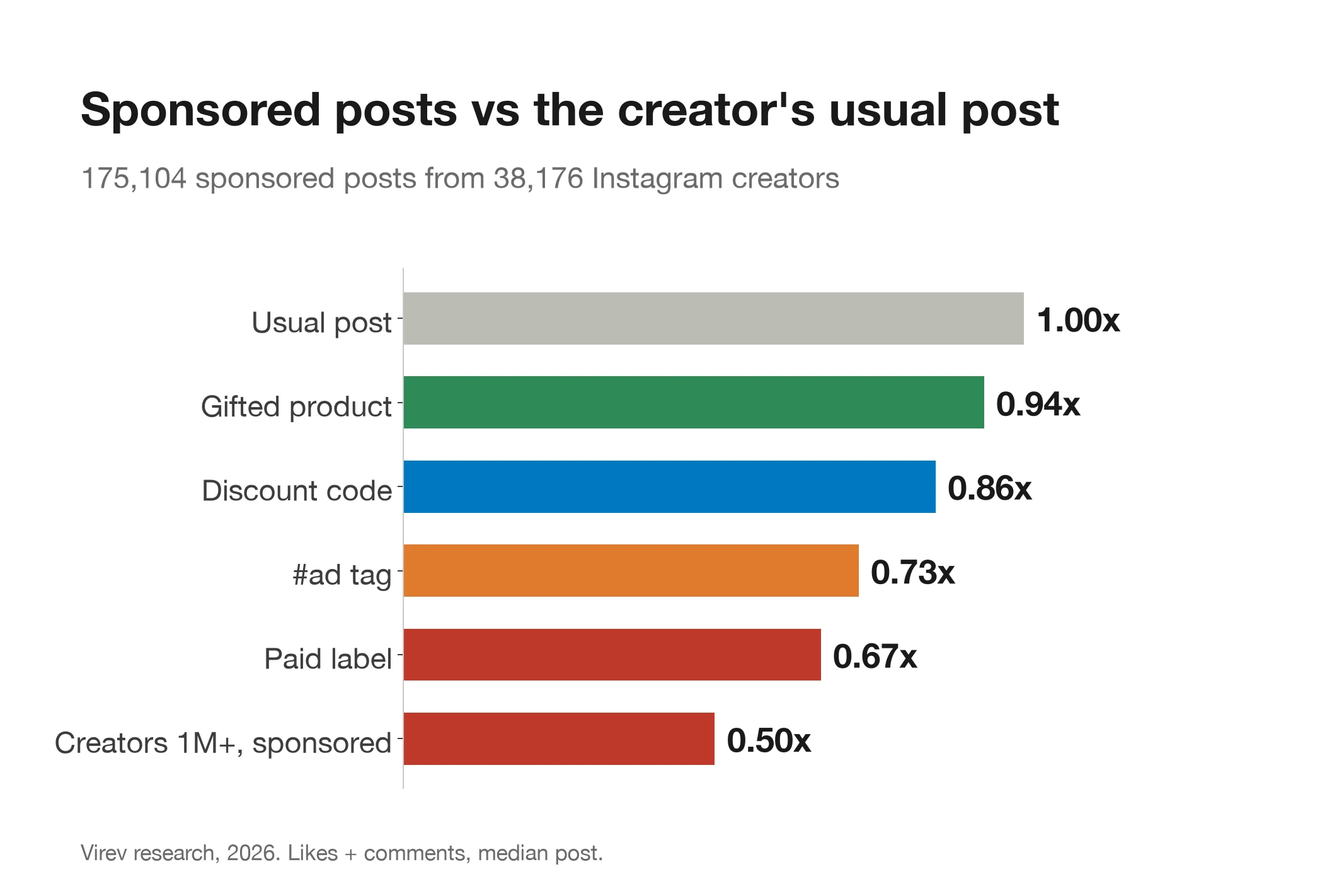
Yes, on average. We compared 175,104 sponsored Instagram posts with the normal posts of the creators who made them. A typical sponsored post got 0.69x the likes and comments of that creator's usual post, so about 31% less. For creators with more than 500,000 followers the drop is close to half. Gifted posts lost much less, at 0.94x. Some brands beat the usual post, and four of them are named below with what they did.
Most pages that rank for this question are pros-and-cons lists. The gifted-vs-paid pages state that gifted content "consistently outperforms" paid content, or give ROI ranges, with no data behind them. This study measures it: every post is compared with the same creator's own normal posts, so a big account and a small one are judged on the same scale.
0.69x
Sponsored post
0.50x
Creators 1M+
0.94x
Gifted product
Sponsored posts get 0.69x the creator's usual engagement
We sorted every post into one of five groups. A post is sponsored if Instagram shows the paid partnership label on it, or if the caption has an ad tag such as #ad, #sponsored, #publi, #werbung, #광고 or #PR. It is gifted if the caption says the product was gifted or sent (gifted by, PR package, 협찬, 提供) and carries no ad tag. Posts with a discount code or affiliate link and no other marker form a third group, giveaways a fourth, and everything else counts as normal.
Then we divided each post's likes plus comments by the median of the same creator's normal posts. A ratio of 1.0 means the post did as well as the creator's usual post.
| Post type | Posts | Creators | Median vs usual post | Share below usual |
|---|---|---|---|---|
| Sponsored, all | 175,104 | 38,176 | 0.69x | 67% |
| Gifted product | 30,466 | 10,338 | 0.94x | 55% |
| Discount code or affiliate link | 55,521 | 18,301 | 0.86x | 58% |
| Giveaway | 64,351 | 26,776 | 2.11x | 28% |
Two out of three sponsored posts did worse than the creator's median normal post. The result holds if you weight each creator once instead of each post (0.69x), and if you compare each sponsored post only with normal posts from the 45 days around it (0.67x, 164,950 posts). So a creator's good months and bad months do not explain it.
Giveaways are the exception, at 2.11x. That number comes from the entry rules more than from interest: "tag a friend and comment to enter" asks every entrant for a comment, and often a like. Read a giveaway's engagement as entries.
The paid label costs more than a gift
How the deal is disclosed lines up with how much engagement the post loses. Posts with Instagram's paid partnership label do worst. Posts that only say the product was gifted lose the least.
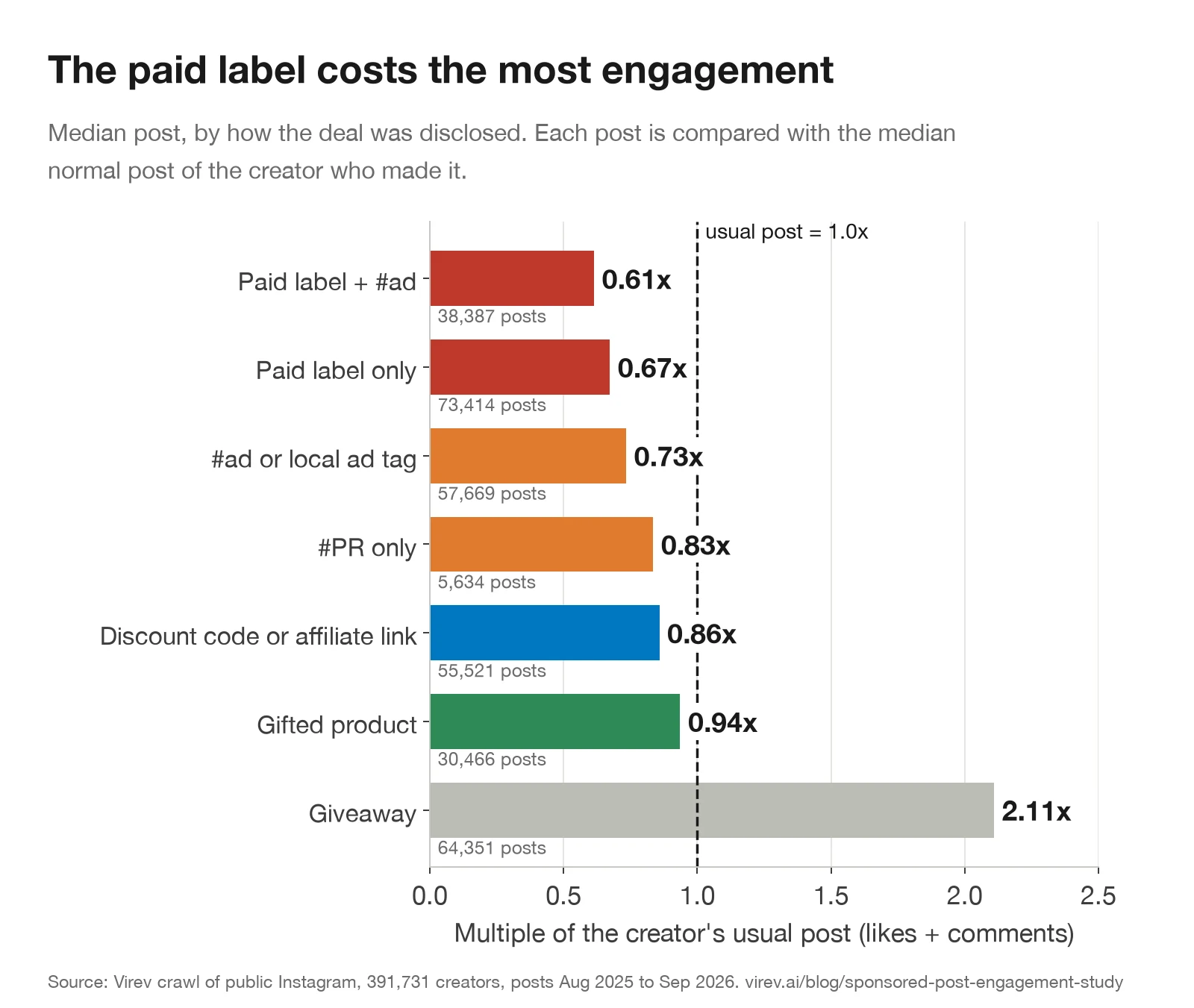
This answers the gifted vs paid question with numbers. A gifted post keeps 94% of the creator's usual engagement and a paid-label post keeps 67%. One likely reason is the content itself. A creator who got a product for free usually posts it only if they like it, and writes it in their own words. A paid post comes with a brief, a deadline and talking points.
The label alone does not explain the whole gap. Posts with both the label and #ad (0.61x) do worse than posts with the label only (0.67x). Those are the deals with the most brand control: the brand asked for both markers and, often, the script.
Our sister studies found the same order in single markets. Japanese creators: paid label 0.64x, #PR 0.76x, gifted 0.86x. Korean creators: #광고 0.69x, 협찬 (gifted) 0.89x. Book creators show the smallest drop: gifted copies and ARCs get 0.98x. Pet creators: discount code or #gifted 0.88x, paid label 0.55x (see dog and pet influencers).
Bigger creators lose more on a sponsored post
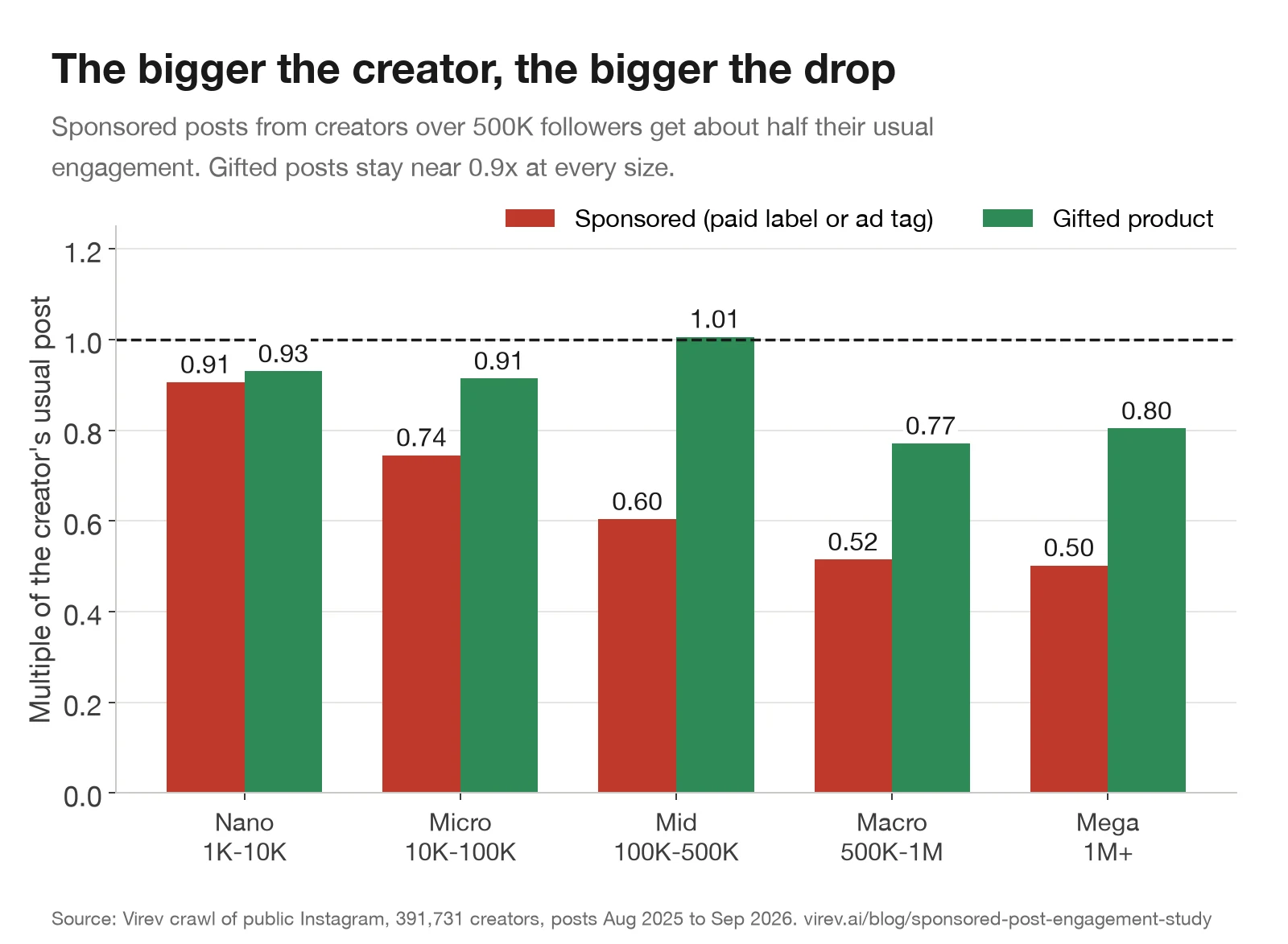
| Tier | Creators who posted any sponsored post | Sponsored vs usual | Gifted vs usual |
|---|---|---|---|
| Nano, 1K to 10K | 3.9% | 0.91x | 0.93x |
| Micro, 10K to 100K | 9.7% | 0.74x | 0.91x |
| Mid, 100K to 500K | 17.2% | 0.60x | 1.01x |
| Macro, 500K to 1M | 19.9% | 0.52x | 0.77x |
| Mega, 1M+ | 21.7% | 0.50x | 0.80x |
A nano creator's sponsored post does almost as well as their normal post. A mega creator's sponsored post gets half. Large accounts also post more ads: one in five posted at least one in the window. For a brand, this means the engagement on a large creator's past posts overstates what your post will get. Halve it before you price the deal.
People still watch sponsored reels, they react less
Likes and comments are only half of the story for reels. Instagram also shows how many times a reel was played, so we measured views the same way.
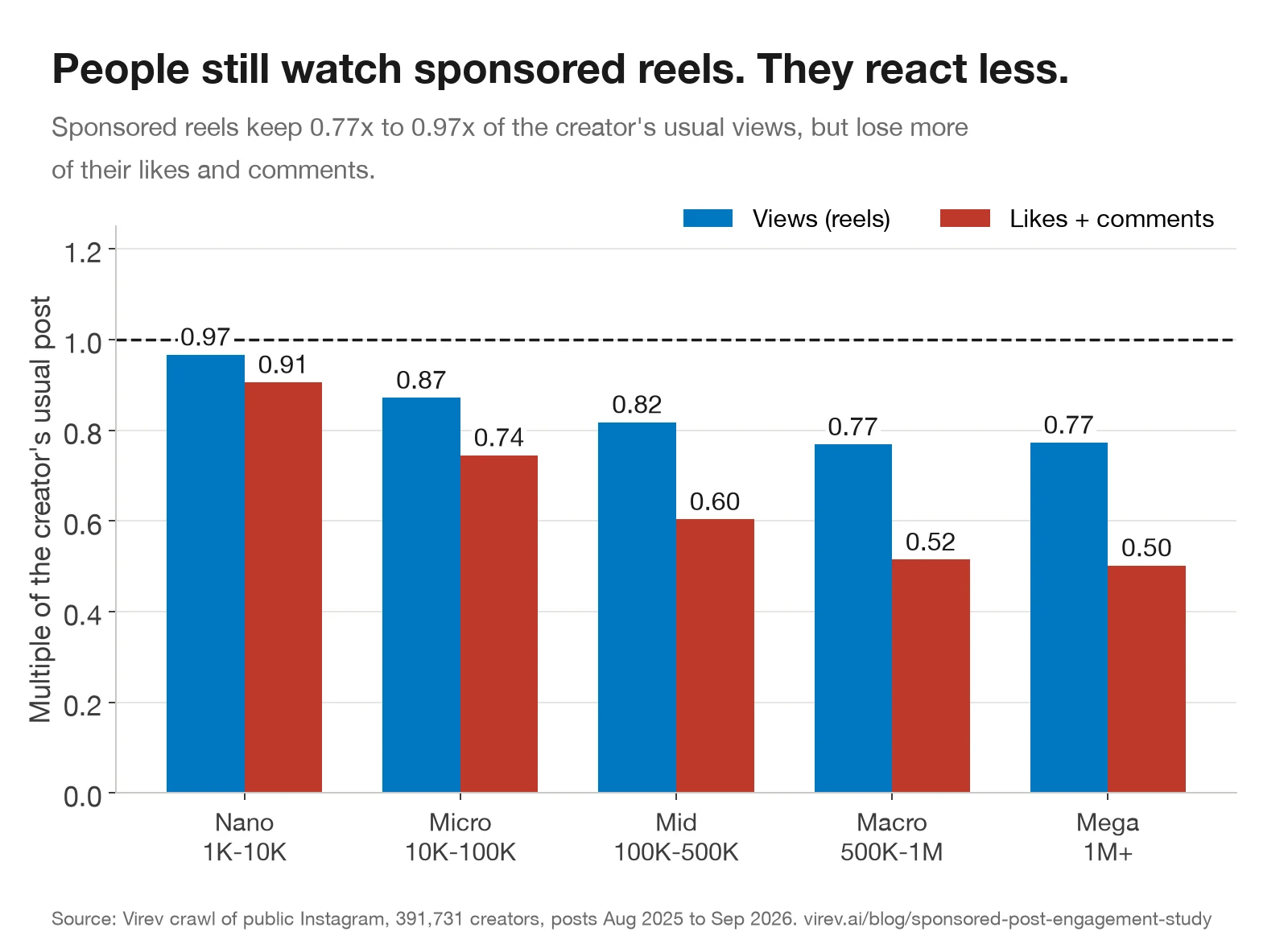
Sponsored reels get 0.85x the creator's usual views and 0.69x the usual likes and comments. So the audience does see the post; fewer of them react to it. The gap grows with size. A mega creator's sponsored reel keeps 0.77x of the views and 0.50x of the reactions.
Paid amplification makes the gap larger. When a brand runs the creator's post as an ad, the plays from the ad count on the post. Verizon is the clearest case in our data: 25 sponsored reels by 20 creators got a median of 16.1x the creators' usual views and 0.74x their usual likes and comments. Views that far above a creator's normal reels usually mean the post also ran as an ad. The extra views came without extra reactions. If you judge a campaign on views, check whether the brand boosted the post before you compare it with a creator's organic reels.
Collab posts close part of the gap
Instagram's Collab feature puts the post on both the creator's and the brand's profile. 57,042 sponsored posts in our data list the brand as co-author.
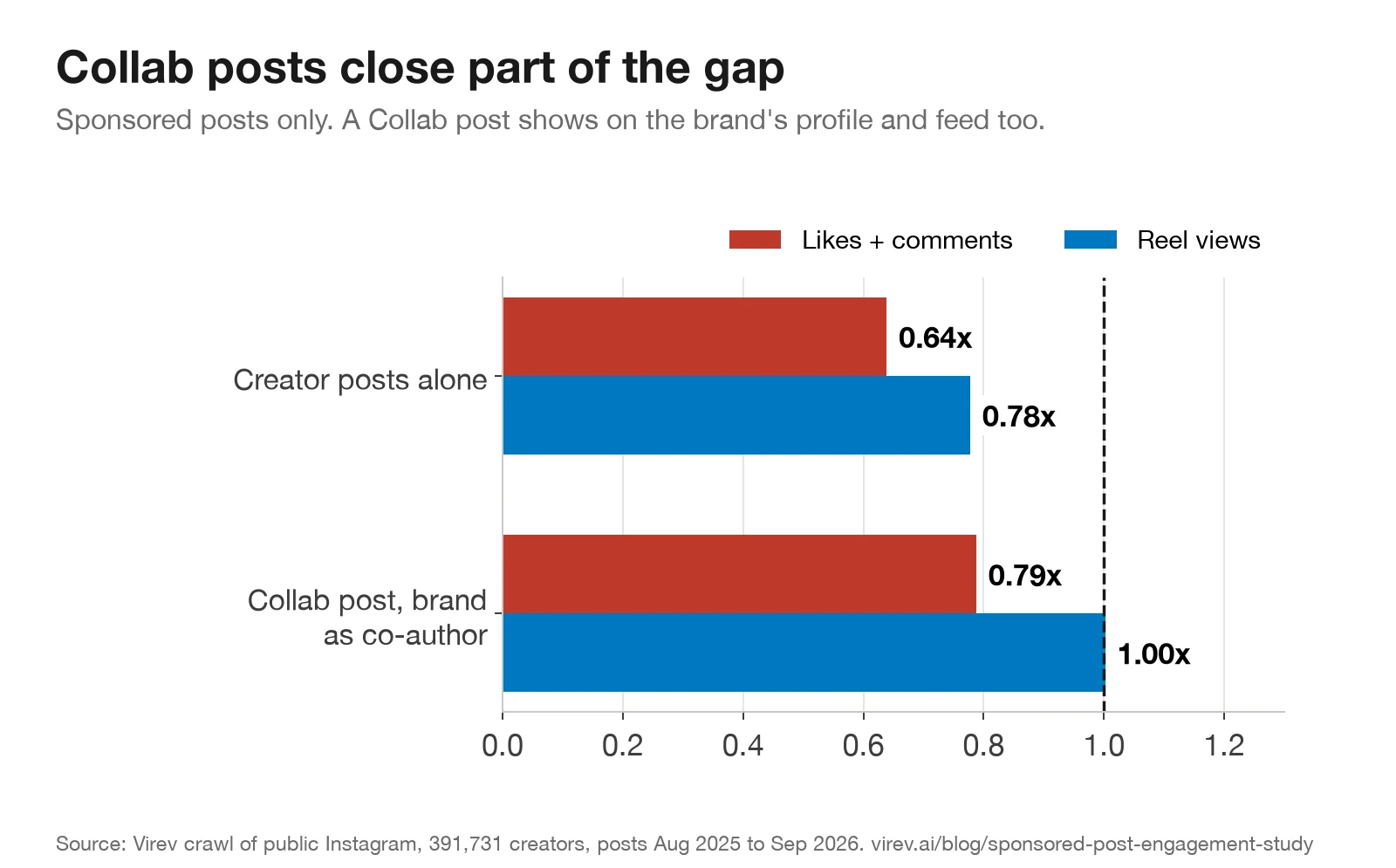
Collab posts got 0.79x the creator's usual engagement, against 0.64x for sponsored posts the creator published alone. Their reels got 1.00x the usual views. Part of that comes from the brand's own followers, who see the post in their feed. The extra engagement is real, but it is not all the creator's audience. Our guide to Collab posts and paid partnership permissions explains the two settings.
Every category loses, by different amounts
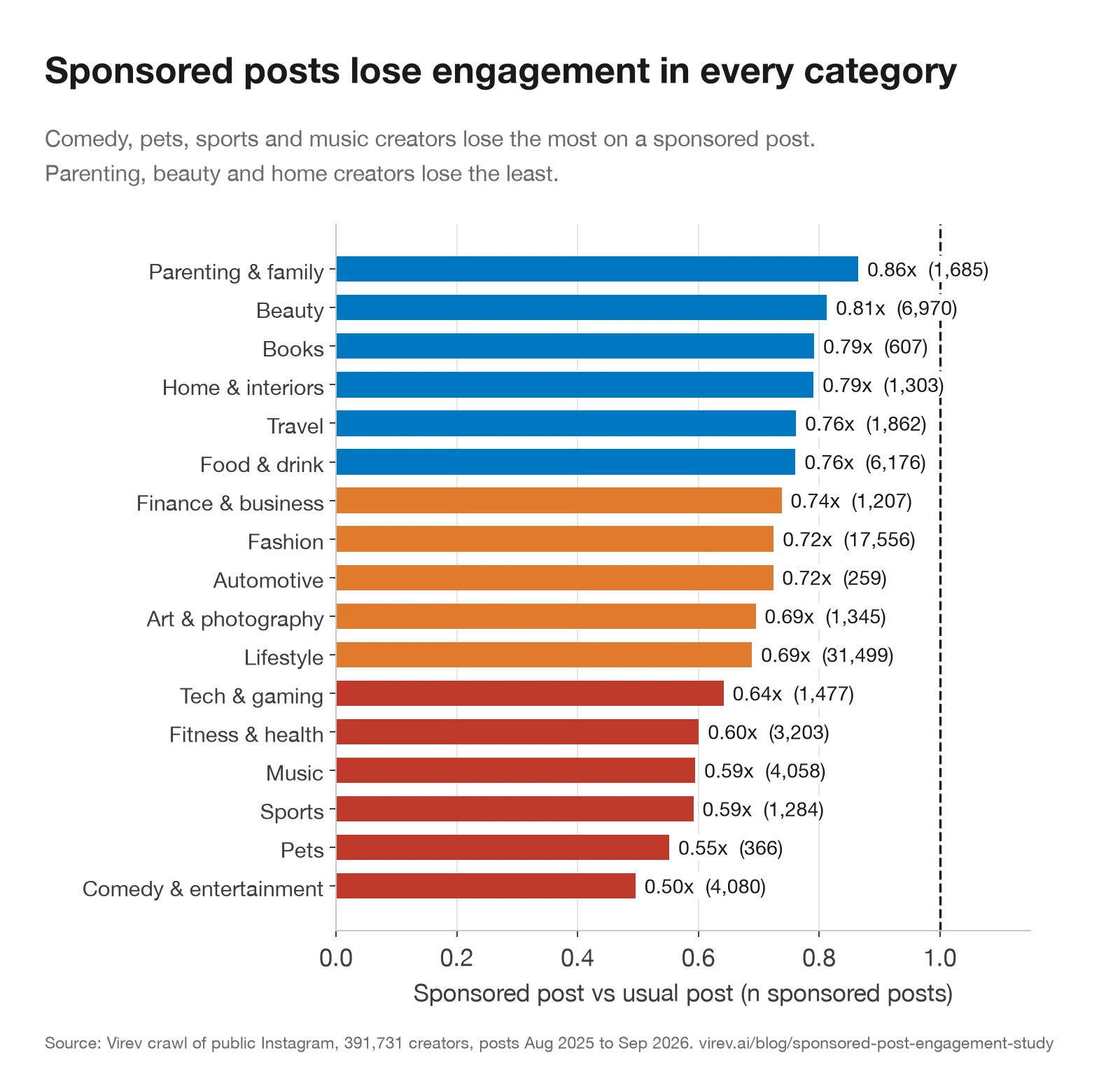
Parenting (0.86x), beauty (0.81x), books and home (0.79x) lose the least. Their followers come for product advice, so a product post is close to what they expect. Comedy (0.50x), pets (0.55x), sports and music (0.59x) lose the most. Their followers come for jokes, animals or games, and an ad is a break from that.
Our niche studies give the same picture inside single categories: finance creators get 0.66x on ad posts, and golf creators 0.63x.
The drop shows up in every market
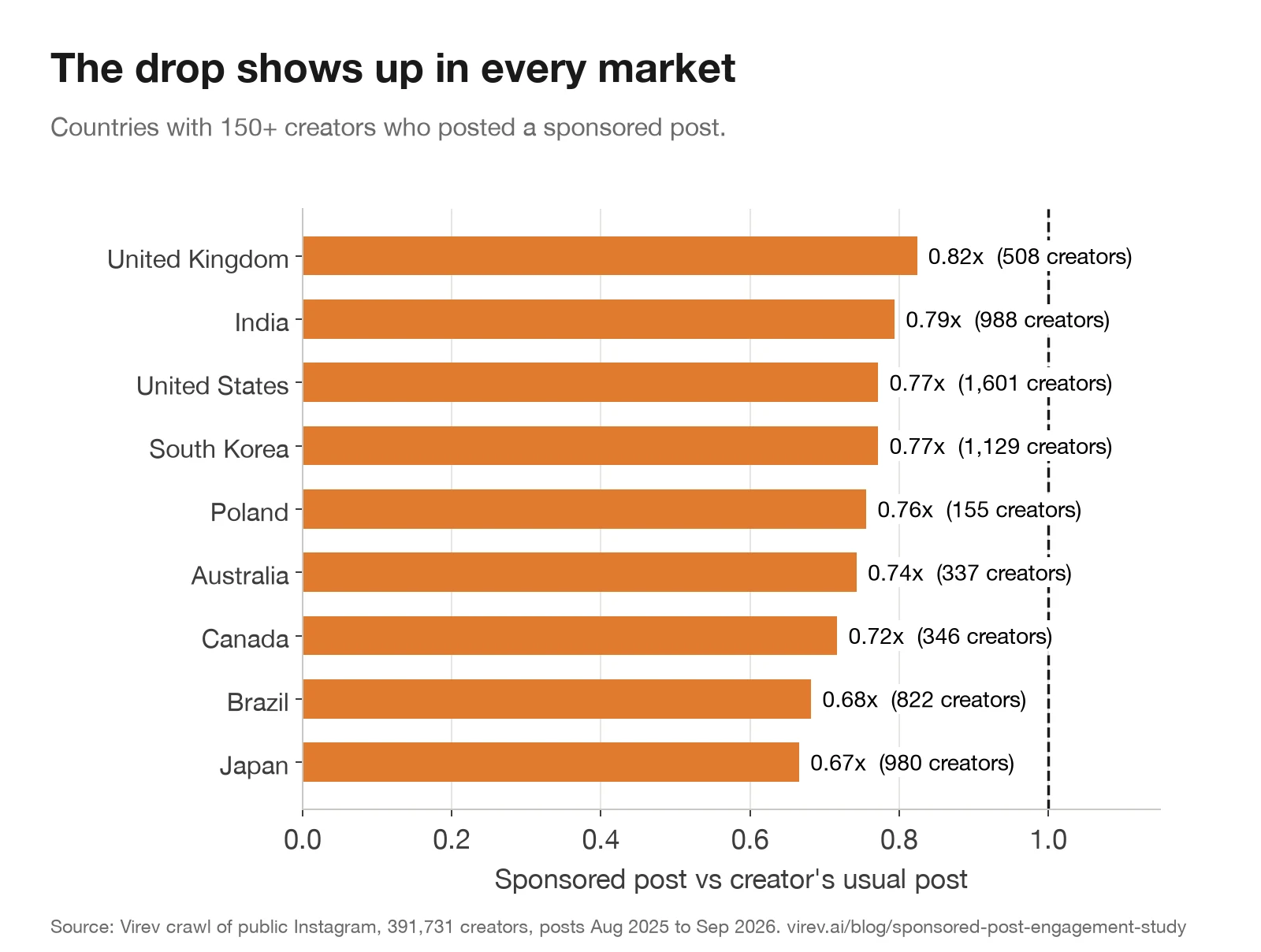
No market is at or above 1.0x. Japan (0.67x) and Brazil (0.68x) have the largest drop, the United Kingdom (0.82x) the smallest. Country is known for a minority of the 391,731 creators, so read these as 155 to 1,601 creators per country, not as national averages. For the Japanese market, see our Japanese influencers study.
TikTok shows the same pattern
TikTok's paid label is not visible in the data we collect, so on TikTok we detect sponsored posts by caption tags only (#ad, #sponsored, #tiktokpartner and local tags). Engagement counts likes, comments and shares.
| TikTok post type | Videos | Creators | Engagement vs usual | Views vs usual |
|---|---|---|---|---|
| Sponsored (caption tag) | 47,862 | 13,399 | 0.63x | 0.80x |
| Gifted product | 5,043 | 2,198 | 0.74x | 0.75x |
| Discount code or affiliate | 16,955 | 5,542 | 0.75x | 0.86x |
| Giveaway | 2,972 | 2,016 | 1.00x | 0.87x |
The sample is 262,437 TikTok creators with 1,000+ followers and 15.5 million videos posted from August 2025 to September 2026. The sponsored drop on TikTok (0.63x) is close to Instagram's (0.69x). Views drop less than engagement here too. For normal TikTok rates, see our TikTok engagement rate benchmarks.
Four brands whose sponsored posts beat the usual post
We grouped sponsored and gifted posts by the brand that Instagram lists as paid partner or co-author. 154 brands appear on posts by 10 or more of our creators. 70% of them land below 1.0x. These four did better, and each did something we can name.
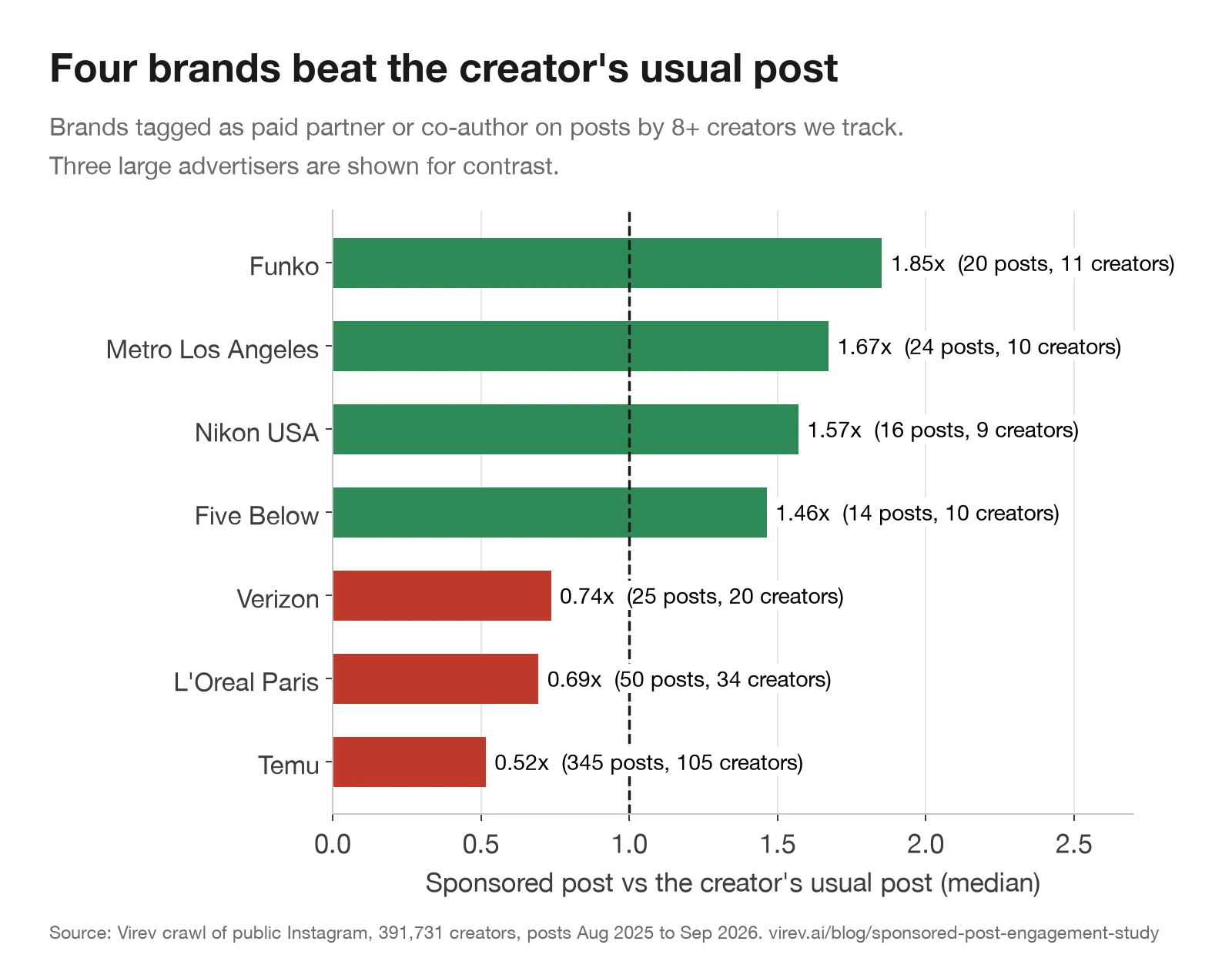
Funko, 1.85x. Funko works with collector accounts and gives them news the audience wants. @toppopsyt (89K followers) usually gets 576 likes and comments. Its post on Funko's Limited Edition Mystery boxes, which "sold out in minutes", got 4,778 at our read. The post is a product drop for people who collect the product. 95% of Funko's posts were Collab posts.
Metro Los Angeles, 1.67x. The transit agency paid local creators to make city guides, with Metro as the way to get there. @gregruben (90K followers) posted "LA's most underrated museum is actually a store in Westlake" with the train and bus lines at the end, tagged #metropartner. It got 49,000 likes and 370 comments against his usual 2,525. Metro was how to get there. The post was about the place.
Nikon USA, 1.57x. 13 of the 16 posts were photo carousels, not reels. Each one showed work shot on a Nikon camera: @netovelasco's "Moving Postcards from Paris" got 910 likes and comments against his usual 58, and @danieljstein's aurora project got 2,663 against 582. The product is visible in the result. The creator posts the kind of work the audience follows them for.
Five Below, 1.46x. Five Below's back-to-school posts went mostly to teachers and parents with small accounts: six of the ten creators have under 25,000 followers. @mrsjosephteaches (10.9K) got 735 likes and comments against her usual 258. The brand also pushed paid reach: these reels had a median of 16.7x the usual views. So part of the lift is ad money.
For contrast. Temu ran 345 paid posts with 105 creators in our data and got 0.52x. None were Collab posts, and 83% of the captions ask viewers to comment for a link or search a code. L'Oreal Paris got 0.69x on 50 posts. Verizon got 16.1x the views and 0.74x the engagement, as shown in the reels section.
What the four winners share: the creator's audience already wanted the subject (collectibles, the city, photography, classrooms), the product sat inside a post the creator would have made anyway, and most posts went out as Collabs.
What to do with this
For brands
- Budget for 0.69x. Take the creator's median post, not the average or the best, and multiply by 0.69 for a sponsored post, or by 0.5 for creators over 500K. Our Instagram engagement rate calculator gives the median-post rate.
- Prefer nano and micro creators when engagement is the goal. They keep 0.91x and 0.74x of their usual engagement on a sponsored post.
- Pick creators whose audience already wants your subject. Parenting, beauty, books and home creators lose least. Comedy and pet creators lose most unless the product fits the joke or the animal.
- Ask for a Collab post. It closes about 40% of the gap, and the post lands on your profile too.
- Report views and reactions apart, and mark boosted posts. A boosted reel's views say little about the creator.
- Before you sign, look at the creator's past sponsored posts against their normal ones. Virev creator search shows each creator's recent posts and engagement.
For creators
- Show your sponsored post median next to your normal post median in your media kit. A brand that finds the gap later trusts you less.
- Gifted and code posts cost you little (0.94x and 0.86x). A paid brief with a script costs more. Ask for room to write the post your way.
- Put the product inside a post you would have made anyway: a city guide, a project, a classroom.
- Disclose clearly. Most large markets require it. Our guide on using Instagram's paid partnership label correctly shows how.
How we measured, and what can be wrong
- Accounts: public Instagram accounts with 1,000+ followers read by Virev's crawler between August 6 and October 1, 2026. We removed brands, media, businesses and organizations by Virev's profile label or Instagram category, and kept creators with at least 6 measurable posts and at least 4 normal posts: 391,731.
- Posts: feed posts and reels, not pinned, with likes visible, at least 3 days old at the read, posted within a year before the read (August 18, 2025 to September 27, 2026): 20,184,861 posts, 19,859,419 of them normal.
- Ratio: likes plus comments of the post, divided by the median of the same creator's normal posts. Reel views use the median of the creator's normal reels. Tables report the median across posts.
- Detection: Instagram's paid partnership label marks 111,801 of the 175,104 sponsored posts. The rest come from caption rules. Our first rules matched event sponsorships ("sponsored by"), contests and the word "gifted" in any sense, and a hand check of 100 posts found 70 correct. We tightened the rules and ran the whole export again. A second check of 100 random caption-detected posts found 86 correct. The errors were #PR used for Puerto Rico, hashtags about advertising, and "courtesy of" photo credits.
- Undisclosed ads: in 100 random normal posts we saw 5 to 8 that looked like brand promotion with no marker. They sit in the baseline, which makes our drop a little smaller than the true one.
- Selection: brands do not pick posts at random. They pick creators, dates and formats, and sponsored posts are more often reels (83% against 53% of normal posts). That is why we also compare reels with reels (0.69x) and images with images (0.63x). This is an observational study, so it shows what sponsored posts get, not why.
- Category and country: from Virev's creator profile, which covers a minority of accounts. TikTok sponsored posts come from caption tags only.
For the engagement rates behind the tiers, see our Instagram engagement rate benchmarks. If you report paid and organic results to a client, our note on tracking organic and paid creator results separately covers the setup.
Download the data
The aggregate tables behind every chart are in one CSV: sponsored-post-engagement-2026.csv. It has one row per group with posts, creators, the median post ratio, the median creator ratio, the share below the usual post and the reel view ratio. Please cite "Virev, October 2026" and link this page.
Sources
- Gifted vs Paid: Why Gifted Performs Significantly Better
- Gifted vs Affiliate vs Paid Influencer Campaigns (2026)
- Gifted vs Paid Influencer Campaigns: When to Use Each for 2026
- 32 Influencer marketing statistics to know in 2026
- 35 Influencer Marketing Statistics on Budgets, ROI, AI, and Platforms
- LA's most underrated museum is actually a store in Westlake
- Moving Postcards from Paris, Volume 2
- Funko Limited Edition Mystery boxes