



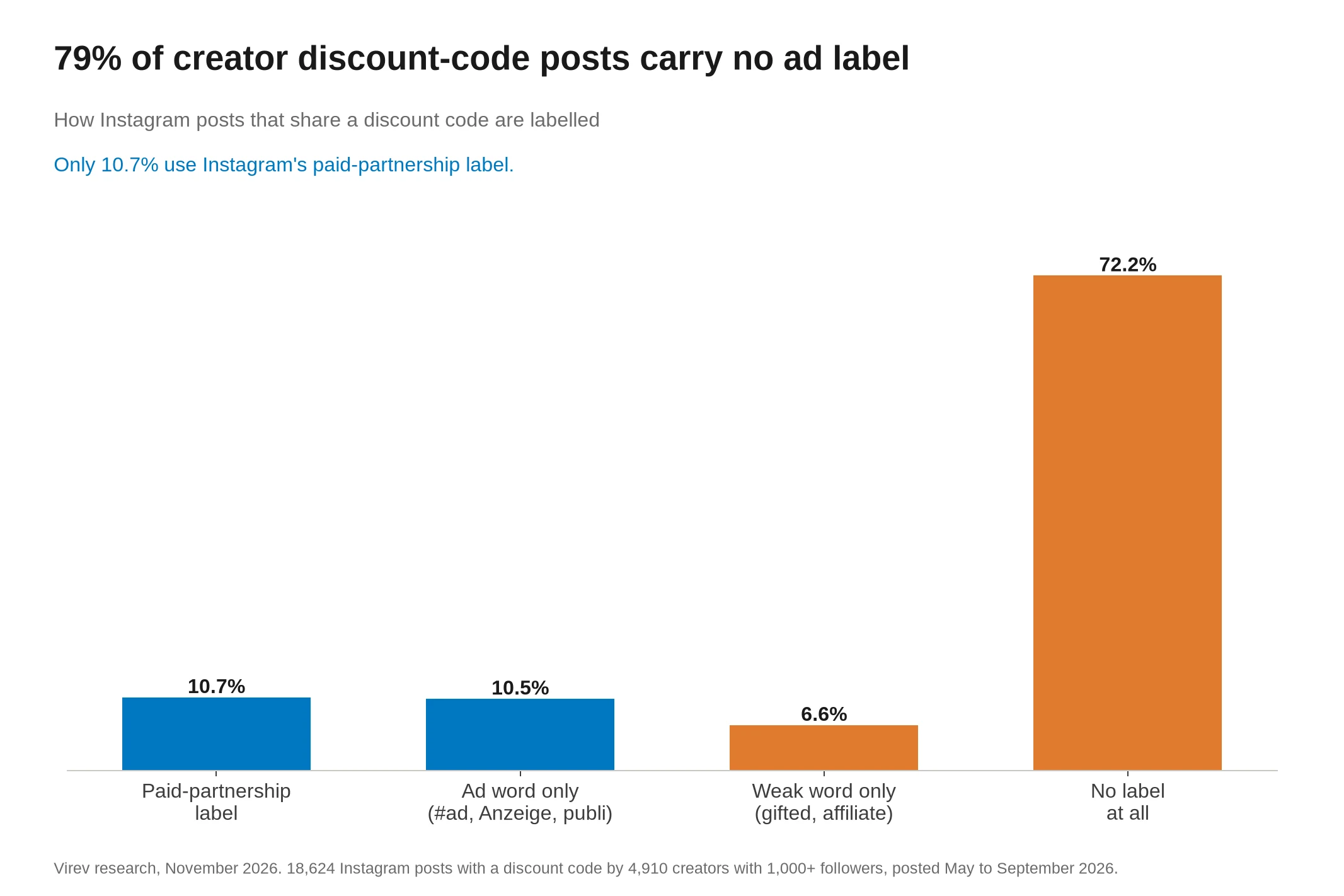
79% of Instagram posts in which a creator shares a discount code carry no ad label. We read 2.1 million Instagram posts that 45,752 creators with 1,000 or more followers published from May to September 2026, and found 18,624 posts by 4,910 creators that give a code such as "use code ANNA15 for 15% off". 10.7% of those posts used Instagram's paid-partnership label, and 10.5% more said #ad, Anzeige, publi or another ad word in the caption. The other 78.9% said neither, and 72.2% had no gifted, affiliate or partner tag either.
A discount code is the clearest public sign that a creator is selling for a brand. The code is personal and tracks sales back to the creator, and in a hand check of 100 code posts, 92 gave another brand's code. The UK Advertising Standards Authority lists "simply using a personalised discount code" among the labels that do not disclose an ad. The ASA lists personalised discount codes first among the signs that a post is likely an ad.
Other studies that rank for this question measure different things. The CEPR column by Ershov, He and Seiler finds about 95% of sponsored posts undisclosed, from a text classifier over 100 million tweets about 268 US brands from 2014 to 2021. The ASA estimates that about 57% of UK influencer ads on Instagram and TikTok were disclosed, from 50,000 pieces of content by 390 UK influencers. The European Commission's 2024 sweep of 576 influencers found that 20% disclosed their ads every time. This study counts one kind of post, the discount-code post, across 4,910 creators in many countries in 2026, and checks whether the label costs views.
78.9%
No ad label
10.7%
Paid-partnership label
12.6%
US creators
79% of discount-code posts carry no ad label
We sorted every code post by the strongest label it carries.
| Label on the post | Share of code posts |
|---|---|
| Instagram's paid-partnership label | 10.7% |
| An ad word only (#ad, Ad |, Anzeige, Werbung, publi) | 10.5% |
| A weak word only (gifted, affiliate, partner, collab) | 6.6% |
| No label or sponsor word | 72.2% |
| No ad label (the two rows above) | 78.9% |
Of the 3,938 code posts with an ad label, 28% used only Instagram's label, 49% used only words in the caption, and 22% used both. More labelled code posts used a caption word than Instagram's own label.
6.6% of code posts carried only a weaker word, such as #gifted, #affiliate, "in partnership with" or a brand hashtag like #brandpartner. The ASA has ruled that gifted, affiliate, partner and collab labels do not tell a reader that the post is an ad. The FTC lists a brand hashtag such as "AcmePartner" as an option on a space-limited platform such as Twitter, so under the FTC's wording the share with no label lies between 72.2% and 78.9%. Read the 78.9% as posts with no ad label under the ASA's test, and 72.2% as posts with no sign at all.
The share hardly moved over the five months. It ran between 78.5% and 79.4% in every month from May to September 2026.
Discount codes are not rare. 10.7% of the creators in the sample shared at least one code in five months, and 0.89% of all their posts held one. Among posts with the paid-partnership label, 11.0% also had a code.
Small creators label code posts least
| Followers | Code posts | Creators | Paid-partnership label | Any ad label | No ad label |
|---|---|---|---|---|---|
| 1K to 10K | 4,604 | 1,240 | 4.9% | 9.6% | 90.4% |
| 10K to 50K | 6,093 | 1,687 | 11.7% | 21.7% | 78.3% |
| 50K to 100K | 2,335 | 610 | 13.6% | 28.8% | 71.2% |
| 100K to 500K | 4,585 | 1,096 | 14.3% | 26.8% | 73.2% |
| 500K to 1M | 593 | 177 | 9.4% | 27.7% | 72.3% |
| 1M+ | 414 | 100 | 6.0% | 25.8% | 74.2% |
| All | 18,624 | 4,910 | 10.7% | 21.1% | 78.9% |
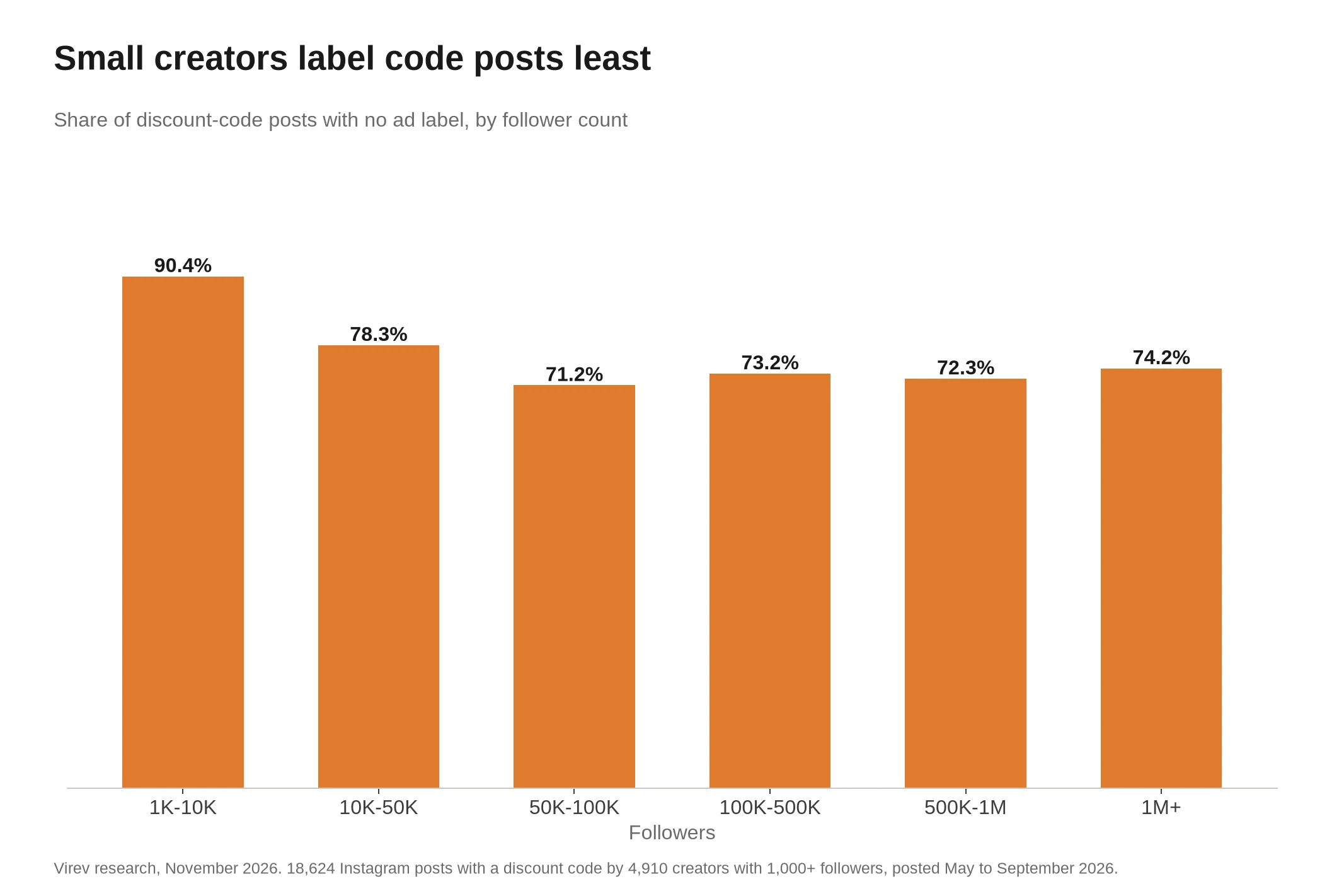
Creators with 1,000 to 10,000 followers left 90.4% of their code posts unlabelled. From 50,000 followers up, the share sits between 71% and 74%. Creators with 1M+ followers used the paid-partnership label least often among the larger tiers (6.0%) and wrote #ad or another ad word more often (22.5%).
A code needs a label even when no fee was paid. The FTC asks for a label whenever the creator has a "material connection" to the brand, which includes free or discounted products, and the ASA treats a personal discount code as a sign that a post is likely an ad.
German creators label most code posts, US creators few
Virev's creator profiles name a country for 12,848 of the code posts. Among countries with 200 or more code posts:
| Creator country | Code posts | Creators | Paid-partnership label | Ad word in caption | Any ad label |
|---|---|---|---|---|---|
| Germany | 389 | 85 | 8.2% | 69.9% | 72.8% |
| France | 221 | 66 | 20.4% | 21.3% | 39.4% |
| United Kingdom | 1,159 | 266 | 10.8% | 34.6% | 38.7% |
| Italy | 251 | 67 | 13.5% | 27.9% | 37.8% |
| Spain | 244 | 67 | 12.7% | 31.1% | 36.9% |
| Brazil | 2,808 | 720 | 9.1% | 22.0% | 24.9% |
| Australia | 715 | 172 | 17.2% | 11.7% | 22.9% |
| Canada | 633 | 162 | 15.6% | 10.3% | 18.2% |
| Mexico | 216 | 54 | 14.4% | 8.8% | 15.3% |
| Philippines | 213 | 69 | 7.5% | 14.1% | 15.0% |
| India | 760 | 278 | 7.5% | 10.1% | 13.9% |
| United States | 3,578 | 1,037 | 9.6% | 6.5% | 12.6% |
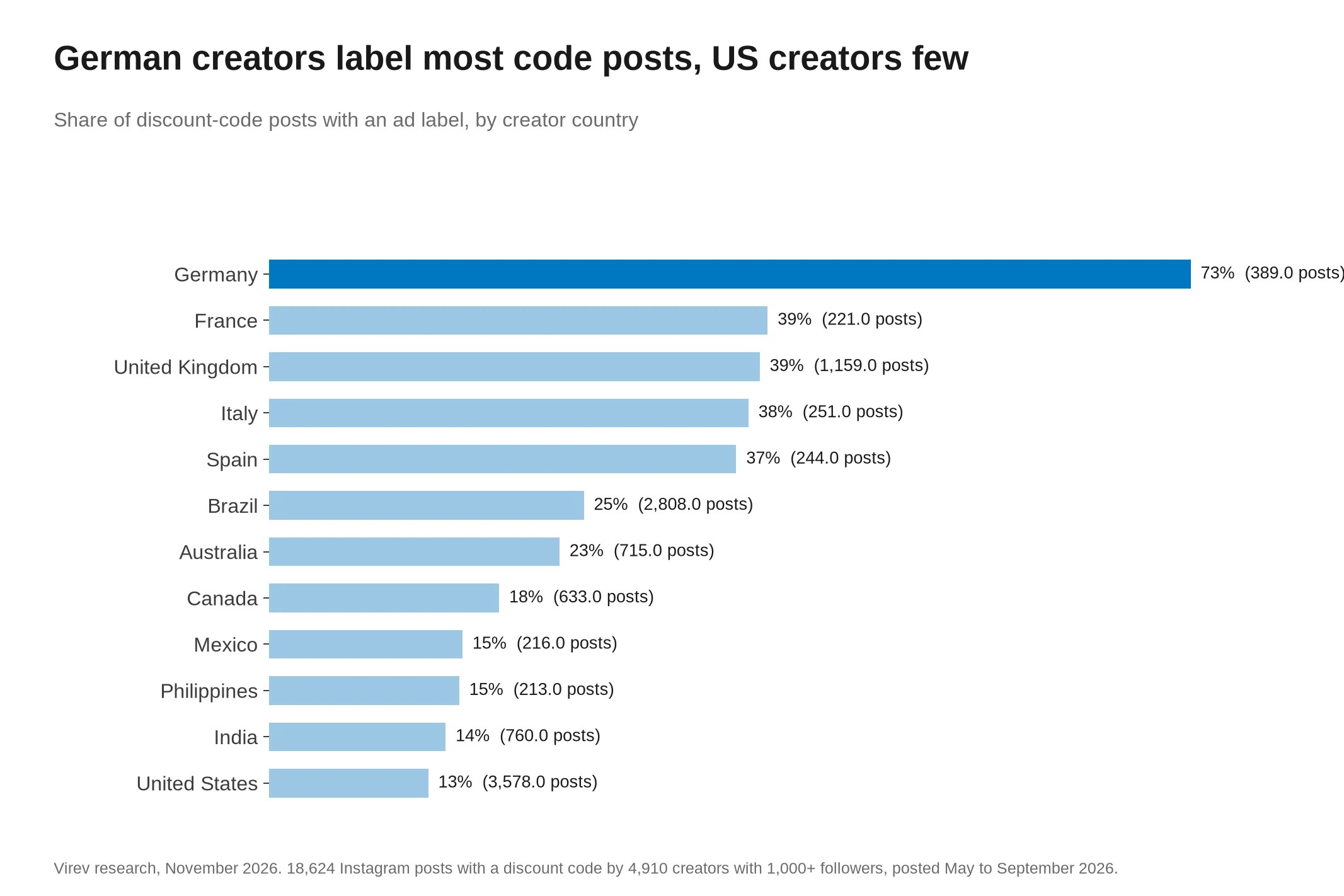
German creators labelled 72.8% of their code posts, almost all with a word in the caption: "Anzeige" or "Werbung" (69.9%), not Instagram's label (8.2%). Bertaglia and colleagues found the same habit in their study of German creators, where about 80% of disclosed posts used keywords, and they link it to strict enforcement in Germany. UK creators labelled 38.7%, and most of that was #ad or "AD |", the wording the ASA asks for.
US creators labelled 12.6% of their code posts. 78.5% of US code posts carried no label or sponsor word at all, and 9.0% carried only a weaker word such as "affiliate" or a brand-partner hashtag. The FTC lists a brand-partner tag as an option on space-limited platforms, and the ASA accepts neither. Brazil, the second-largest group, labelled 24.9%, mostly with publi or #publicidade.
The German row comes from 85 creators. Its five most active creators made 41% of its code posts, and without them the row still reads 72.9%. The US, Brazil and UK rows come from 266 to 1,037 creators each.
Labels by creator niche
Virev's creator profiles give a niche for every creator in the sample. Among niches with 200 or more code posts:
| Creator niche | Code posts | Creators | Any ad label | No ad label |
|---|---|---|---|---|
| Art and photography | 430 | 115 | 44.0% | 56.0% |
| Family and parenting | 1,755 | 368 | 36.2% | 63.8% |
| Travel | 1,117 | 321 | 32.9% | 67.1% |
| Pets and animals | 418 | 89 | 28.9% | 71.1% |
| Food | 1,415 | 511 | 27.6% | 72.4% |
| Fashion | 1,284 | 319 | 26.5% | 73.5% |
| Beauty | 1,460 | 357 | 25.8% | 74.2% |
| Lifestyle | 1,741 | 546 | 23.3% | 76.7% |
| Health and wellness | 456 | 143 | 22.8% | 77.2% |
| Comedy and entertainment | 962 | 389 | 20.6% | 79.4% |
| Education and books | 657 | 174 | 11.0% | 89.0% |
| Fitness and sports | 3,801 | 645 | 9.3% | 90.7% |
| Music and dance | 544 | 237 | 7.7% | 92.3% |
| Cars | 500 | 98 | 4.4% | 95.6% |
Fitness and sports creators shared the most codes, 3,801 posts from 645 creators, and labelled 9.3% of them. Many of these posts list a supplement or gym-wear brand with "code NAME" at the end of a workout caption. Car creators labelled 4.4%, often in long lists of part makers with a code for each. Parenting and travel creators labelled the most, at 36.2% and 32.9%. The 1,551 code posts whose niche fit no category labelled 12.3% and are not in the table.
Reels carry the label more often than photos
| Post type | Code posts | Paid-partnership label | Any ad label | No ad label |
|---|---|---|---|---|
| Reel | 13,998 | 13.2% | 24.3% | 75.7% |
| Carousel | 3,135 | 4.3% | 14.6% | 85.4% |
| Photo | 919 | 0.8% | 4.2% | 95.8% |
Reels made up 75% of code posts and were labelled most often. Single photos with a code carried an ad label 4.2% of the time.
Most creators who share codes never label them
69.7% of the 4,910 creators with a code post never labelled any of their code posts in the five months, and 14.5% labelled all of them. Among the 1,697 creators with three or more code posts, 55.7% never labelled one and 7.8% labelled every one. The rest label some code posts and not others. 317 of those 776 creators used the same code once with a label and once without.
An ad label does not cost a code post views
Some creators skip the label because they think Instagram shows labelled posts to fewer people. We compared each Reel with a code against the same creator's median Reel with no code and no label, posted in the same five months, for 29,527 creators with five or more such Reels.
| Reels | Reels | Creators | Median views, creator's usual Reel = 100 |
|---|---|---|---|
| Code Reel with an ad label | 3,042 | 1,269 | 85 |
| Code Reel with no ad label | 9,973 | 3,252 | 88 |
| Ad-labelled Reel with no code | 28,990 | 5,943 | 89 |
| Any Reel with the paid-partnership label | 15,647 | 3,781 | 91 |
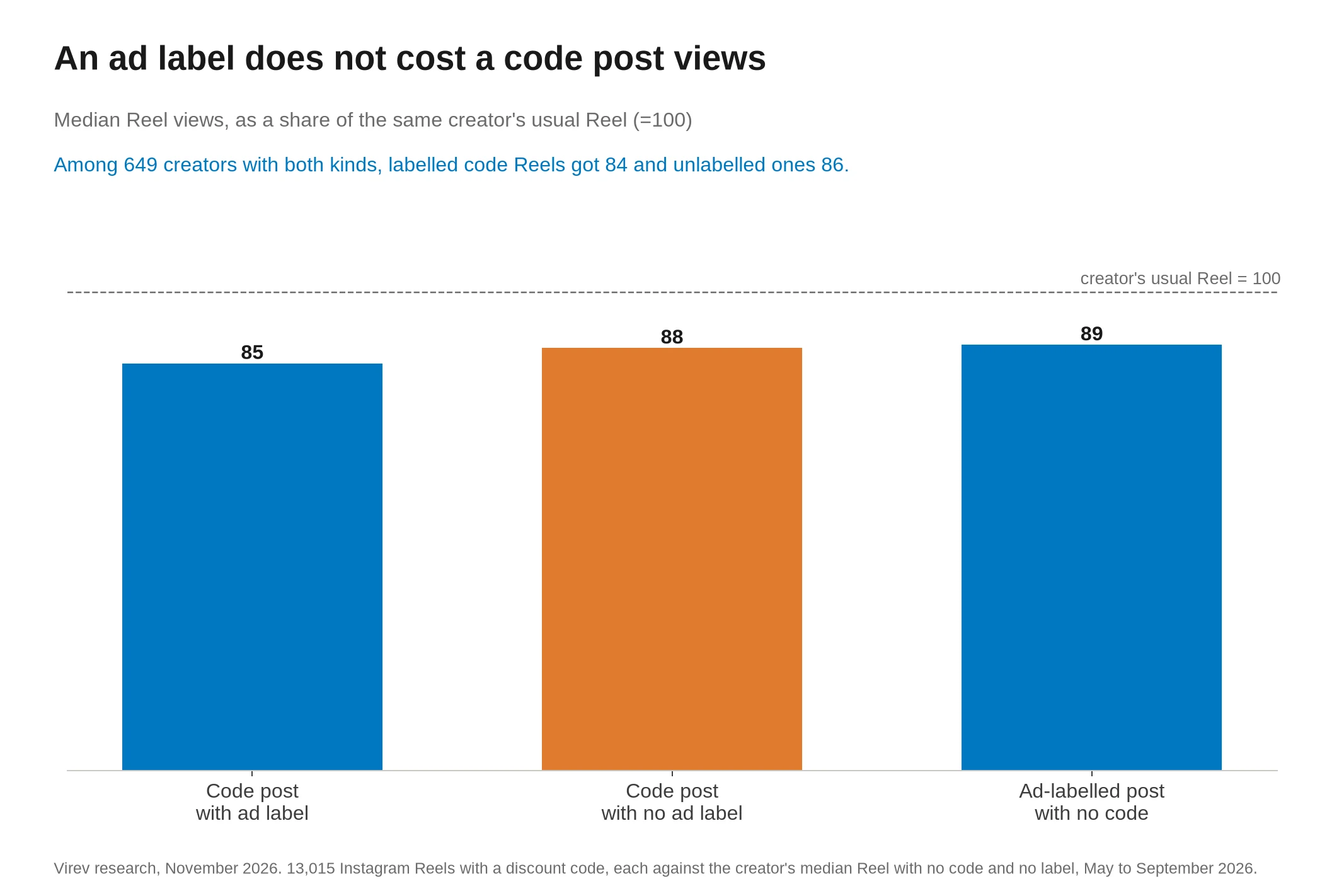
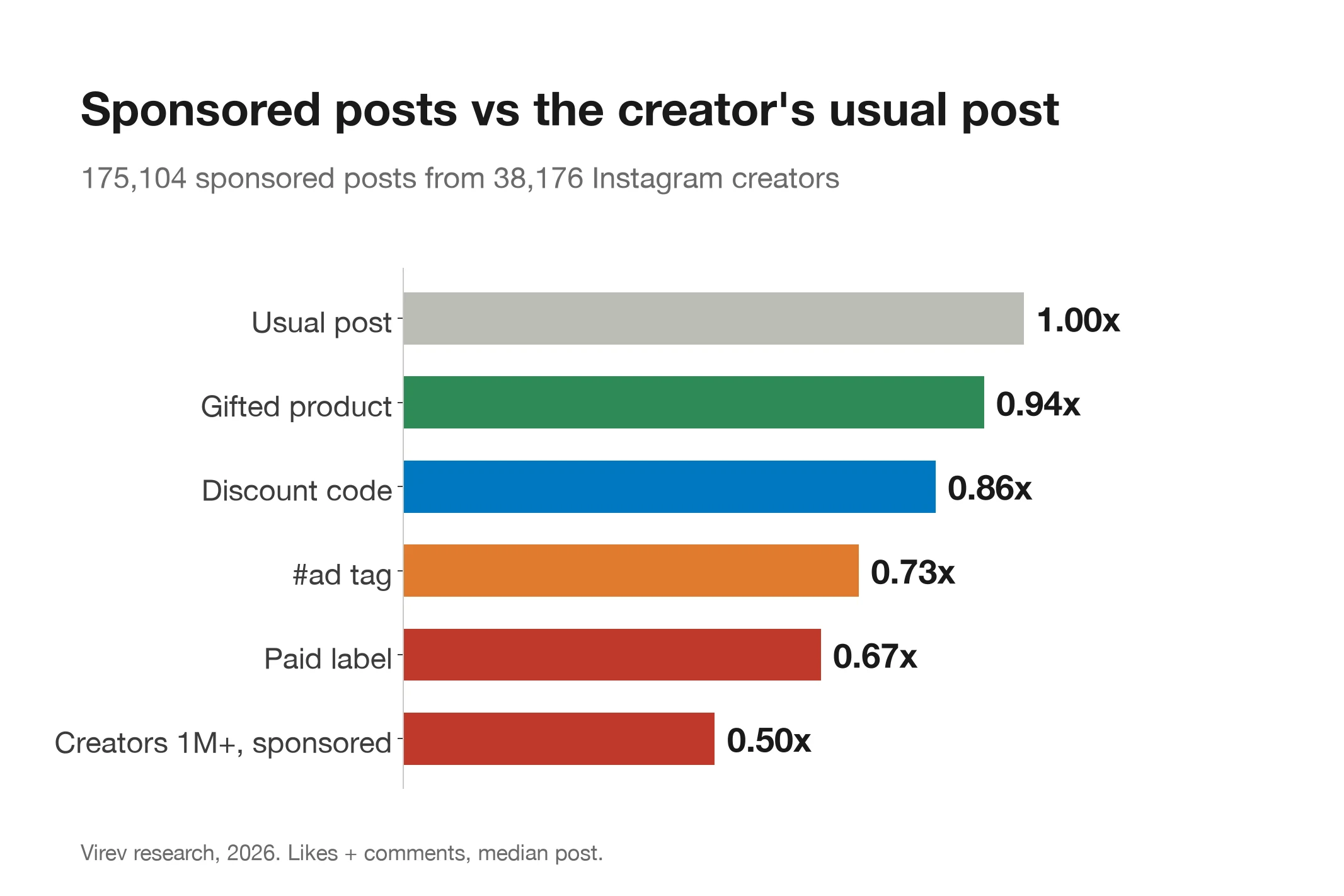
Code Reels get a little fewer views than a creator's usual Reel, with or without a label. A labelled code Reel got 85% of the usual views and an unlabelled one 88%. The gap is small and mixes creators who label with creators who do not. The cleaner test is the 649 creators who posted both kinds. Their labelled code Reels got 84% of their usual views and their unlabelled ones 86%, and the labelled Reel did better for 51.6% of them, close to a coin flip.
The IMTB and HypeAuditor study of UK creators in February 2026 found that posts with #ad had higher median likes and comments. Bertaglia and colleagues found that sponsored posts get less engagement, and that disclosing them did not lower it further. Our views test points the same way. The ad label is not why a code post gets fewer views. For engagement on sponsored posts, see our sponsored post engagement study.
What to do with this
For brands and agencies
- Ask for the label in writing, because 78.9% of code posts carry none and the ASA says brands and agencies must make sure their ads are clearly disclosed.
- Ask for Instagram's paid-partnership label and "Ad" in the first line, because the ASA accepts both and a code alone is not a label.
- Check a creator's last few code posts before you sign, because 55.7% of creators with three or more code posts never labelled one.
- Do not trade the label for reach, because labelled code Reels got about the same views as unlabelled ones from the same creators.
Find creators in Virev creator search, which covers 180M+ creators, and save them to a list so you can read their recent sponsored posts before you brief them. Sign up to search creators by niche, country and size.
For creators
- Label every post with a code, because a personal code is a commercial link even when the product was free.
- Use the paid-partnership label or "Ad" at the start of the caption, because #gifted, #affiliate and #partner alone do not meet the ASA rules.
- Do not worry that the label hides the post, because in our data a labelled code Reel got 84% of the creator's usual views and an unlabelled one 86%.
For what creators earn from deals like these, see how much influencers make.
How we measured, and what can be wrong
- The sample is 2,101,910 public Instagram feed posts and Reels published from May 1 to September 30, 2026 by 45,752 creators with 1,000+ followers, whose captions Virev's crawler read in October 2026.
- The creators are a random 30% of the Instagram accounts that Virev's creator profiles mark as individual creators, picked by a hash of the account id, so brands and media pages are not in it.
- Virev's creator profiles hold more US, Brazilian and Indian creators than other countries, and those three make 56% of the code posts with a known country, so the overall shares lean toward them.
- Stories are not in the sample, and the ASA found most influencer content in its monitoring was Stories (83%), so this study says nothing about Stories.
- A post counts as a code post when its caption has a code word (code, promo code, coupon, cupom, código, Rabattcode and others) followed by the code itself, such as "code ANNA15" or "cupom: MARIA10".
- In a hand check of 100 random code posts, 92 were a code for another brand, 7 were for the creator's own shop, course or event, and 1 was not a discount code.
- The ASA expects an own-brand post to be clear about it too, so the 7% own-shop posts stay in the count.
- In a hand check of 100 random posts that name a code word but that the rule skipped, 35 held a real code, often a lowercase name or a code in styled letters, so the rule misses about one code post in nine. 6 of those 35 had an ad label, about the same share as the posts it found.
- A post counts as labelled when it has Instagram's paid-partnership label or an ad word in the caption: #ad, Ad |, (ad), sponsored by, paid partnership, advertisement, Anzeige, Werbung, publi, publicidade, reklama, adv, collaboration commerciale, 광고, 협찬, PR and their common spellings.
- In the same 100 code posts, the ad-word rule missed a label on 4 posts (Collaboration commerciale, "/anzeige", a lowercase "ad" at the start of a line and "ad." after an emoji), and we fixed all four before the final count.
- A second reader checked 100 more unlabelled code posts with the final rules and found 1 missed label, an "Anzeige|" right after an emoji, and found no false label in 60 posts the rules marked with an ad word only. With the missed paid-partnership labels below, the true share with no ad label is about 1 to 2 points under 78.9%, and we read it as about 75% to 79%.
- We read the paid-partnership label from Instagram's own field at the October read. On 222 posts that our other crawl marked as paid partnerships, this field showed the label on 200, so the label share may be about one point low and the no-ad-label share up to one point high.
- A post with only #gifted, #affiliate, #partner, "in partnership with" or a brand-partner hashtag counts as having no ad label, because the ASA rules these terms are not enough, while the FTC lists a brand-partner hashtag as an option, so the 6.6% with only those words are reported in their own row.
- Followers are each creator's latest count, and niche and country come from Virev's creator profiles, which a language model writes from public profile text.
- A post with no label is not proof of a paid deal, so this study reports shares by group and names no creator.
- TikTok is not in this study, because our crawl does not store TikTok's own ad label.
- The views test uses Reels with a view count and the creator's median Reel with no code and no label. Views are the highest play count the crawler read for each Reel, at different post ages.
For how much less engagement sponsored posts get, see our sponsored post engagement study. For checking a creator before a deal, see how to check a creator's sponsorship history.
Download the data
All tables are in one CSV: influencer-ad-disclosure-2026.csv. Each row is one group in one table, such as a follower tier, a country, a niche or a post type, with the number of code posts and creators, the share with the paid-partnership label, with an ad word, with either, with neither, with only a weak word and with nothing at all. The views rows give the median views against the creator's usual Reel. Please cite "Virev, November 2026" and link this page.
Sources
- The majority of influencer advertising is undisclosed
- Influencer Ad Disclosure on Social Media: Instagram and TikTok
- Investigation of the Commission and consumer authorities finds that online influencers rarely disclose commercial content
- Influencer Self-Disclosure Practices on Instagram: A Multi-Country Longitudinal Study
- New data shows
- Disclosures 101 for Social Media Influencers