



Instagram posts that ask for a comment keyword, such as "Comment LINK and I'll send it to you", get 1.7 times the comment count of the same account's usual post, and no more views. Part of that count can be the account's own replies. We compared 17,522 keyword-ask posts from 3,828 Instagram accounts with 1,000+ followers against each account's own posts with no comment ask, posted from July 1 to October 23, 2026. The median keyword post got 1.71 times the account's usual comment count. Its reel views were 0.97 times the usual and its likes 0.94 times.
Tool vendors say the comments lift the post. Manychat's guide says "the public comment boosts your post in the algorithm", and Inro's guide says the public replies draw more comments and "it compounds reach". Neither page measures it. The numbers that rank for "comment to dm statistics" are DM open rates and single cases from tool customers, such as Reachook's 85 to 92% open rate for comment-triggered DMs and Inro's Kidnest post with 2,000 comments and 100 sales. This study compares each account with itself, across thousands of accounts, and checks views as well as comments.
1.71x
Comment count
0.97x
Reel views
2.0%
Accounts that use it
What counts as a comment-keyword ask
A keyword ask tells readers to comment one set word, phrase or emoji. Most of them promise something back, usually in a DM: "Comment GUIDE and I'll send you the free PDF", "Comenta QUERO que te envio o link", "댓글에 '정보' 남겨주시면 보내드릴게요". These are the posts that comment-to-DM tools such as Manychat, Inro and LinkDM answer. A few name no reward, such as "Comment YES if you agree".
A general ask invites comments with no set word: "Let me know in the comments", "Comment below", "Tell me in the comments". We count a general ask only when the caption names comments. We kept the two apart, because they are different tactics and they got different results.
We sorted every caption with a keyword rule in about 20 languages and checked the rule by hand on two seeded samples. In the second sample, read after the last big fix, 98 of the 100 captions the rule called keyword asks asked for a set word, and 89 of them promised something back. The method section has the miss rate.
Keyword posts get 1.7 times the comment count, and no more views
For each account, we took the median of its keyword-ask posts and the median of its posts with no comment ask, in the same format, and divided one by the other. Posts with a paid-partnership label, an ad tag, a giveaway or a Collab were left out of both sides. Every post was read at least 7 days after it went up.
| Metric | Accounts | Keyword-ask posts | Median ratio to the usual post | 95% range | Accounts above their usual |
|---|---|---|---|---|---|
| Comments | 3,828 | 17,522 | 1.71x | 1.63x to 1.80x | 66.3% |
| Likes | 4,038 | 16,404 | 0.94x | 0.92x to 0.96x | 44.8% |
| Reel views | 3,055 | 10,297 | 0.97x | 0.94x to 1.00x | 48.3% |
"95% range" is where the median ratio landed in 1,000 resamples of the accounts. "Accounts above their usual" counts the comparisons where the keyword posts' median beat the account's usual median.
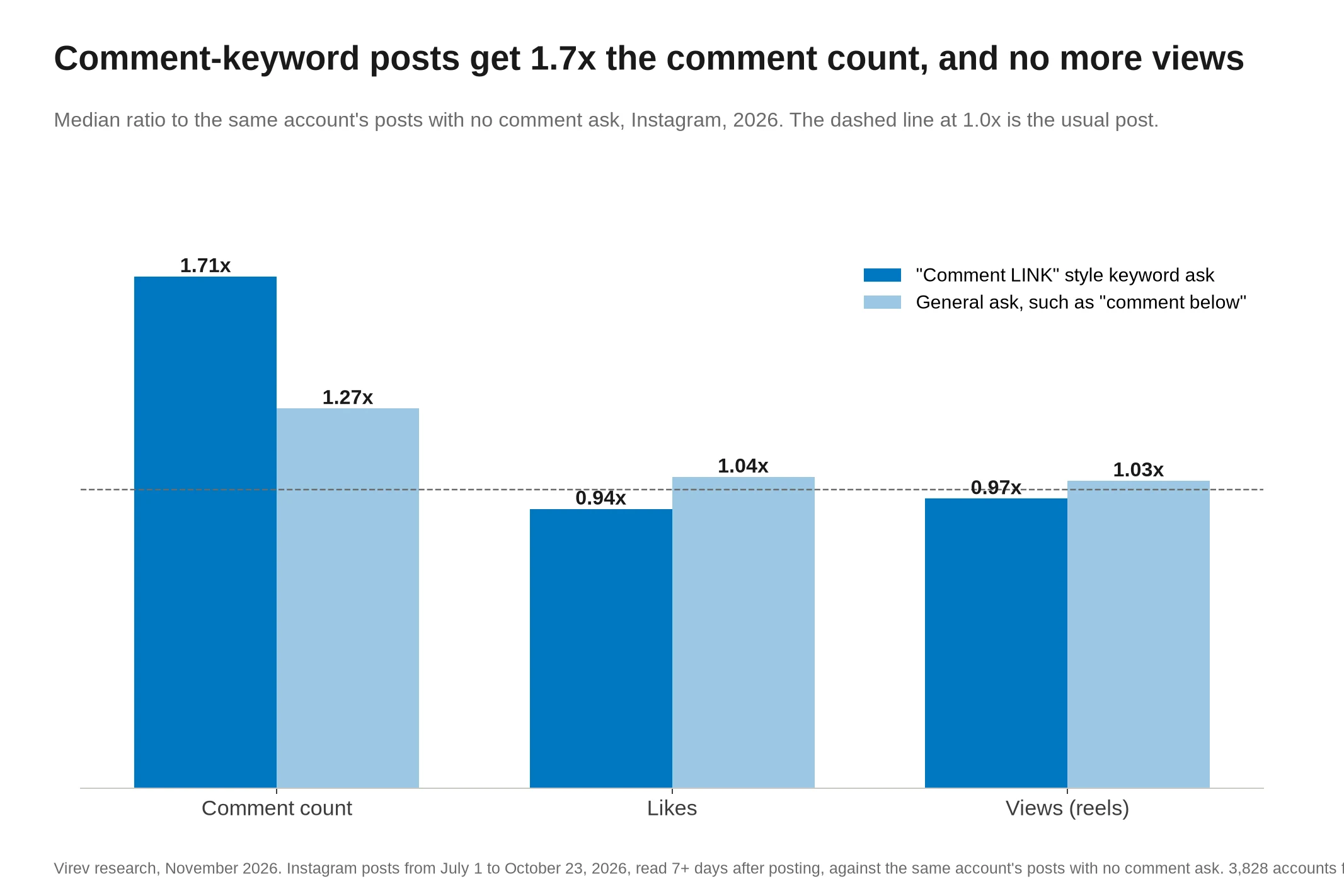
The median keyword post had 13 comments where the account's usual post had 6. Two in three keyword posts (66.8%) beat their account's usual comment count. Views did not move. About half of the reels landed above the account's usual views and half below, and the median ratio was 0.97. Likes fell a little, to 0.94 times the usual.
On reels, the comment rate per view rose too. Keyword reels got a median 7.2 comments per 1,000 views, against 2.8 on the same accounts' reels with no ask, and the median account's rate was 2.1 times its usual, across 2,151 accounts.
So the keyword ask raises the comment count and leaves the number of viewers where it was. A reel that asks for a comment keyword reaches about as many people as the account's other reels, and slightly fewer of them like it. The next section shows how much of the extra count can be the account's own replies.
Posts with a promise named in the caption, such as "and I'll DM you the link", got 1.96 times the usual comments. Posts with a set word and no stated promise got 1.56 times.
How much of the lift is the account's own replies
Meta's API reference says Instagram's comment count includes replies, and many comment-to-DM tools post a public reply under each comment, such as "Sent! Check your DMs". Those replies come from the account, not from the audience. Our data holds the comment count but not the comments themselves, so we cannot take the replies out.
That gives the comments from other people a range. If an account's tool answered every comment in public and the account replied to none on its usual posts, half of the count on its keyword posts would be its own replies, and the comments from other people would be about 0.86 times the usual. If it answered none, they would be 1.71 times the usual. On accounts with 1,000 to 10,000 followers, the median went from 3 comments to 5, so with one reply per comment the comments from other people would not rise at all. Accounts that set their tool to send the DM without a public reply sit at the top of that range.
Replying can still help a post. Buffer compared more than 700,000 Instagram posts across nearly 68,000 profiles and found about 21% higher engagement on posts where the creator replied to comments, against the same profile's other posts. Buffer says posts that already do well may draw more replies, so its data does not show which way it runs.
The views do not depend on that split. Whatever share of the comments were replies, the posts did not reach more people.
A general ask adds fewer comments, and does not cost likes
Posts that asked for comments with no set word, such as "Tell me in the comments", got 1.27 times the usual comments (95% range 1.24 to 1.33), 1.04 times the likes and 1.03 times the reel views, across 5,995 accounts. That is a smaller comment lift than the keyword ask, with no drop in likes.
On the 429 accounts that used both kinds in the same format, the keyword posts got 1.16 times the comments of their general-ask posts.
The comment lift grows with account size
The size tables add our sample of large accounts, so each tier holds more accounts than the overall table.
| Followers | Accounts | Comments, ratio | Usual comments | Keyword-post comments | Likes, ratio | Reel views, ratio |
|---|---|---|---|---|---|---|
| 1K to 10K | 1,632 | 1.33x | 3 | 5 | 0.95x | 1.00x |
| 10K to 100K | 1,456 | 2.00x | 7 | 16.5 | 0.95x | 0.97x |
| 100K to 1M | 7,345 | 2.50x | 20 | 59 | 0.91x | 0.93x |
| 1M+ | 832 | 2.35x | 64.5 | 182 | 0.82x | 0.91x |
"Usual comments" and "Keyword-post comments" are the medians across accounts. The ratio column is the median of each account's own ratio, so it is not the ratio of the two medians.
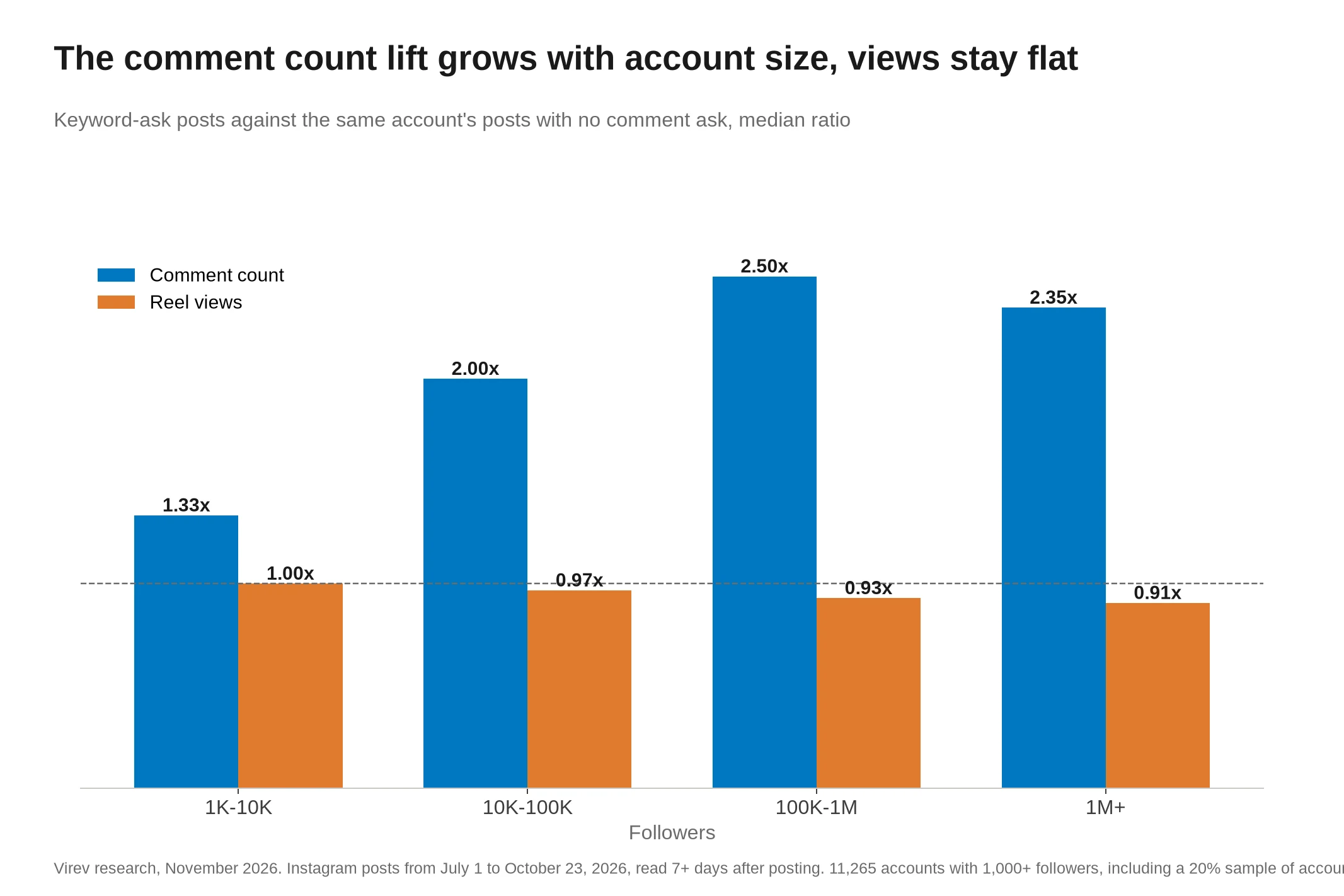
Accounts with 100,000 to 1 million followers got the largest comment lift, 2.5 times. Small accounts got the least, and an account with 1,000 to 10,000 followers went from a median 3 comments to 5. Views stayed flat at every size, and on accounts with 1 million+ followers the keyword posts got 0.91 times the usual reel views and 0.82 times the likes.
2% of accounts use comment keywords, and 10% of large ones
From July 1 to October 23, 2026, 2.0% of Instagram accounts with 1,000+ followers posted at least one keyword ask, and 0.79% of their posts carried one. The rule found a general comment ask on 2.8% of accounts and 0.47% of posts, but it finds only about 3 in 10 general asks, so both shares are a floor.
| Followers | Accounts | Used a keyword ask | Used one with a stated promise | Share of posts with a keyword ask | Used a general ask |
|---|---|---|---|---|---|
| 1K to 10K | 933,502 | 1.5% | 0.9% | 0.49% | 2.2% |
| 10K to 100K | 154,077 | 4.5% | 3.0% | 1.20% | 5.3% |
| 100K to 1M | 209,112 | 9.4% | 7.1% | 2.03% | 9.1% |
| 1M+ | 13,543 | 10.5% | 7.9% | 1.53% | 12.0% |
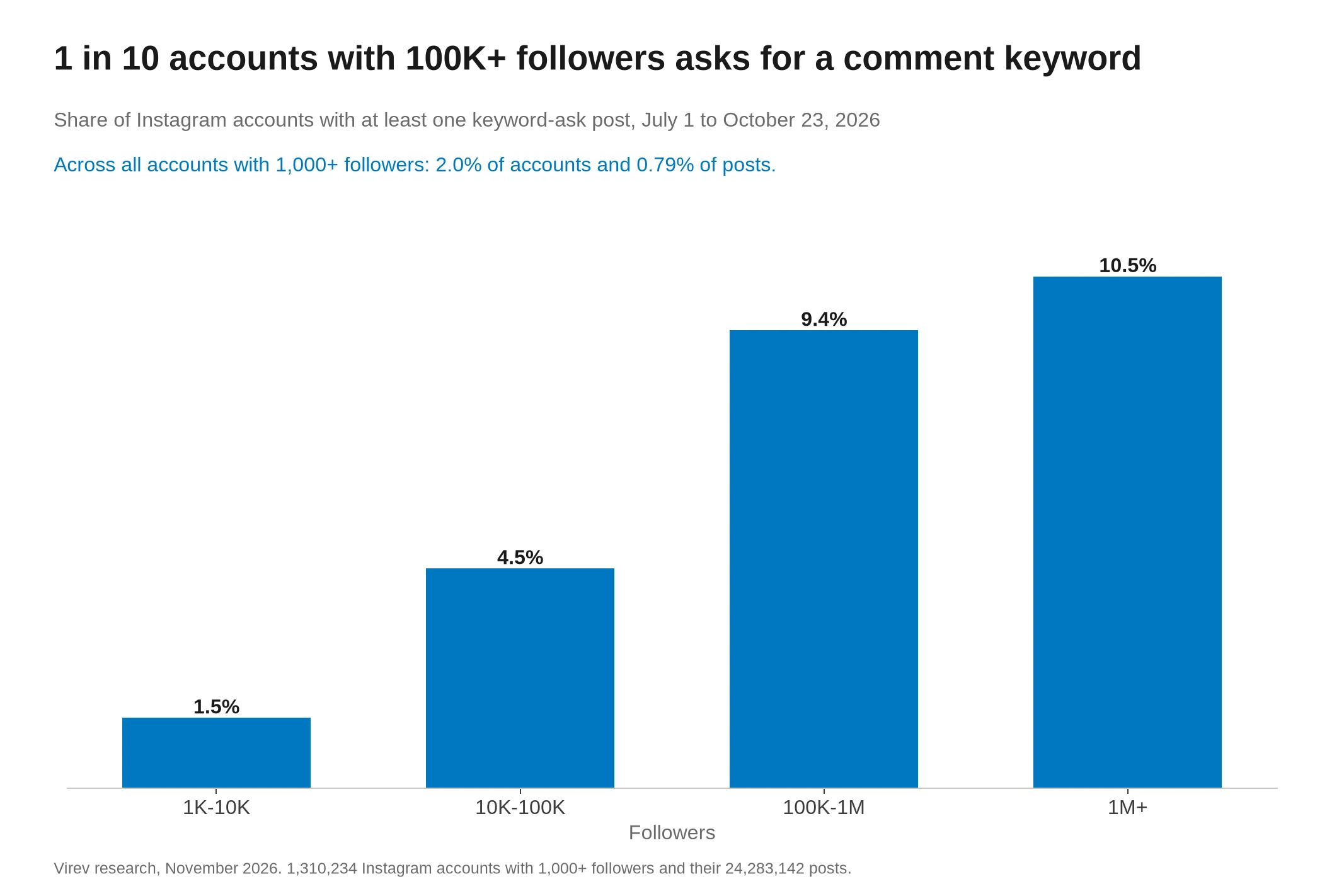
The ask is more common on reels: 1.04% of reels carried one, against 0.64% of photos and carousels. It is also spreading. Among 366,798 accounts that posted in both July and October, the share of posts with a keyword ask rose from 0.74% to 0.93%, by about a quarter in three months.
LINK and EU QUERO are the words people ask for most
We took the set word from each keyword ask in our 2% sample and counted the accounts that asked for it, because one account can post the same word hundreds of times. Of the 22,461 accounts that posted a keyword ask, these words were asked for by the most accounts:
| Word | Accounts | Share of accounts that used a keyword ask | What it asks for |
|---|---|---|---|
| EU QUERO | 1,292 | 5.8% | Portuguese for "I want", for an offer or a link |
| LINK | 1,275 | 5.7% | A product or shop link |
| QUERO | 552 | 2.5% | Portuguese for "I want" |
| INFO | 409 | 1.8% | Details or a price |
| YES | 281 | 1.3% | Agreement, mostly with no reward |
| SHOP | 245 | 1.1% | A shop link |
| GUIDE | 236 | 1.1% | A free guide |
| QUIERO | 231 | 1.0% | Spanish for "I want" |
| READY | 184 | 0.8% | A reply that the reader is ready |
| PROMPT | 173 | 0.8% | An AI prompt |
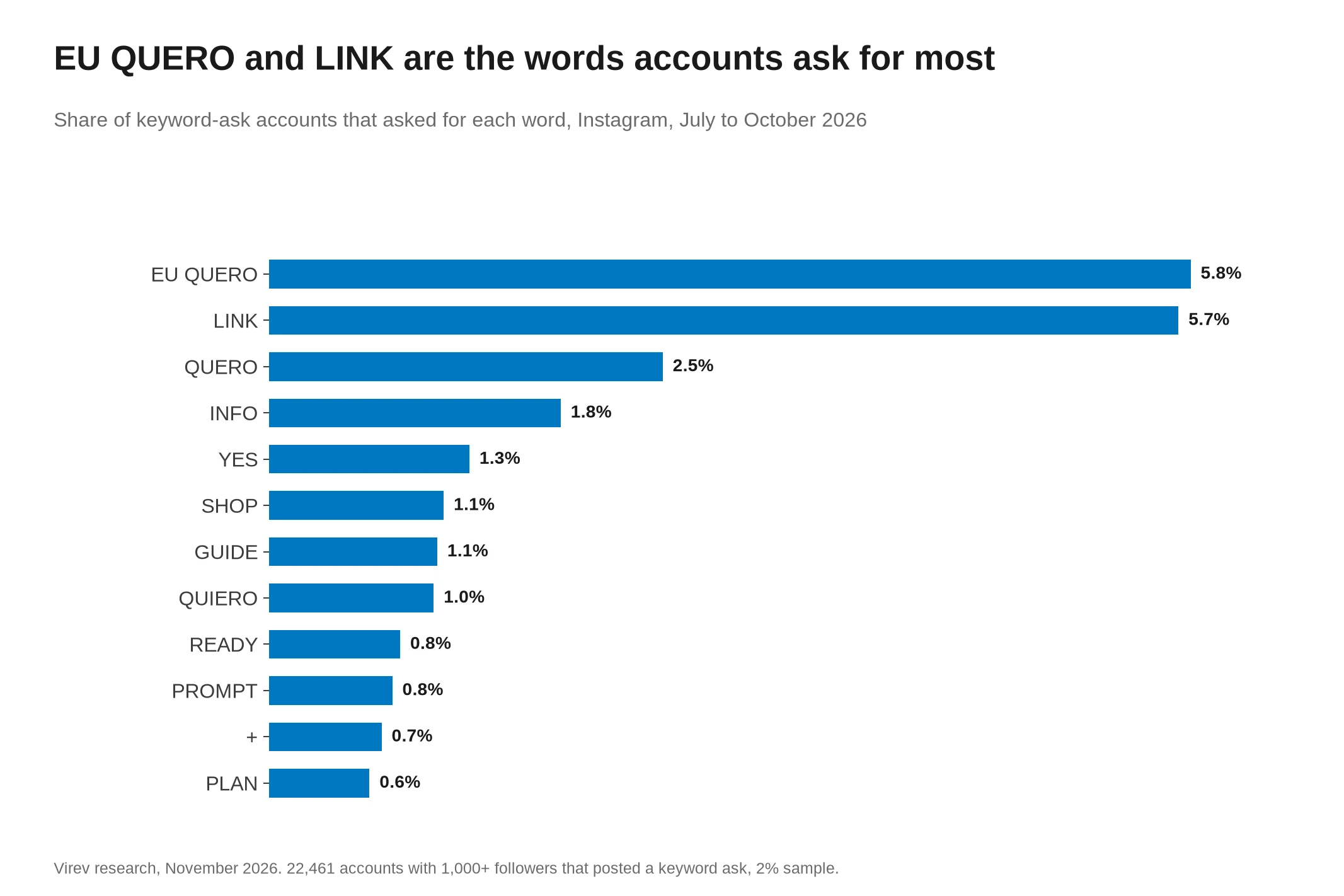
No word was asked for by more than 6% of the accounts, because most accounts pick a word that matches the post, such as the product or the topic. Portuguese "eu quero" ties with LINK, and Portuguese-language accounts use the ask often.
What to do with this
For creators
- Use a keyword ask when you want DMs, because it raised the comment count 1.7 times in our data, and up to 2.5 times on accounts with 100K to 1M followers, and each of those comments can start a DM.
- Do not use it to reach more people, because keyword reels got 0.97 times the views of the same accounts' other reels.
- Expect a few fewer likes, because the same posts got 0.94 times the usual likes.
- Use a general comment ask instead when likes matter more than DMs, because "tell me in the comments" posts got 1.27 times the comments and kept their likes.
For brands and agencies
- Read comment counts on keyword-ask posts with care, because the tool's own public replies can make up to half of the count.
- Judge a creator's reach by views, because a keyword ask raised the comment count without raising views.
- Count DMs and clicks from the ask as its result, because that is what it changes.
Virev reads each creator's posts, so you can see who runs comment-keyword asks and how their views compare with their comments before you pitch. Find creators in Virev creator search, which covers 180M+ creators, and sign up to save them to a list.
How we measured, and what can be wrong
- The main sample is a 2% sample of Instagram accounts with 1,000+ followers: every run of 2,000 consecutive account ids in each 100,000, which gave 1,108,454 accounts with 13,191,950 posts posted July 1 to October 23, 2026.
- The size tables add a 20% hash sample of accounts with 100,000+ followers, 201,780 accounts with 11,091,192 more posts, and the overall rows use the 2% sample only, because the extra sample holds ten times as many large accounts per account as the population.
- The follower count is the last one our crawler read on or before October 31, 2026, and likes, comments and views are the last read of each post on or before that time.
- A keyword ask asks readers to comment a set word, phrase or emoji, in quotes, in capitals, as "the word X", or as an emoji with a reason, and a stated promise is a word such as DM, send, link or inbox in the same caption.
- We wrote the rule for about 20 languages and checked it on two seeded samples of 240 and 200 captions, which a person read without seeing the rule's answer.
- In the second sample, 98 of 100 captions the rule called keyword asks asked for a set word, 89 of them promised something back, and all 52 that the rule said named a promise did.
- In the same sample, 45 of 50 captions the rule called general asks were general asks, and 6 of 50 captions that mention comments but that the rule called no ask were keyword asks it missed.
- In the same sample, 28 of the 50 captions that the rule called no ask were general asks it missed, so the rule finds about 3 in 10 general asks, and the general-ask shares in the adoption table are a floor.
- From that miss rate and the counts, the rule finds about three in four keyword asks among captions that mention comments, and it misses asks in languages it does not cover, so the adoption shares are a floor.
- The missed asks sit in the "no ask" side of the comparison, where they are about 0.2% of the posts, too few to move the usual medians. The missed general asks are about 1% of the no-ask posts.
- The comparison uses posts read 7+ days after posting with no paid label, ad tag, giveaway or Collab, and accounts with 5 or more such posts with no comment ask in the same format.
- Each ratio is (median of the account's keyword posts + 1) / (median of its usual posts + 1), and the tables give the median across accounts, so a few accounts with huge ratios do not pull it.
- Meta's API reference says Instagram's comment count includes replies, and comment-to-DM tools can add one public reply per comment, so the lift in comments from other people lies between about 0.86 and 1.71 times.
- This is a comparison inside each account, and an account may save the ask for posts it expects to do well, or for offers that draw comments on their own.
- Views cover reels only, because Instagram shows no view count on photos.
For engagement by account size, see our Instagram engagement rate benchmarks. For captions, see how long an Instagram caption should be, which compares caption lengths inside each account the same way.
Download the data
All tables are in one CSV: comment-to-dm-statistics-2026.csv. Each row is one group in one table: adoption by account size, format and month, the lift in comments, likes and views for each kind of ask overall and by size and format, comments per 1,000 views on reels, the most common words, and the hand checks of the rule. Please cite "Virev, November 2026" and link this page.
Sources
- IG Media reference
- The Ultimate Guide to Instagram Comment Automation
- Instagram Comment-to-DM Automation: How It Works 2026
- Instagram Auto DM Statistics 2026: Open Rates & Conversion Benchmarks
- Comment-to-DM Automation Case Studies
- Do Automated Instagram DMs Work?
- Replying to Comments Boosts Engagement by 5-42% on These Major Platforms