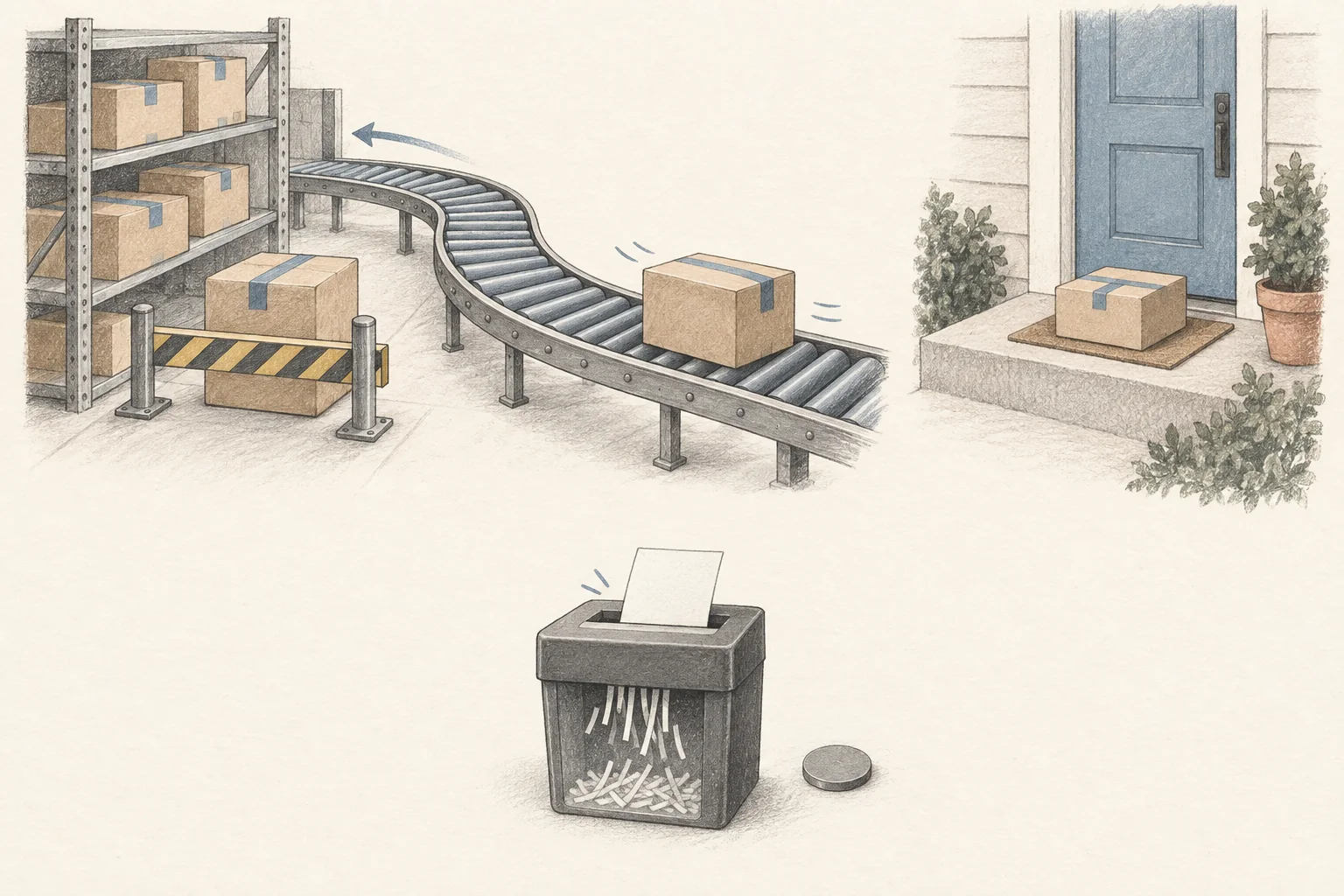





Pause new seeding shipments when a fault can repeat across the next batch, when unresolved cases exceed your team's recovery capacity, or when you cannot tell which packages are affected. Choose those triggers before the next dispatch. Hold the affected work, keep helping creators with packages already sent, and restart only after a named person checks evidence that the process has changed.
The thresholds below are hypothetical team choices. They are not industry benchmarks, carrier rules or proof that a particular error rate is acceptable. This checklist covers ordinary fulfillment errors such as wrong items, duplicate orders and unreconciled shipments. Product-specific handling, customs and regulatory incidents need their own qualified review.
Decide what the pause stops
A pause needs a boundary. "Stop seeding" can mean stopping invitations, order creation, packing or carrier handoff. Each leaves different work in motion.
Use the narrowest boundary you can verify:
- One order: hold a package with an unresolved item selection while unrelated orders continue.
- One affected group: stop orders using a faulty kit recipe, packing station or import file.
- The whole queue: stop new releases when you cannot reliably separate affected orders from unaffected ones.
Record the last released order and the first held order. Tell the warehouse which queued orders must stay put. Get confirmation that the hold reached the person who controls dispatch. A message to the marketing team alone does not establish that boundary.
Keep recovery work open. Staff still need to answer creators, investigate missing shipments and arrange approved remedies. Do not automatically send replacements through the same process that produced the original error.
Write triggers your team can explain
A useful model comes from software operations. Google's example error-budget policy defines when releases halt, what work may continue and how disagreements escalate. That is a policy-design analogy here. Its service targets and numerical limits do not establish shipping standards.
For each fulfillment trigger, write the event, the counting window, the owner and the action. Include a count as well as a percentage. On a small batch, one additional case can change a percentage sharply.
Hypothetical pause policy for one seeding team
| Signal | Team-selected trigger | Action |
|---|---|---|
| Wrong item or duplicate | At least 3 affected orders among the latest 40 packed orders | Hold the affected packing workflow |
| Recovery backlog | More than 8 open cases at the daily dispatch review | Stop new order releases until capacity recovers |
| Shared mapping fault | One confirmed fault that could affect other orders | Hold every order from that import |
| Unclear shipment records | Team cannot identify which queued orders already shipped | Hold the queue until records reconcile |
The numbers require local justification. A team choosing eight open cases should explain how many cases its available staff can resolve before the next dispatch. A costly replacement or a fault with wide reach may justify an earlier hold.
Do not average away a known shared failure. A single confirmed import error can warrant a pause even when the overall exception rate looks low.
Keep posting performance out of this decision. Low posting volume asks a different question from repeated packing errors. Modash's gifting challenges article separates shipment tracking and recipient follow-up from content tracking. Your pause log should preserve that separation.
Count affected orders consistently
Use one row per order, with a primary exception reason and any secondary reasons. Count an order once in the overall affected-order total, even if it has both a wrong item and a duplicate shipment.
Match each denominator to its event. Wrong-item checks belong to packed orders inspected. Delivery exceptions belong to dispatched orders that have reached the review point you defined. Orders awaiting packing cannot dilute a delivery-exception rate.
Keep unknown status visible. An order with missing shipment evidence is unresolved; it should not silently count as successful.
Hypothetical decision at the dispatch review
| Measure | Count or calculation |
|---|---|
| Latest packed orders reviewed | 40 |
| Orders with a wrong item | 2 |
| Separate orders sent twice | 1 |
| Total affected orders | 3 |
| Affected-order rate | 3 divided by 40 = 7.5% |
| Open recovery cases across earlier batches | 9 |
| Next batch waiting for release | 25 |
Under the hypothetical policy, both the packing trigger and backlog trigger fire. The manager holds the next batch. The 7.5% figure describes this review; it is not a universal stop line.
The packing lead then finds a kit-recipe mismatch and checks every order using that recipe. The recovery lead assigns the nine open cases. Finding a cause does not close those cases or authorize the waiting batch.
For the records needed to make this decision, use the guide to reconciling seeding records with warehouse shipments.
Run the pause without losing existing cases
Create a pause record with the following checklist:
- State the fault in observable terms, such as an item code mismatch.
- List affected order IDs, the suspected shared cause and what remains unknown.
- Name the person authorized to release held work.
- Assign each existing exception an owner, next action and next update time.
- Disable queued releases and follow-ups that assume delivery succeeded.
- Reserve staff time for recovery before promising another dispatch date.
- Set the next review time, even if the restart date remains unknown.
Carrier investigations have separate clocks. For USPS shipments, USPS says to check tracking first and permits Missing Mail search requests starting seven days after mailing. That timing does not require your team to keep releasing new orders while an internal fault persists. Nor does your internal pause change the carrier's search process.
Tell an affected creator what you know, what action you are taking and when you will update them. Avoid a replacement delivery promise you cannot support. If the gift had no posting obligation, do not add one during recovery. The guide to following up after delivery without demanding a post covers that conversation.
Restart against evidence
Choose the restart checks when you declare the pause. Otherwise, pressure to clear the queue can replace the original criteria.
For a packing mismatch, the release owner should require evidence that:
- The team identified all orders using the faulty recipe.
- Someone corrected the recipe and independently checked the item mapping.
- A trial run exercised the corrected step with the affected kit variants.
- Recovery cases have owners and the remaining workload fits available capacity.
- A limited restart batch has a named reviewer and a repeat-failure stop rule.
A packing fix can be checked before dispatch. A delivery-process change needs observation through the relevant delivery stage. Match the test to the failure instead of treating a label scan as proof that the entire process works.
Release a batch small enough to inspect before the next release. Record its outcome separately from the earlier failed batch. A clean trial reduces uncertainty; it does not prove that errors cannot recur. Use the warehouse-capacity batch-size guide to set the restart volume against available labor.
Before the next dispatch, ask the fulfillment lead and program owner to sign off on one pause trigger and its matching restart evidence. Put both beside the release queue, where the person sending packages will see them.