



51.5% of individual Instagram creators with 1,000 or more followers are women, in Virev's 2026 data. Virev's AI profile names a gender for 153,269 of the 163,774 individual creators with 1,000+ followers it has profiled, 78,966 women and 74,303 men, and leaves 6.4% with no gender. In a blind hand check of 300 of these profiles, the reader and the model named a gender on 228 and disagreed on 2. The share stays near half in every follower tier, and it swings widely by niche, from 89.7% women in beauty to 20.2% in cars.
Women also get more brand deals. Of the 154,424 creators in this set who posted on Instagram from May to October 2026, 10.9% of the women and 3.9% of the men posted at least once with Instagram's Paid partnership label. The women's rate is higher in each follower tier, in each niche we could test and in each group of creators with the same number of posts read, though for the few creators with 1M+ followers the gap is within the margin of error.
The pages that rank for this question quote surveys. Influencer Marketing Hub and Meltwater say 84% of influencers are women, from Klear's 2020 rate report, and Quartz reports Klear's survey of about 2,500 influencers. Fohr cites Collabstr's 2023 report that 77% of creators who sell content on its marketplace are women, and Fast Company reports Collabstr's 2025 count of 72% women, from more than 15,000 collaborations on its marketplace in 2024. Influencity counts 60.2% women among the 7.0 million US Instagram profiles its database classifies, with brands and media in the same pool and no error rate. This study counts individual creators only, in many countries, checks the label by hand, and adds what none of them counts, how often each gender posts a labelled brand deal.
51.5%
Women
2.8x
Paid partnerships
81.7%
Paid posts by women
51.5% of influencers with 1,000+ followers are women
| Gender on the profile | Creators | Share of all | Share of named |
|---|---|---|---|
| Women | 78,966 | 48.2% | 51.5% |
| Men | 74,303 | 45.4% | 48.5% |
| No named gender | 10,505 | 6.4% | |
| All | 163,774 | 100% |
The count covers every account that Virev's AI profile marks as an individual creator, with an Instagram account of 1,000 or more followers at our latest read. It leaves out brands, businesses, media pages and fan pages, which the same profile marks with another account type. "No named gender" holds profiles the model marked unknown, mixed, such as a couple's account, or did not answer. With 153,269 named profiles the share of women has a 95% interval of 51.3% to 51.8%.
So the share is close to half, far from the 84% that pages repeat as the share of influencers who are women. Influencer Marketing Hub describes Klear's 84% as the share of sponsored Instagram posts made by women, and in our data women made 81.7% of the labelled paid posts, so that figure fits who posts the ads, not who the influencers are. The 77% and 72% figures count creators who sell their services on Collabstr's marketplace. Influencity's 60.2% counts every US profile in its database, with no tier or account type removed.
The share of women by follower tier
| Followers | Creators | Women, of named | No named gender |
|---|---|---|---|
| 1K to 10K | 80,256 | 50.0% | 8.5% |
| 10K to 100K | 57,718 | 53.7% | 5.0% |
| 100K to 1M | 23,664 | 51.7% | 3.3% |
| 1M+ | 2,136 | 48.2% | 2.0% |
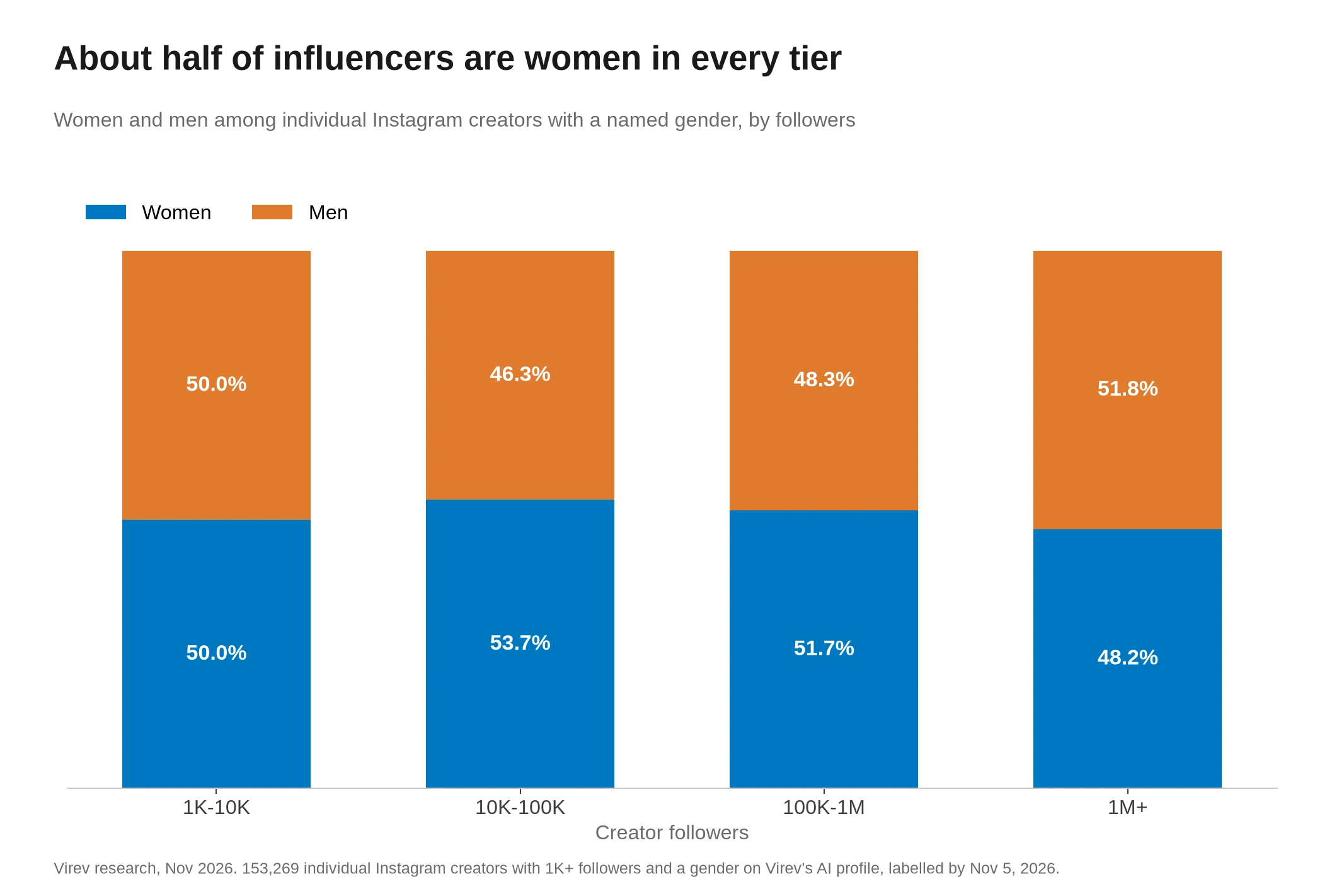
Women are 50.0% of the creators with 1K to 10K followers and 48.2% of those with 1M+. The tiers differ by 5.4 points at most, so the gender mix barely changes with size in this set. Influencity reports a female share that falls from 60.7% for nano profiles to 50.1% for mega profiles in the US.
The set is not a random sample of Instagram. 49.0% of these creators have 1K to 10K followers, against 77.1% of the Instagram accounts with 1,000+ followers in Virev's count of influencers, and 14.4% have 100K to 1M, against 3.3%. Because the share of women is about the same in each tier, weighting the tiers to the full count gives 50.7%, against 51.5% unweighted.
The share of women by niche
| Niche | Creators | Women, of named | No named gender |
|---|---|---|---|
| Beauty | 12,633 | 89.7% | 5.5% |
| Parenting & Family | 4,134 | 88.2% | 5.3% |
| Fashion | 8,058 | 81.4% | 2.1% |
| Books & Writing | 3,237 | 78.5% | 5.8% |
| Health & Wellness | 3,310 | 70.8% | 1.2% |
| Travel | 5,767 | 69.1% | 10.3% |
| Lifestyle | 15,946 | 67.7% | 2.6% |
| Food & Drink | 7,429 | 65.6% | 6.8% |
| Home & DIY | 2,279 | 62.8% | 4.7% |
| Dance | 3,717 | 61.4% | 2.8% |
| Pets & Animals | 1,315 | 59.9% | 38.6% |
| Fitness | 4,944 | 52.5% | 0.7% |
| Causes & Sustainability | 3,756 | 51.9% | 4.9% |
| Education & Science | 1,526 | 48.3% | 2.9% |
| Money & Business | 2,810 | 45.9% | 0.9% |
| Entertainment & Pop Culture | 12,045 | 44.3% | 8.3% |
| Art, Design & Photo | 16,406 | 36.7% | 13.6% |
| Faith & Spirituality | 2,186 | 35.1% | 4.4% |
| News & Society | 6,348 | 33.6% | 2.2% |
| Outdoors & Nature | 1,445 | 29.9% | 5.5% |
| Comedy | 5,628 | 28.1% | 4.1% |
| Music | 17,607 | 27.5% | 6.4% |
| Sports | 13,560 | 25.0% | 3.8% |
| Cars & Vehicles | 4,188 | 20.2% | 19.7% |
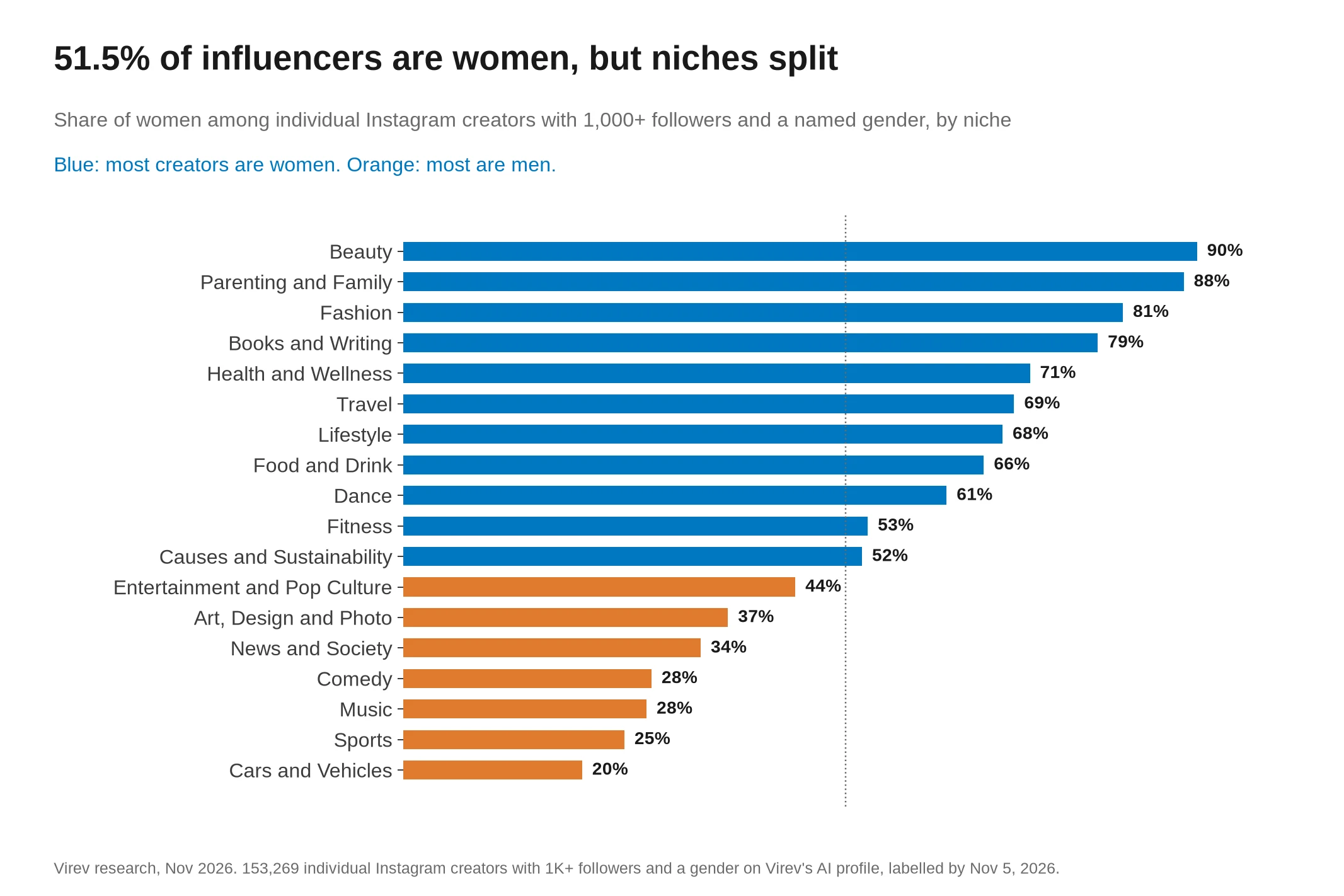
The niche is the first creator category on the profile, rolled up to one of Virev's 27 top-level creator categories. Beauty, parenting, fashion and books lean most to women, and cars, sports, music, comedy and outdoors lean most to men. Our list of car influencers shows what car and motorcycle creators get per post and per Reel at each follower count. Our list of dance influencers does the same for 2,225 dance creators, 61.0% of them women among those with a named gender. Fitness, causes, education and money sit near half. Music is the largest niche in this set and sports the fourth, and both lean to men, which is one reason the overall share is lower than in surveys of creators who sell sponsored posts.
The share of women by country
| Country | Creators | Women, of named | No named gender |
|---|---|---|---|
| South Korea | 1,600 | 79.9% | 14.2% |
| Japan | 1,878 | 79.6% | 11.7% |
| Poland | 1,324 | 65.9% | 4.2% |
| Philippines | 1,210 | 63.7% | 6.9% |
| Canada | 3,484 | 63.5% | 7.0% |
| Australia | 3,388 | 59.8% | 9.5% |
| United Kingdom | 6,127 | 58.5% | 6.2% |
| Russia | 1,030 | 55.3% | 3.1% |
| Turkey | 1,689 | 54.6% | 4.0% |
| Indonesia | 3,486 | 52.6% | 6.1% |
| United States | 28,123 | 51.8% | 6.5% |
| Germany | 2,282 | 49.7% | 6.4% |
| Colombia | 1,094 | 47.9% | 3.0% |
| Spain | 1,757 | 47.7% | 3.6% |
| France | 2,097 | 47.2% | 5.6% |
| Italy | 1,896 | 45.7% | 2.6% |
| Brazil | 16,761 | 45.0% | 2.9% |
| Argentina | 1,880 | 44.6% | 3.7% |
| India | 18,655 | 44.3% | 4.1% |
| Mexico | 2,518 | 42.2% | 6.8% |
| Iran | 1,268 | 42.1% | 4.6% |
The country is the one the AI profile reads from the bio and captions, and 76.2% of these creators have one. We merged plain aliases such as USA, UK and Türkiye into one name, folded regions such as Scotland or Hawaii into their country, and left out answers that name two countries. Countries with 1,000+ creators are in the table. Japan and South Korea lean most to women, at 79.6% and 79.9%, and the lowest shares are in Iran, Mexico, India, Argentina and Brazil. The US is close to half, at 51.8% of 28,123 creators.
Women are 2.8 times as likely to post a paid partnership
Instagram puts a "Paid partnership with" label above a post when the creator tags the brand that paid for it. We counted the posts each creator published from May 1 to October 31, 2026 that our crawler had read, and marked the creators with at least one labelled post.
| Followers | Women with 1+ post | Women with a paid partnership | Men with 1+ post | Men with a paid partnership | Women to men |
|---|---|---|---|---|---|
| 1K to 10K | 32,965 | 5.6% | 32,561 | 1.3% | 4.4 |
| 10K to 100K | 29,215 | 13.9% | 25,158 | 4.5% | 3.1 |
| 100K to 1M | 11,772 | 18.2% | 10,984 | 9.7% | 1.9 |
| 1M+ | 1,007 | 14.5% | 1,080 | 10.6% | 1.4 |
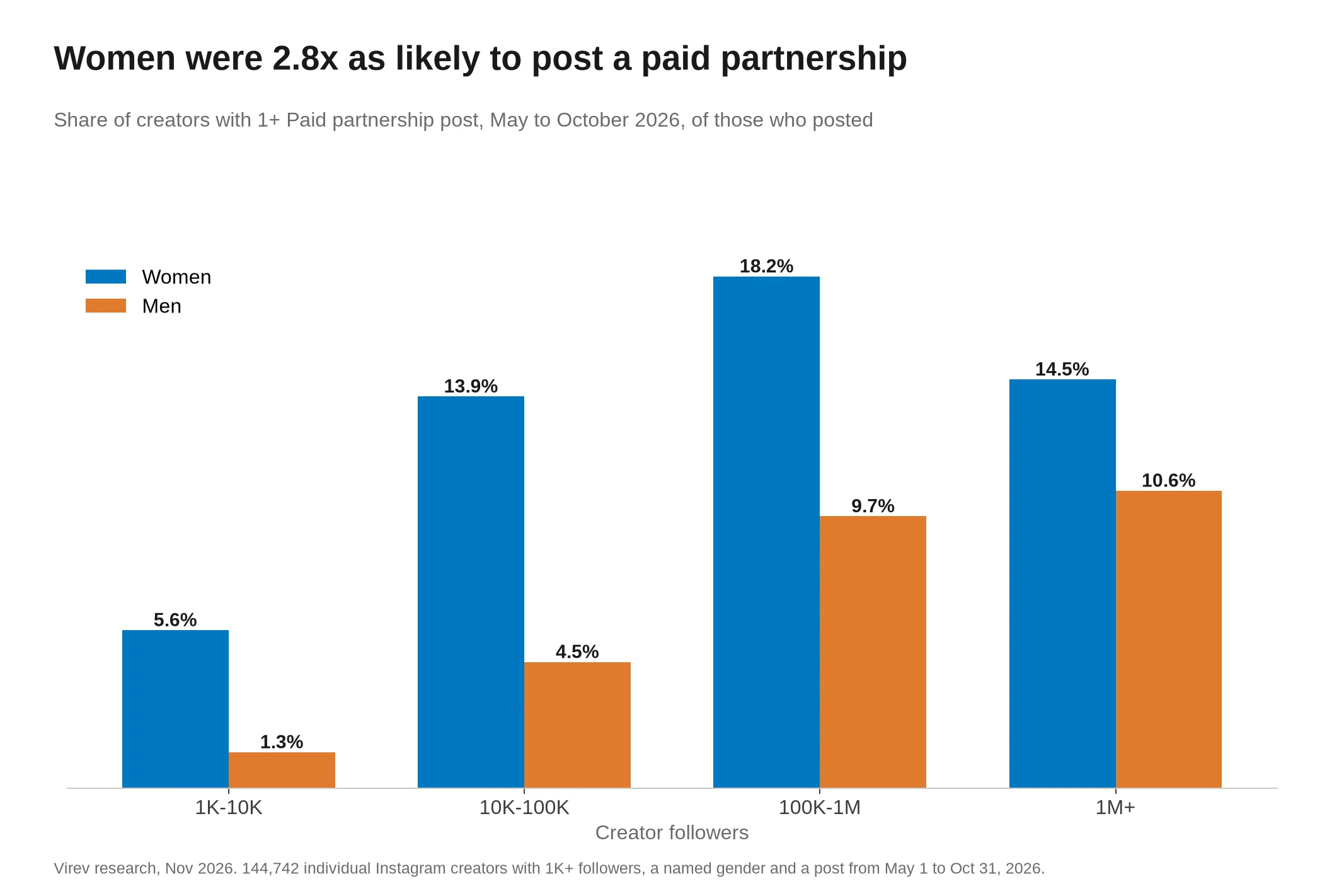
10.9% of the women and 3.9% of the men posted at least one paid partnership in the six months. The women's rate was higher in every tier, 4.4 times the men's at 1K to 10K followers and 1.9 times at 100K to 1M. At 1M+ followers the rates are 14.5% and 10.6%, and the two 95% intervals overlap, so that gap is within the margin of error. Weighted to the same tier mix, the rates are 10.7% for women and 3.9% for men.
Counted by post, 1.60% of the women's posts and 0.43% of the men's posts carried the label, 3.7 times as many. Across both, 1.07% of posts carried it, close to the 0.87% in our sponsored post study.
Our crawler read more posts for women than for men, a median of 16 against 13, and a creator with more posts read has more chances to show a label. The women's rate is still higher when we compare creators with the same number of posts read. Split by both follower tier and posts read, it is higher in 15 of 16 groups, and the exception is creators with 1M+ followers and 10 to 29 posts read (9.2% of 446 women against 9.9% of 496 men).
| Posts read in May to October | Women with 1+ post | Women with a paid partnership | Men with 1+ post | Men with a paid partnership | Women to men |
|---|---|---|---|---|---|
| 1 to 9 posts | 22,347 | 1.6% | 28,272 | 0.8% | 2.1 |
| 10 to 29 posts | 31,210 | 8.1% | 24,452 | 4.1% | 2.0 |
| 30 to 59 posts | 11,835 | 21.3% | 9,248 | 7.4% | 2.9 |
| 60+ posts | 9,567 | 29.3% | 7,811 | 10.5% | 2.8 |
By niche
| Niche | Women with 1+ post | Women with a paid partnership | Men with 1+ post | Men with a paid partnership | Women to men |
|---|---|---|---|---|---|
| News & Society | 2,021 | 1.6% | 3,985 | 0.5% | 3.2 |
| Faith & Spirituality | 698 | 2.1% | 1,282 | 0.7% | 3.1 |
| Outdoors & Nature | 379 | 11.6% | 904 | 4.2% | 2.8 |
| Health & Wellness | 2,198 | 12.0% | 895 | 4.6% | 2.6 |
| Money & Business | 1,215 | 8.8% | 1,414 | 3.4% | 2.6 |
| Lifestyle | 9,864 | 10.6% | 4,560 | 4.3% | 2.4 |
| Causes & Sustainability | 1,734 | 4.4% | 1,641 | 1.9% | 2.4 |
| Cars & Vehicles | 652 | 7.7% | 2,529 | 3.4% | 2.3 |
| Travel | 3,436 | 18.6% | 1,507 | 8.4% | 2.2 |
| Parenting & Family | 3,338 | 24.5% | 433 | 12.0% | 2.0 |
| Beauty | 10,340 | 16.6% | 1,173 | 8.3% | 2.0 |
| Dance | 2,063 | 2.7% | 1,324 | 1.4% | 1.9 |
| Fitness | 2,456 | 9.3% | 2,200 | 5.0% | 1.8 |
| Home & DIY | 1,280 | 20.5% | 767 | 11.2% | 1.8 |
| Sports | 3,106 | 6.1% | 9,169 | 3.3% | 1.8 |
| Education & Science | 676 | 7.2% | 724 | 4.0% | 1.8 |
| Entertainment & Pop Culture | 4,642 | 5.3% | 5,840 | 3.4% | 1.6 |
| Music | 4,275 | 1.8% | 11,141 | 1.2% | 1.5 |
| Food & Drink | 4,384 | 22.0% | 2,285 | 14.9% | 1.5 |
| Art, Design & Photo | 4,689 | 2.7% | 8,232 | 1.9% | 1.5 |
| Books & Writing | 2,267 | 3.7% | 622 | 2.7% | 1.4 |
| Comedy | 1,465 | 7.4% | 3,756 | 6.2% | 1.2 |
| Fashion | 6,182 | 11.7% | 1,395 | 10.2% | 1.2 |
The table shows niches with 300+ women and 300+ men with a post. Part of the overall gap is that women work more in beauty, fashion, food and travel, where paid posts are common, and men more in music, art and news, where they are rare. Within each niche the women's rate was still higher, though in Fashion, Books & Writing, Dance, Comedy, Faith & Spirituality and Education & Science the gap is within the margin of error. The gap is small in fashion (11.7% against 10.2%) and comedy (7.4% against 6.2%), and large in health and wellness (12.0% against 4.6%) and lifestyle (10.6% against 4.3%).
By country
| Country | Women with 1+ post | Women with a paid partnership | Men with 1+ post | Men with a paid partnership | Women to men |
|---|---|---|---|---|---|
| Indonesia | 1,651 | 4.1% | 1,492 | 1.3% | 3.2 |
| United States | 12,892 | 12.4% | 11,938 | 3.9% | 3.1 |
| Nigeria | 319 | 4.1% | 307 | 1.3% | 3.1 |
| Brazil | 6,983 | 5.2% | 8,539 | 1.7% | 3.0 |
| India | 7,587 | 9.3% | 9,303 | 3.3% | 2.8 |
| Japan | 1,286 | 26.4% | 310 | 9.7% | 2.7 |
| Spain | 769 | 12.7% | 835 | 4.8% | 2.7 |
| France | 881 | 15.2% | 975 | 5.7% | 2.6 |
| Italy | 800 | 13.6% | 940 | 5.4% | 2.5 |
| Colombia | 493 | 4.7% | 532 | 1.9% | 2.5 |
| Australia | 1,735 | 19.6% | 1,158 | 8.3% | 2.4 |
| Turkey | 850 | 6.5% | 685 | 2.8% | 2.3 |
| Canada | 1,970 | 20.3% | 1,106 | 9.5% | 2.1 |
| Philippines | 696 | 14.5% | 390 | 7.2% | 2.0 |
| United Kingdom | 3,191 | 15.1% | 2,264 | 7.6% | 2.0 |
| Germany | 1,018 | 10.1% | 1,009 | 5.5% | 1.9 |
| Egypt | 393 | 2.3% | 313 | 1.3% | 1.8 |
| Mexico | 941 | 3.6% | 1,285 | 2.3% | 1.6 |
| Argentina | 766 | 3.5% | 949 | 2.4% | 1.5 |
| Iran | 491 | 0.2% | 656 | 0.2% | 1.3 |
| Poland | 809 | 14.3% | 412 | 10.9% | 1.3 |
| Chile | 407 | 4.4% | 453 | 3.8% | 1.2 |
| Russia | 521 | 0.0% | 436 | 0.0% |
The table shows countries with 300+ women and 300+ men with a post. In Iran and Russia almost no creator of either gender used the label, under 0.5% of each. In each of the other 21, the women's rate was higher, and in Mexico, Poland, Argentina, Colombia, Chile, Egypt and Nigeria the gap is within the margin of error.
What this says about the influencer pay gap
Women posted 81.7% of the paid partnership posts by creators with a named gender, while they posted 54.8% of all posts. 75.1% of the creators with at least one paid partnership were women. So the 84% that pages quote as the share of sponsored posts by women is close to this count. It describes who posts the ads, and it is not the share of influencers who are women.
The pay gap figures on those pages are prices per post. Klear's survey found women charged $351 per post against $459 for men, IZEA's figures for 2021 were $2,289 against $2,978, and Collabstr's 2025 report found $208 against $291 per collaboration, and $160 against $234 for gaming creators. This study does not see prices. It sees that women in this set ran more labelled brand deals than men with the same follower count, in the same niche. If men charge more per post, they do it on fewer deals.
What to do with this
For brands and agencies
- Expect a creator search for 1,000+ followers to return about as many men as women, because 51.5% of the individual creators in this set are women and every tier sits near half.
- Look past beauty, fashion and parenting when you need male creators, because women are 89.7% of beauty creators and 88.2% of parenting creators.
- Expect male creators to have fewer past brand deals to show, because only 3.9% of the men posted a paid partnership in six months, against 10.9% of the women.
- Expect most creators to have no labelled deal on their profile, because 92.6% of the creators who posted in the six months had none.
Virev creator profiles show each creator's gender, niche, country and past brand posts. Find creators in Virev creator search, which covers 180M+ creators, and filter by gender and follower count. Sign up to search creators by niche, size and gender.
For creators
- Use the Paid partnership label on brand deals, because brands can see it and 10.9% of women and 3.9% of men in this set used it at least once in six months.
- If you are a man in a niche where women lead, such as beauty or parenting, you compete with fewer creators of your gender, because men are fewer than one in five there.
How we measured, and what can be wrong
- The set is every profile in Virev's AI profile table labelled by November 5, 2026, 513,010 profiles, of which 303,694 are marked as individual creators and 163,774 have an Instagram account with 1,000+ followers.
- Virev's crawler profiles creators it has crawled, creators on the collab rosters of brands it watches, and creators who land in a campaign, so the set leans toward creators near brands and is not a random sample of Instagram.
- Most profiles in the set were labelled in August and September 2026, and from October 18, 2026 the queue ran mostly creators added to a campaign.
- One model call reads a rendered snapshot of the profile, with the profile picture and the post grid, plus the username, the follower count and up to 12 recent captions, and fills a gender field of male, female or unknown with no further instruction.
- A profile with no saved image gets the same call from its name, bio, category and captions only.
- A later run that returns no gender keeps the earlier one.
- In a blind hand check of 300 random creators from the set (seed 20261109), a reader saw only the name, bio and Instagram category, and named a gender where those made it clear.
- The model named a gender on 277 of the 300, and the reader on 228 of those, and the two disagreed on 2 (0.9%, 95% interval 0.2% to 3.1%).
- On the other 49 profiles the model named, the name and bio did not show the gender, so the model read it from the photo and posts, which the reader did not see, and we could not check those labels.
- On the 23 profiles the model left without a gender, the reader could name 6 from the name and bio.
- A second hand check by a separate reviewer on 200 other creators found 1 disagreement in 150 profiles where both named a gender.
- Gender here is a read of the person who runs the account, not self-reported, and the label has no option for non-binary creators.
- Follower counts are the account's latest read, up to November 5, 2026, and a creator counts in the tier of that count.
- A profile with two Instagram accounts counts once, with the larger account.
- The niche is the first creator category on the profile, rolled up to its top level, and the 847 creators with no category are left out of the niche tables.
- The country is the AI profile's read of where the creator lives, from the bio and captions, and is missing for 23.8% of creators.
- The paid partnership count covers posts published May 1 to October 31, 2026 that our crawler had read by November 5, and the crawler reads more of some accounts than others.
- Our crawler had no Paid partnership reading for about 36% of the posts in the window, the same share for women and men (35.6% and 35.8% in a seeded sample of 1,000 women and 1,000 men), so every paid partnership rate here is a floor.
- Instagram shows the Paid partnership label only when the creator adds it, so unlabelled paid posts, gifts and affiliate posts are not counted.
- The tables cover Instagram only.
For the age of the same creators, see our influencer age statistics, where women are younger than men, with 25.8% of women and 21.0% of men under 25. For what creators charge by tier, see our influencer rates study. For how many creators each brand works with, see how many influencers brands work with. For how often creators label ads, see our ad disclosure study.
Questions and answers
What percentage of influencers are female?
51.5% of the individual Instagram creators with 1,000+ followers in Virev's 2026 data are women, 78,966 of 153,269 with a named gender. The older 84% figure counts sponsored posts, which women make most of, and the 72% and 77% figures count creators who sell posts on one marketplace.
Are there more male or female influencers?
About the same number. Women are 51.5% and men 48.5% of the creators with a named gender, and every follower tier sits between 48.2% and 53.7% women. Women lead in beauty, parenting and fashion, and men lead in cars, sports and music.
Do female influencers get more brand deals than men?
Yes, in this data. 10.9% of women and 3.9% of men who posted from May to October 2026 posted at least one paid partnership, and the women's rate was higher in every tier and niche we could test and in every country where the label is in use, though in some smaller groups, such as creators with 1M+ followers, the gap is within the margin of error.
Is there a gender pay gap for influencers?
In the surveys and marketplace reports these pages cite, women charge 23% to 32% less per post than men. This study does not see prices, but it shows that women post more labelled brand deals than men with the same follower count.
Download the data
All tables are in one CSV: influencer-gender-2026.csv. Each row is one group in one table, such as a follower tier, a niche or a country, with the number of creators, the women, men and creators with no named gender and the share of women, or for the brand deal tables the creators of each gender with a post, the creators with a paid partnership, the rates and the posts. Please cite "Virev, November 2026" and link this page.
Sources
- Income Inequality in Male vs. Female Influencers
- The Pay Gap in Influencer Marketing
- There's even a gender pay gap for social media influencers
- Women dominate online influencing. So why are they paid less?
- 7 Stats That Show Women Dominate Influencer Marketing
- Influencer report highlights gender pay gap in sponsored content earnings
- Instagram Influencer Marketing in the United States 2026 Study
- Women lead as health and wellness influencers. Why do so many men have more followers?