



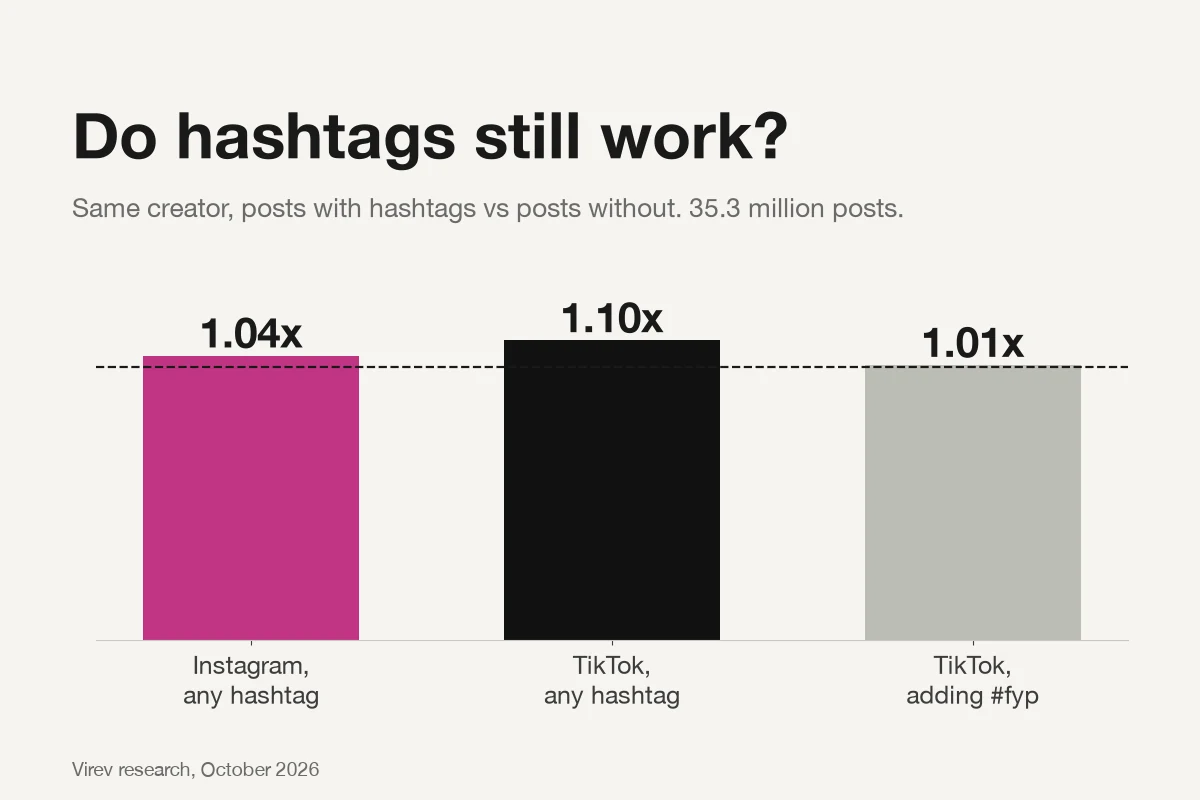
A little, and less than most guides say. We compared posts with hashtags against posts without them from the same account, across 35.3 million Instagram posts and TikTok videos. On Instagram, the typical account got 1.04x the likes and comments on its tagged posts, so about 4% more. On TikTok it got 1.10x. Tags like #fyp, #viral and #explorepage added nothing on TikTok. Instagram's 5-hashtag limit, which started in December 2025, took away most of the long tag blocks, and the accounts that lost them did not lose engagement.
Most pages that rank for "instagram hashtags" are tag lists. The pages that answer "how many hashtags" either repeat Adam Mosseri's line that hashtags "have never been a good way to actually increase your reach", or pool millions of posts from different accounts. Pooling compares accounts, not hashtag choices. A page that tags heavily may also post at other times and in other formats. Metricool's 2026 study found tagged posts got 32% fewer views and said itself it cannot tell the cause. This study compares each account with itself.
1.04x
1.10x
TikTok
24.7% to 2.7%
6+ tags, Instagram
Hashtags add 4% on Instagram and 10% on TikTok
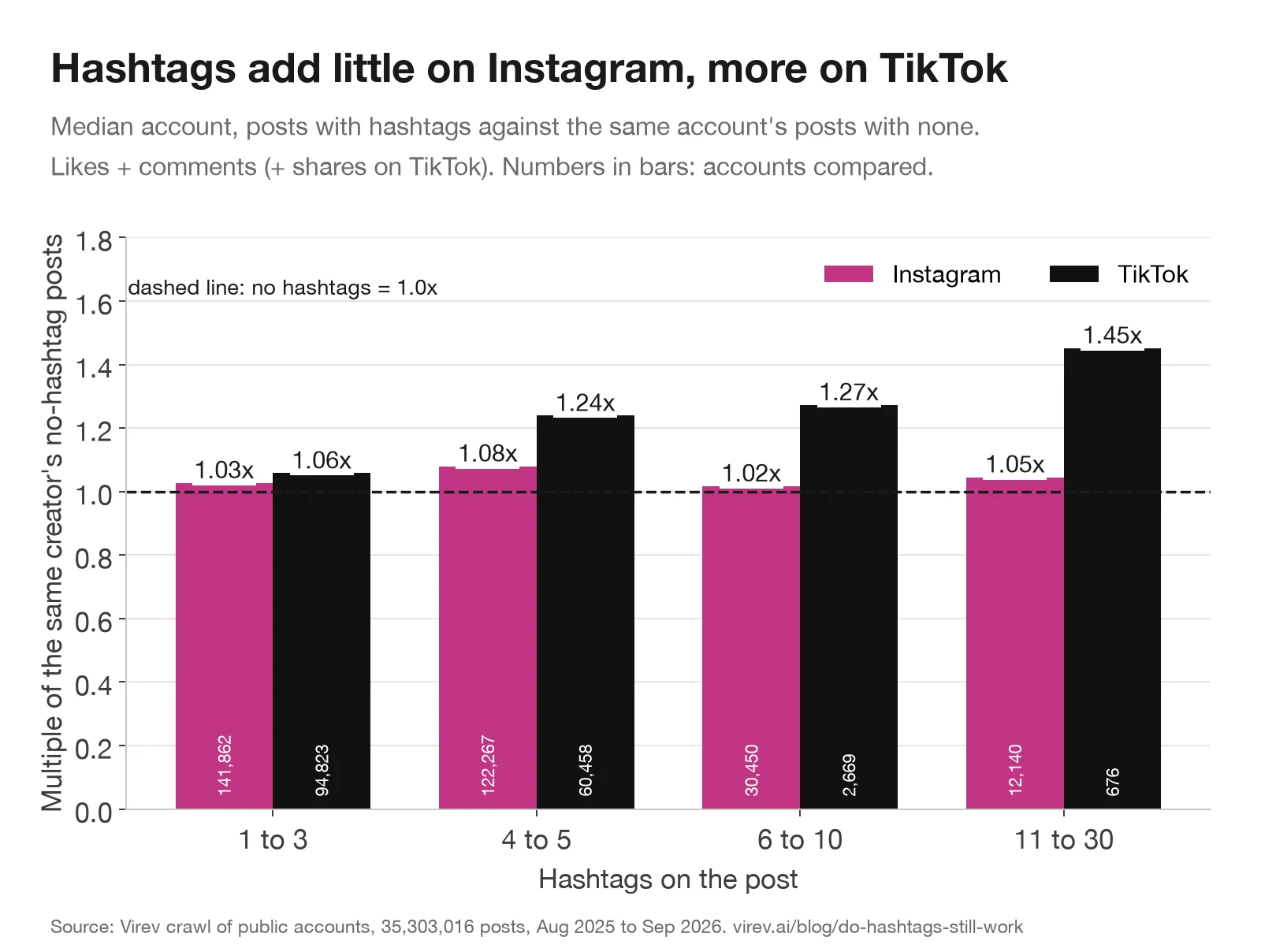
We counted the hashtags in every caption and put each post in one of five groups: no hashtags, 1 to 3, 4 to 5, 6 to 10, or 11 to 30. Then, for each account, we compared the median post in each group with the median post that had no hashtags. A ratio of 1.0 means hashtags made no difference for that account. An account enters a row only if it has at least three posts in both groups.
| Hashtags | IG accounts | TikTok accounts | TikTok | |
|---|---|---|---|---|
| 1 to 3 | 141,862 | 1.03x | 94,823 | 1.06x |
| 4 to 5 | 122,267 | 1.08x | 60,458 | 1.24x |
| 6 to 10 | 30,450 | 1.02x | 2,669 | 1.27x |
| 11 to 30 | 12,140 | 1.05x | 676 | 1.45x |
| Any | 190,218 | 1.04x | 105,177 | 1.10x |
On Instagram, the difference is small at every count. Four or five tags did best, at 1.08x. On TikTok the gap is larger, 1.24x at four or five tags. Few TikTok accounts use more than five, so the 6-to-30 rows rest on 676 to 2,669 accounts.
Reach moves the same way. Instagram reels with hashtags got 1.04x the views of the same account's untagged reels. TikTok videos with hashtags got 1.10x the views.
The result holds when we change the comparison:
- Only posts from the same quarter of the year: Instagram 1.07x to 1.10x per row, TikTok 1.07x to 1.43x.
- Only posts of the same format (reel against reel, carousel against carousel): Instagram 1.01x to 1.07x.
- A model that compares each post only with the same account's posts in the same month: Instagram 1.01x to 1.08x, TikTok 1.06x to 1.47x.
- Only the 126,382 accounts that Virev's profile model labels as individual creators: Instagram 1.04x, TikTok 1.12x.
These are upper limits for what the tags do. A creator who cares more about a post may also write a longer caption and add tags, and that post may have been better anyway. The next section has a test where Instagram removed the tags for the creators.
How many hashtags to use on Instagram: four or five
Instagram now allows five hashtags per post and reel. Later dates the limit to December 2025. Our data shows when creators followed it.
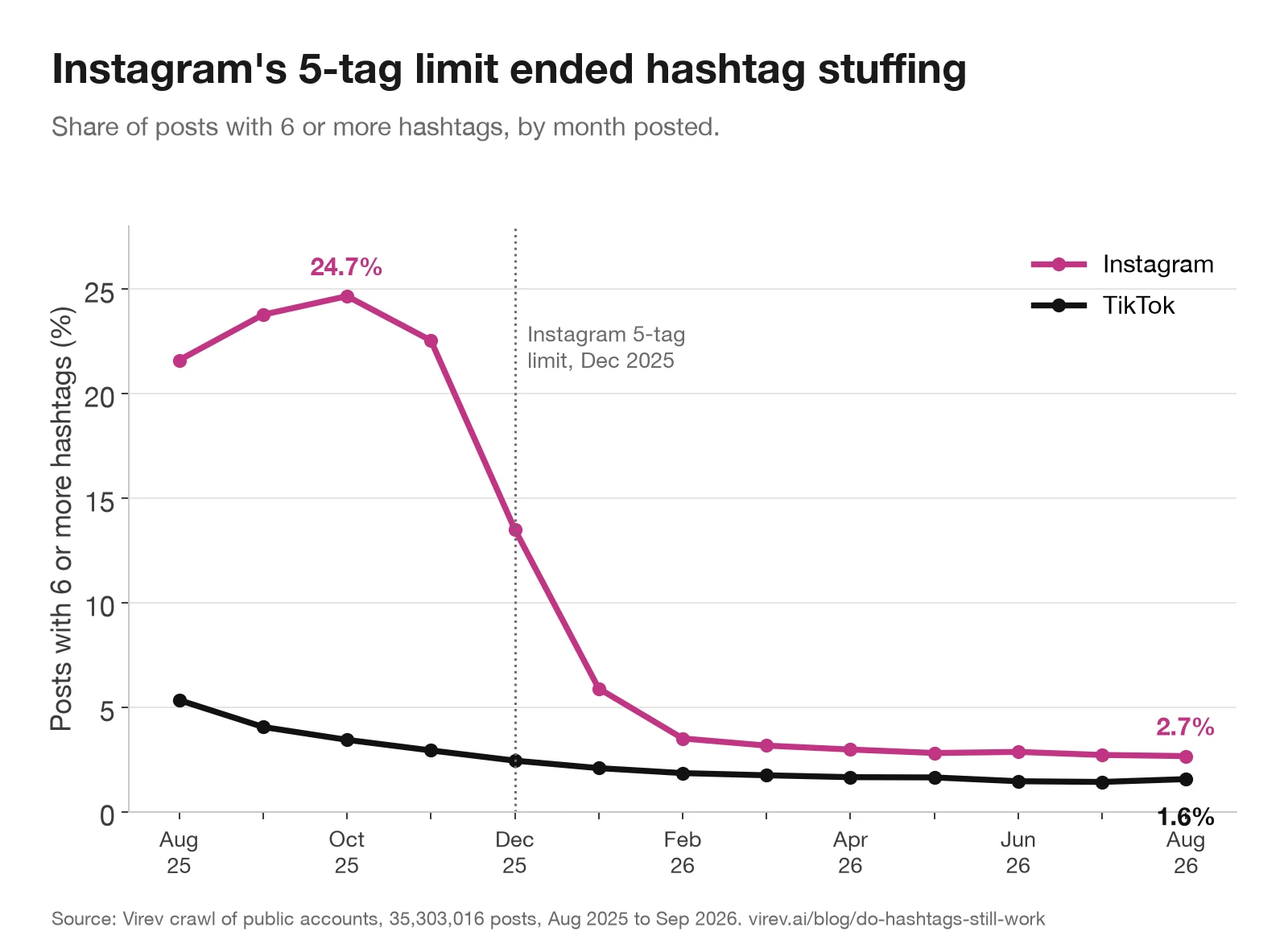
In October 2025, 24.7% of Instagram posts had six or more hashtags. By February 2026 it was 3.5%, and in August 2026 2.7%. The average Instagram post went from 3.7 hashtags to 2.1. The share of posts with no hashtags at all did not change. It stayed between 47% and 51% in every month. Creators did not give up on tags. They cut them to five.
We followed 91,396 Instagram accounts that posted both in October and November 2025 and between June and September 2026. Before the limit, 22.5% of them used six or more tags on most posts. After it, 1.8% did. Only 3.3% stopped tagging altogether.
TikTok has no such limit, and its numbers moved slowly. Long tag blocks were already rare there (5.3% of videos in August 2025, 1.6% a year later).
Creators who lost their extra tags kept their engagement
The limit gives a clean test. 12,702 Instagram accounts used six or more hashtags on at least 80% of their posts in September to November 2025, 12.7 tags on average. From February to April 2026 they averaged 4.9. If the extra tags had been bringing in engagement, these accounts should have lost some against accounts that never used tags.
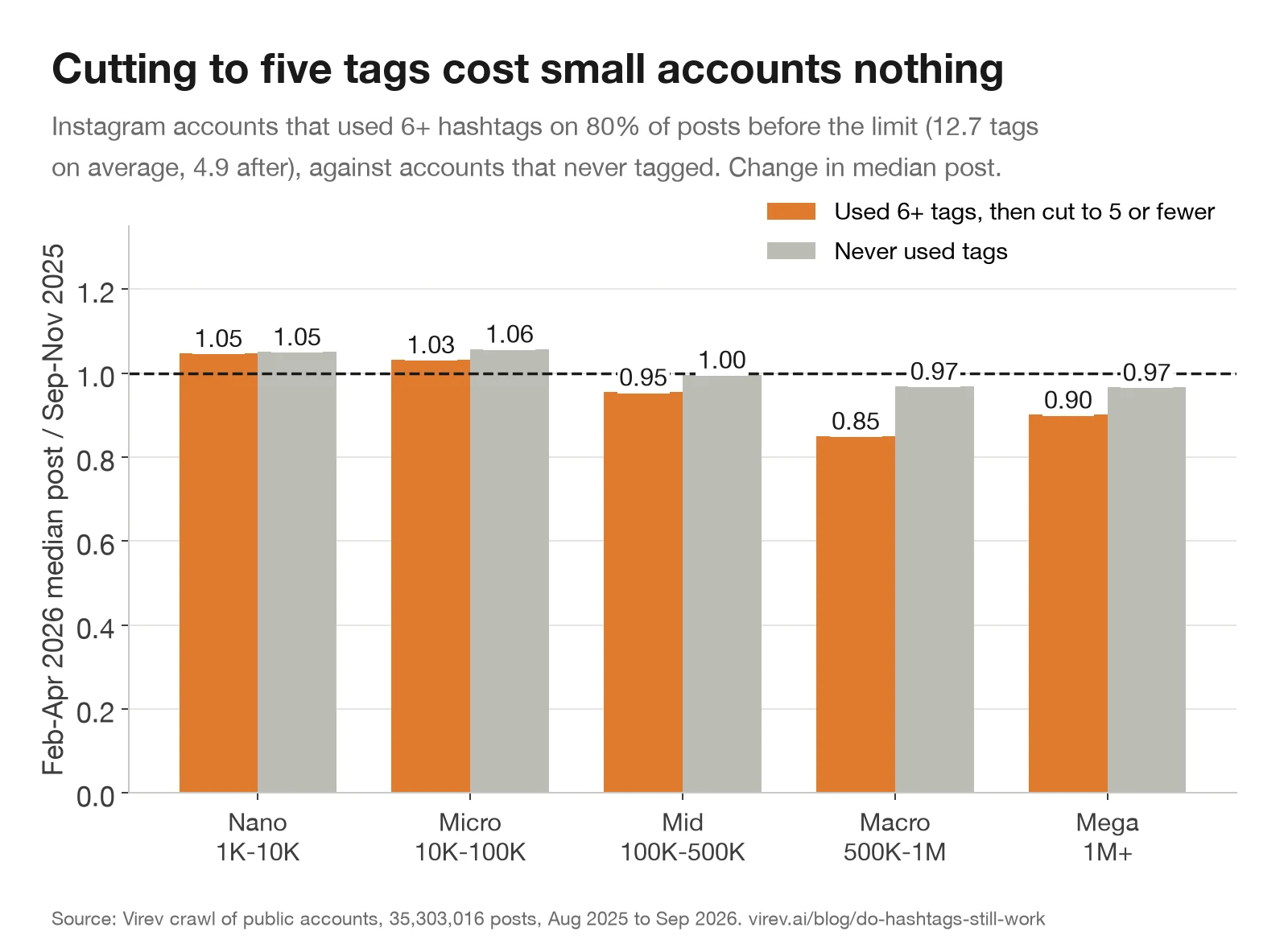
They did not lose. The median heavy tagger's typical post changed by 1.03x between the two periods. Accounts that never tag changed by 1.03x too. Among accounts labelled as individual creators, it was 1.06x for both groups.
The exception is large accounts. Heavy taggers with 500,000 to a million followers fell to 0.85x, against 0.97x for large accounts that never tagged. That rests on 181 accounts, and over 1 million followers on 122, so read it as a possible effect, not a measured one.
Javeno McLean, @j7healthjaveno, 662K followers. He trains people with disabilities and older clients at the J7 Health Centre and posts their sessions. In autumn 2025 his captions ended in 12 to 15 tags, such as #javeno #j7healthcentre #autism #fun #gymmotivation #instalike #instadaily #fitnessaddict #teamwork. His median post then got 2,334 likes and comments across 72 posts. After the limit he used five, and his median post from February to April 2026 got 2,931, over 73 posts. On September 25, 2026 he posted a 91-year-old client doing squats with five tags (#disability #squats #gymmotivation #gym #beauty). When we checked it in the browser on October 3 it had 3,503 likes and 81 comments, more than his September 30, 2025 post about Alfie, a severely autistic boy (3,407 likes and 32 comments, 15 tags).
TikTok hashtags: #fyp adds nothing
TikTok is where generic tags are most common. 31% of tagged TikTok videos in our data carry #fyp, #foryou, #foryoupage or a variant. We compared each video that has a generic tag with the same account's videos that have the same number of hashtags and no generic tag.
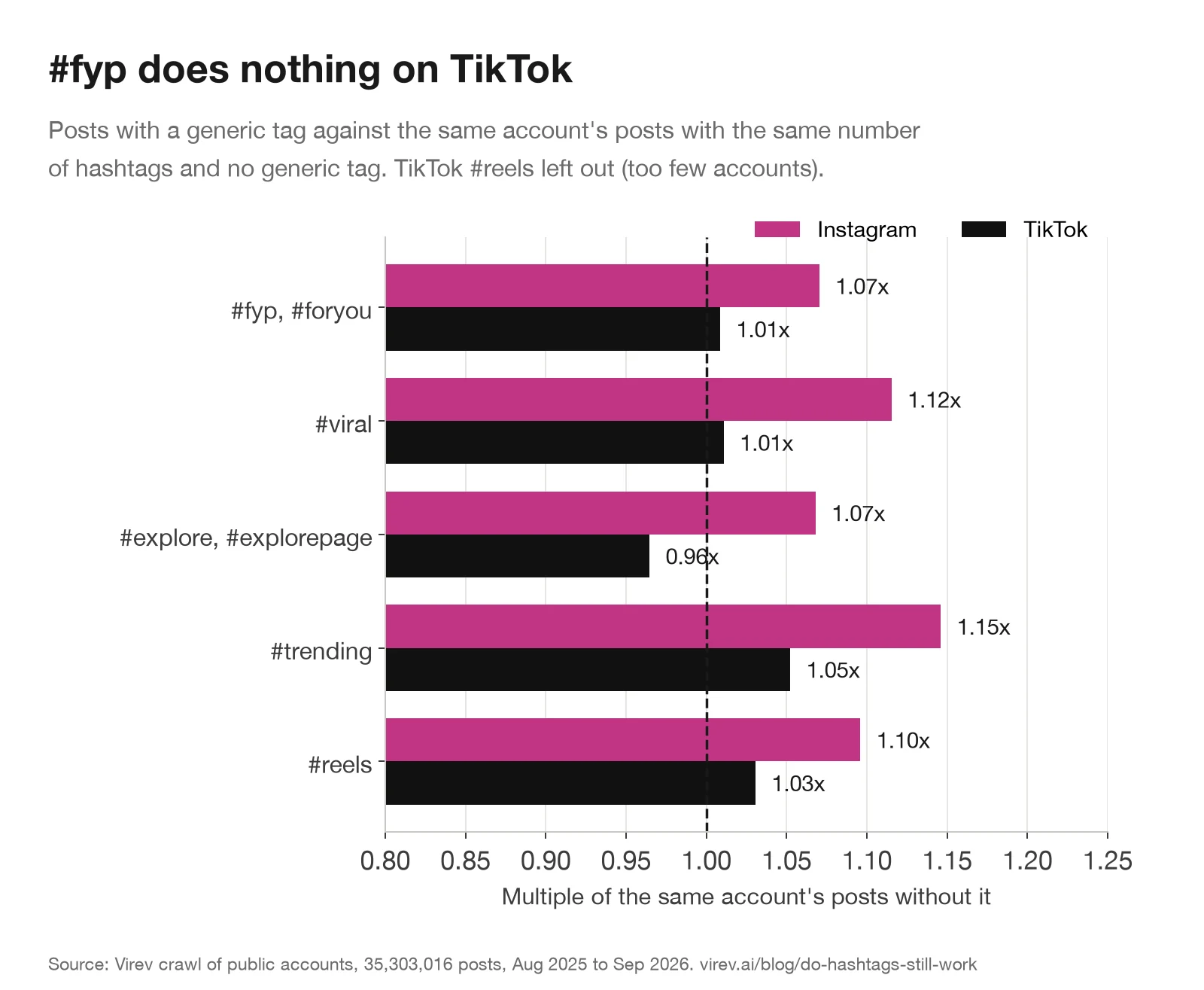
On TikTok, #fyp scored 1.01x and #viral 1.01x. Views tell the same story. Videos with any generic tag got 0.99x the views of the same account's other tagged videos. Swapping a topic tag for #fyp gains nothing.
The biggest tags do slightly worse on TikTok. A video whose tags are all used by 2,000 or more accounts in our sample got 0.94x the engagement of the same account's videos with the same number of tags in a mix of big and small. Videos tagged only with small tags (under 50 accounts) got 1.04x. OpusClip ranks TikTok tags by the average views of all clips that use them. That tells you which tags are popular, not what a tag does for your video.
Instagram shows the opposite. Posts with #trending (1.15x), #viral (1.12x) or #reels (1.10x) did a little better than the same account's posts without them. Fewer Instagram posts carry these tags (2% to 4% of tagged posts), and the accounts that use them post many short reels that ride trends. We think the trend drives the result more than the tag, but we cannot separate them.
Large accounts gain nothing from hashtags
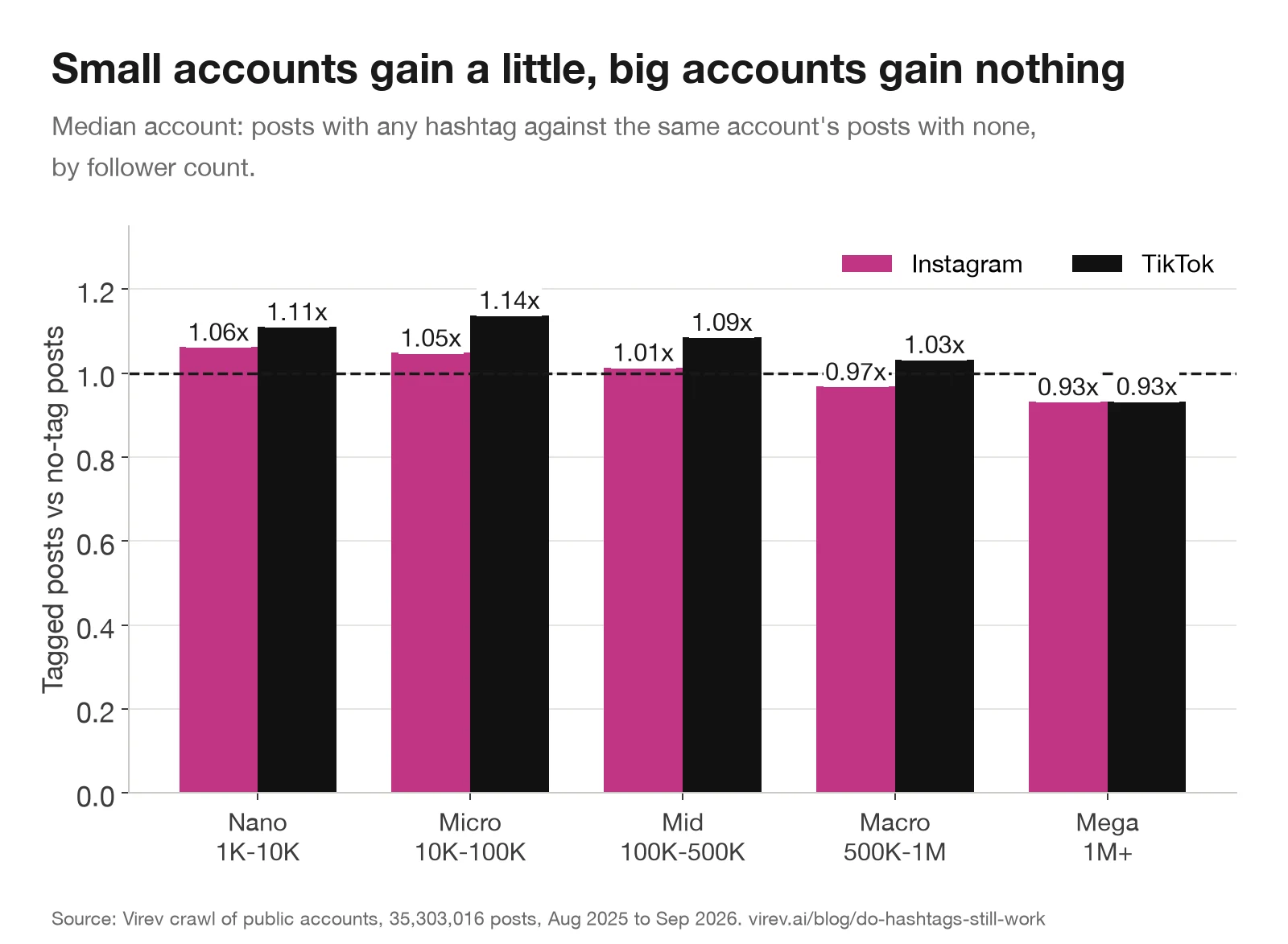
| Followers | IG accounts | TikTok accounts | TikTok | |
|---|---|---|---|---|
| Nano, 1K to 10K | 73,473 | 1.06x | 35,975 | 1.11x |
| Micro, 10K to 100K | 73,981 | 1.05x | 33,341 | 1.14x |
| Mid, 100K to 500K | 27,358 | 1.01x | 19,984 | 1.09x |
| Macro, 500K to 1M | 7,613 | 0.97x | 6,329 | 1.03x |
| Mega, 1M+ | 7,793 | 0.93x | 9,548 | 0.93x |
A nano or micro account's tagged post does 5% to 14% better than its untagged one. An account with a million followers does 7% worse with tags, on both apps. Its audience already sees the post, and a big account's untagged posts may be the personal ones its followers like most.
Tags with the account's own name (#j7healthcentre on Javeno's posts) appear on 13% of tagged posts from individual creators on Instagram and 10% on TikTok. They scored 1.03x on Instagram and 1.12x on TikTok against the same account's posts with the same number of other tags. Tags that name a large brand scored 1.09x on Instagram and 1.12x on TikTok. On TikTok these are mostly fan tags such as #fortnite, #netflix and #harrypotter, not brand campaign tags, and our brand detector was right in 71% of the cases we checked, so treat that row as rough.
Creators who post without hashtags and still grow
On Instagram, 28% of the accounts in our sample used no hashtags on at least 90% of their posts. On TikTok it was 16%. We read 71,892 Instagram accounts and 6,588 TikTok accounts twice or more, 10 to 60 days apart, and measured their follower growth.
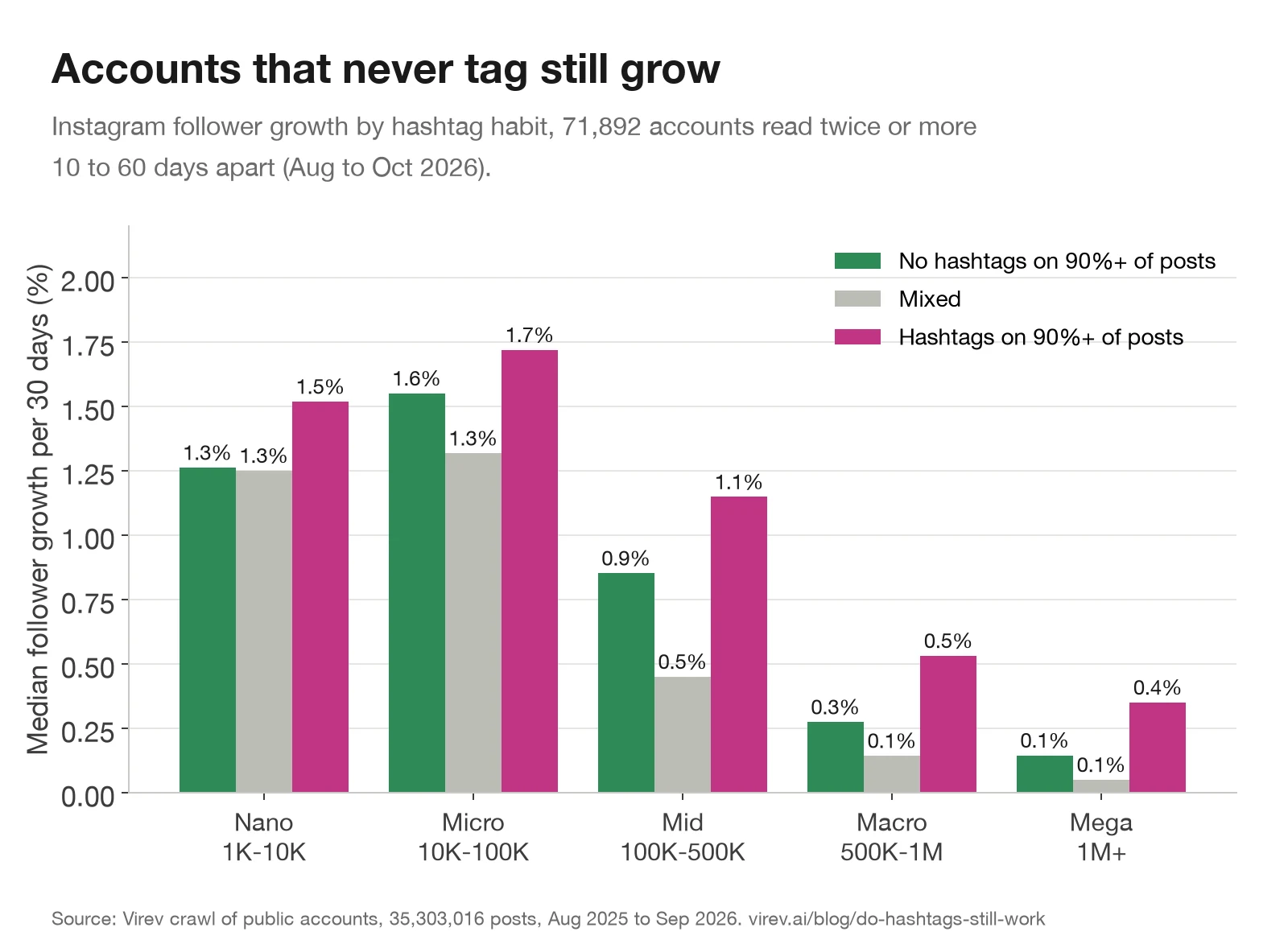
Accounts that never tag grew. 80% of them gained followers between our reads, and their median growth was 1.2% a month on Instagram, against 1.5% for accounts that always tag. On TikTok it was 3.0% against 4.0%. Accounts that always tag grew a little faster. We cannot tell whether the tags caused that, or whether accounts that tag every post also post more, in other niches, at an earlier stage. The difference is a fraction of a percent per month. Four large accounts that post with almost no hashtags:
Caleb Wielhouwer, @calebwielhouwer. An adventure and travel filmmaker. His 13 regular posts in our window had no hashtag, and his captions are a few words ("Keep moving"). The only four posts with tags were paid partnerships, tagged #adobepartner, #claudepartner and #wixharmony. He had 314,966 followers on August 19, 2026, 325,546 on September 5, and 332K when we checked on October 3. His August 1 reel had 225,000 likes and 880 comments when we checked it.
Ree Drummond, @thepioneerwoman, 4 million followers. None of her 88 posts in our window carried a hashtag. Her August 10, 2026 reel had 27,000 likes and 270 comments when we checked, and her 66 reels in our data had a median of 617,000 plays.
Alex Warren, @alexwarren on TikTok, 21.6 million followers. 98% of his 102 videos in our window had no hashtag. His captions read like texts to a friend ("today was the best day of my life"). He grew from 21.2 million to 21.6 million followers between August 19 and September 19, 2026.
Bullyjuice, @bullyjuice on TikTok, 2.3 million followers. A father who posts training and chores with his young children. He went from 2,118,749 followers on August 19 to 2.3 million on September 11. When we checked his profile, his family videos had no hashtags. The only videos with tags were his brand deals, which carry #sharkPartner and #ninjapartner as disclosure.
What to do with this
For creators
- On Instagram, use four or five tags that say what the post is about. That scored best (1.08x). You can no longer use more, and our data says you are not missing anything.
- On TikTok, tags help more (1.10x overall, 1.24x at four or five). Use topic tags, not #fyp or #viral.
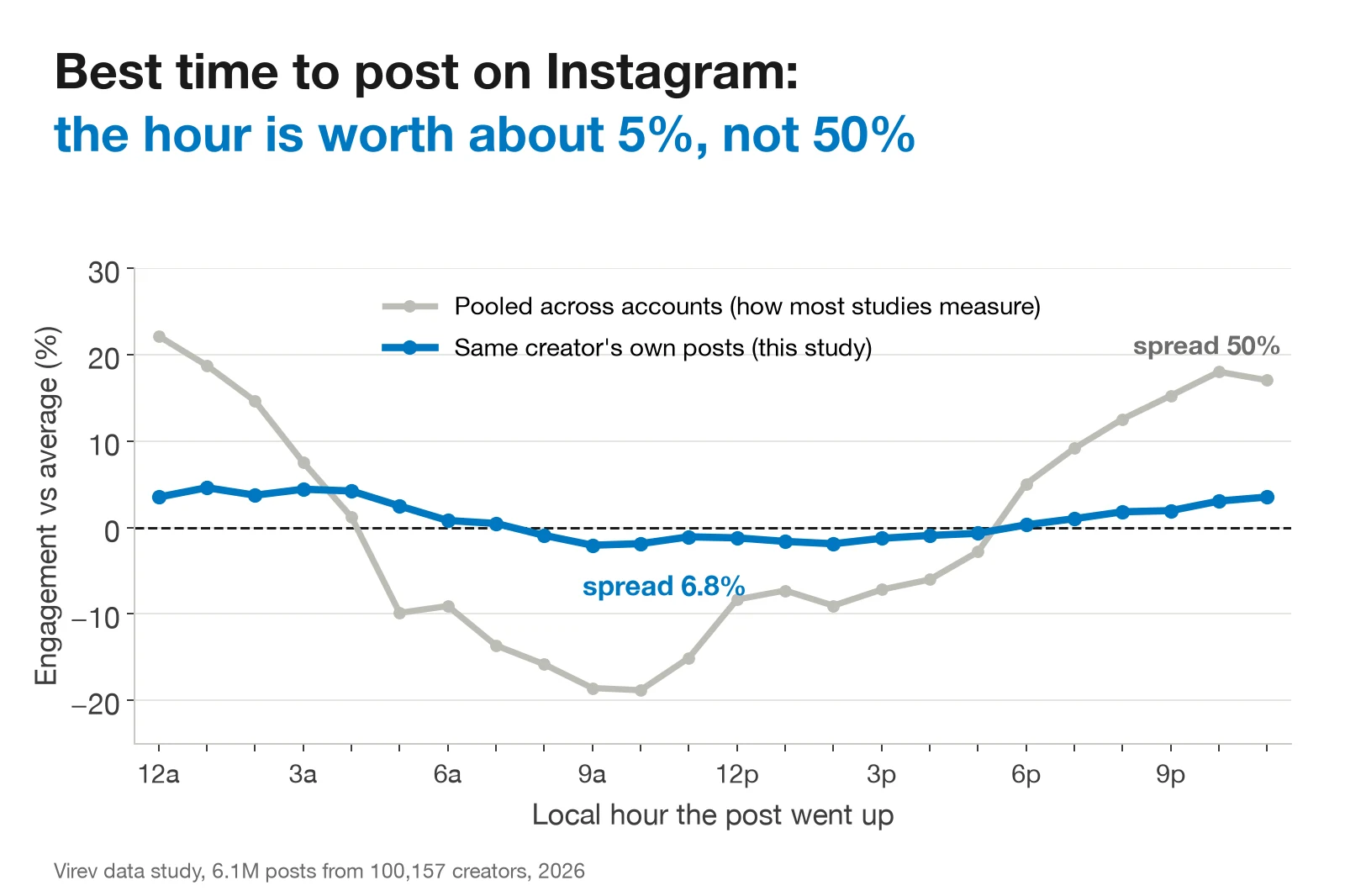
- Do not spend time on tag lists. The gap between a tagged and an untagged post is smaller than the gap between your good and bad posts. Our best time to post study found a 5.5% gap between the best and worst posting window, which is about the same size.
- Over a million followers, tags do not help. Leave them off if you like.
For brands and agencies
- Do not judge a creator by hashtag use. Creators who never tag grow too, and some of the largest accounts in our data use none.
- Do not search for creators by hashtag alone. Over a quarter of Instagram creators rarely tag, so a hashtag search misses them. Our guide to finding micro-influencers beyond hashtag lists shows other ways, and Virev creator search finds creators by what their posts are about, tagged or not.
- In a brief, ask for the campaign tag and one or two topic tags, not a list of ten. On Instagram the creator cannot post more than five.
- Compare a creator's engagement with our Instagram engagement rate benchmarks or check one account with the Instagram engagement rate calculator and the TikTok engagement rate calculator.
How we measured, and what can be wrong
- Accounts: public Instagram and TikTok accounts with 1,000+ followers read by Virev's crawler between June and October 2026. We removed accounts that Virev's profile model labels as brands, businesses, media or organizations, and Instagram accounts with a business category and no label. We kept accounts with at least 6 posts and a median above zero: 388,774 on Instagram and 262,342 on TikTok.
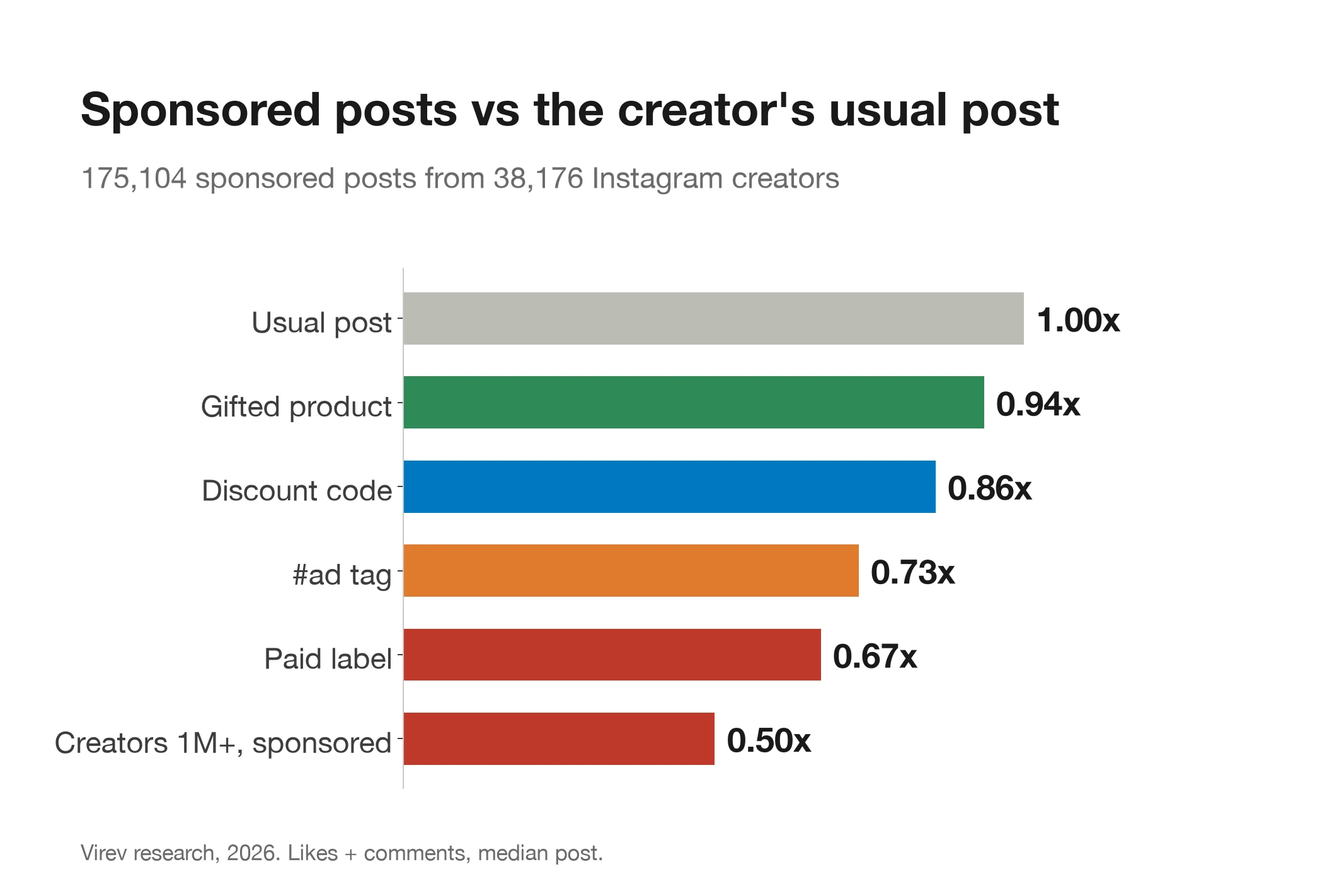
- Posts: Instagram feed posts and reels, not pinned, with likes visible, at least 3 days old at the read and posted within a year before it (August 18, 2025 to September 29, 2026). TikTok videos under the same rules (August 13, 2025 to September 29, 2026). We removed posts with a paid partnership label, an ad tag or a giveaway, because those get different engagement for other reasons (see our sponsored post study), and TikTok LIVE program tags.
- Engagement: likes plus comments on Instagram, plus shares on TikTok. Views: reel plays and TikTok plays.
- Ratio: for each account, the median of its posts in a group divided by the median of its posts with no hashtags. Tables report the median account. For the main rows, the 95% bootstrap intervals are within 0.01 of the median (all intervals are in the CSV).
- Hashtag parser: a hashtag is a # followed by letters, numbers or underscores, in any script. A hand check of 50 Instagram and 50 TikTok captions found the count right in all 100. On Instagram, we saw captions where the first five tags kept their # and the rest appeared as plain words. We count only tags with a #.
- Generic tags: a fixed list (#fyp, #foryou, #viral, #explore, #explorepage, #trending, #reels and variants). In a check of 40 posts flagged as generic, all 40 carried a listed tag. Three were flagged only for #love, which is on the wider list.
- Own-name tags: a tag that contains the account's username, or a username that contains a tag of six or more letters. 76 of 80 checked were right. The errors were common words inside a username (#training for @km1_training).
- Brand tags: a tag that matches the username of a brand or business account with 100,000+ followers in our data. 57 of 80 checked were right (71%). The errors were places (#sydney), genres (#heavymetal) and #tiktokfrance.
- Business accounts left in: in our check of 50 random Instagram posts, about a third came from brands, venues or media pages that our filter missed. That is why every main result is repeated on the 58,280 Instagram and 68,102 TikTok accounts labelled as individual creators (in the CSV). The answers match within a few points.
- Follower growth: from our follower counts read 10 to 60 days apart between August 2 and October 2, 2026. These are short windows.
- This is an observational study. It shows what tagged posts get compared with the same account's untagged posts, not why. The Instagram limit gives one natural test, and it found no loss for small and mid-size accounts.
Download the data
The tables behind every chart are in one CSV: hashtag-study-2026.csv. It has one row per group, for all accounts and for creators only, with the number of accounts and posts, the median account ratio, its 95% interval, and the share of accounts above 1.0. It also has monthly tag use on both apps, the before-and-after test for the Instagram limit and the follower growth tables. Please cite "Virev, October 2026" and link this page.
Sources
- Instagram hashtags in 2026, win with the 5-tag limit
- How Many Hashtags to Use on Instagram (18M Posts Analyzed)
- Do hashtags still work on Instagram in 2026? Mosseri finally settled it
- Instagram hashtags in 2026: how many to use
- Trending Hashtags on Instagram, June 2026
- Best Hashtags for TikTok (2026 Data)
- TikTok hashtags: How to use the best hashtags
- Hannah is 91 years old and today she squats
- caleb wielhouwer on Instagram
- Alex Warren on TikTok
- Bullyjuice on TikTok