



The median Instagram account with 1,000 or more followers posts 2.3 times a week, and so does the median TikTok account. Bigger accounts post more often. Posting more did not lower the views of each post: against the same account's own posts, a post that came after a busy week got within 4% of the views of one after a week with 1 or 2 posts. Weeks with more posts brought more total views and faster follower growth.
We read the post counter of 363,622 Instagram accounts and 332,056 TikTok accounts at least 28 days apart, between August 2 and October 24, 2026. Then we compared each post with posts by the same account, so big and small accounts do not get mixed.
When we asked an OpenAI model "how often should influencers post on Instagram per week" on October 19, it cited Buffer's study of 2.1 million posts from 102,000 accounts, which recommends 3 to 5 posts a week. For TikTok it cited Buffer's study of 11.4 million posts and Pew Research Center's 2025 study of creators that U.S. adults follow. Buffer's studies say what to do. This page adds what accounts do, split by follower count and category, and a CSV anyone can check.
2.3
Posts a week
0.97-1.02x
Views per post
+24
Followers per 10,000
How often accounts post on Instagram and TikTok
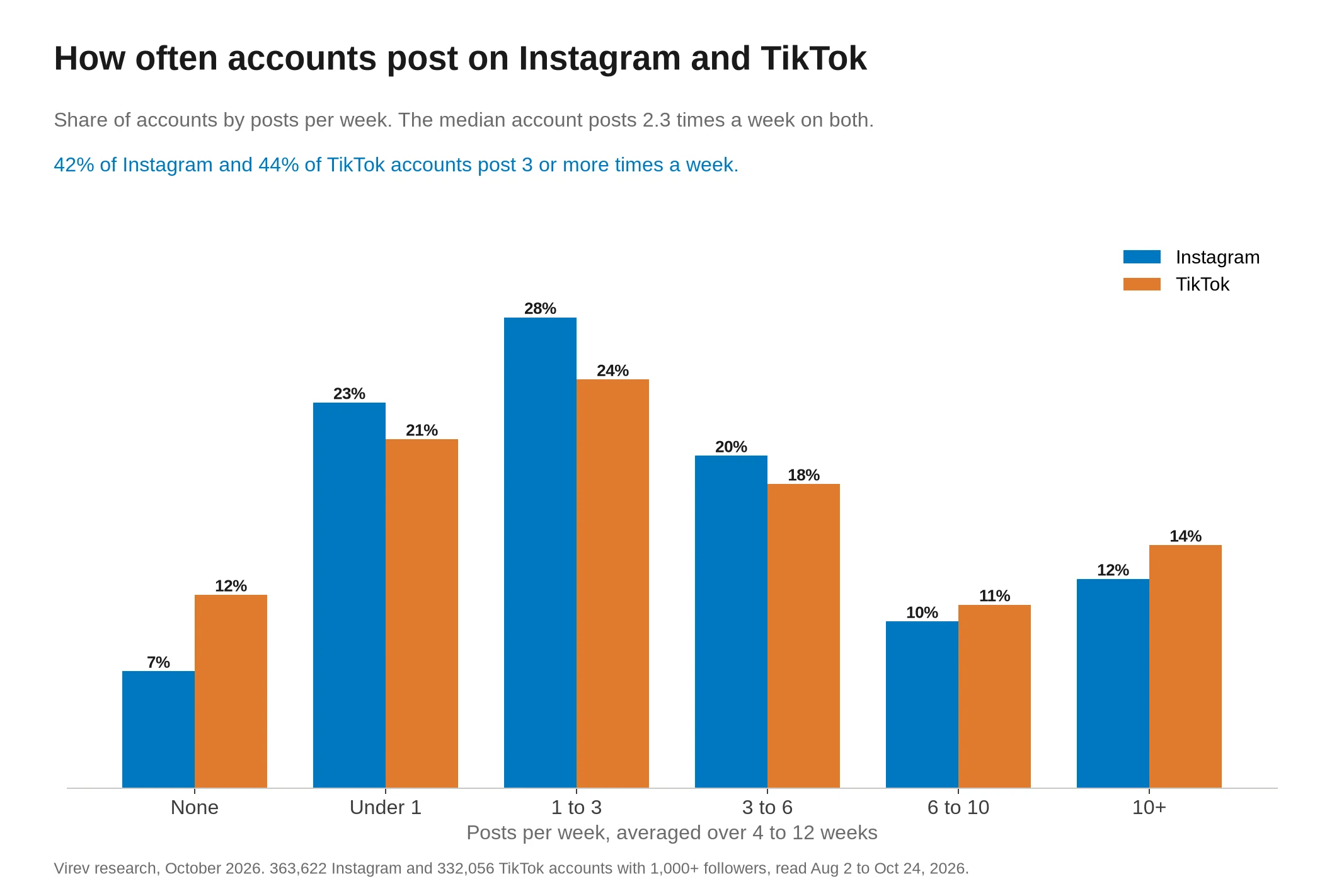
Instagram and TikTok both show a post count on each profile. We read it twice for each account, at least 28 days apart and 63 days apart for the median Instagram account. New posts between the two reads, divided by the weeks between them, give posts per week.
| Posts per week | Instagram accounts | TikTok accounts |
|---|---|---|
| None | 7% | 12% |
| Under 1 | 23% | 21% |
| 1 to 3 | 28% | 24% |
| 3 to 6 | 20% | 18% |
| 6 to 10 | 10% | 11% |
| 10 or more | 12% | 14% |
The middle half of Instagram accounts post 0.7 to 5.4 times a week, and the middle half of TikTok accounts 0.6 to 6.1 times. 19% of Instagram accounts and 22% of TikTok accounts post 7 or more times a week, about once a day or more. The Instagram count covers feed posts: reels, photos and carousels. Stories do not count.
So when guides say to post 3 to 5 times a week, that is more than most accounts do. Only 42% of Instagram accounts and 44% of TikTok accounts post 3 or more times a week.
How often creators post by follower count
| Followers | TikTok | |
|---|---|---|
| 1K to 10K | 1.5 (30%) | 1.1 (26%) |
| 10K to 100K | 2.5 (44%) | 2.7 (47%) |
| 100K to 1M | 2.9 (49%) | 4.0 (59%) |
| 1M+ | 2.9 (50%) | 3.8 (58%) |
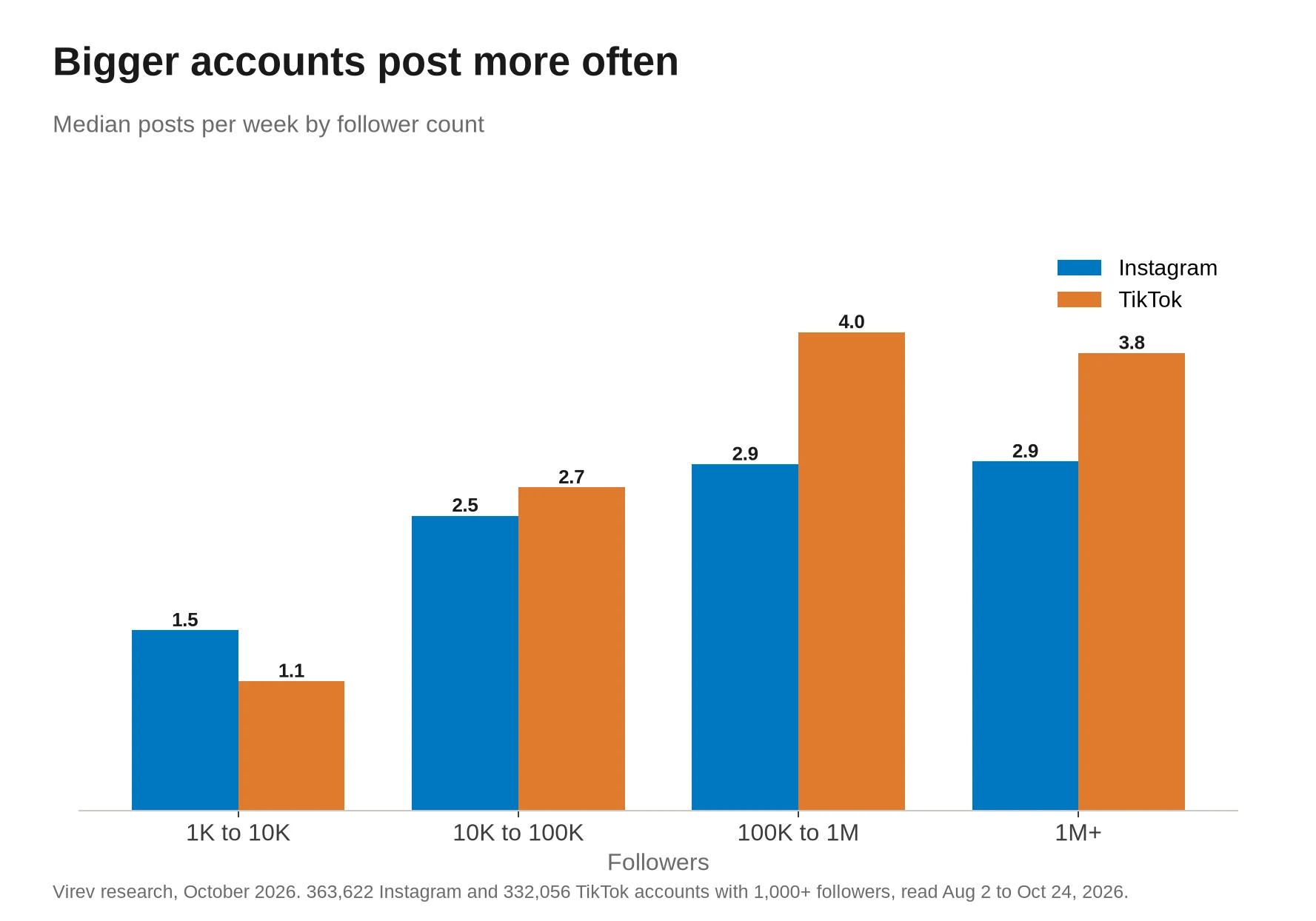
Each cell is the median posts per week, with the share of accounts that post 3 or more times a week in brackets. The tiers hold 101,475, 133,215, 102,650 and 26,282 Instagram accounts and 116,105, 112,969, 81,060 and 21,922 TikTok accounts. Accounts with 1,000 to 10,000 followers post least: 1.5 times a week on Instagram and 1.1 on TikTok. 18% of these TikTok accounts posted nothing in the period, against 5% to 6% of accounts above 100,000. On TikTok the median account with 100,000 to 1 million followers posts 4.0 times a week, almost four times the rate of the smallest tier. Pew Research Center found the same pattern among the TikTok creators U.S. adults follow: the smallest post about once a week and the most popular post several times a week.
Brands, businesses and media accounts are part of these numbers. Among the accounts that Virev's creator profiles label, individual creators post a median of 1.75 times a week on Instagram (28,266 creators) and 2.9 on TikTok (67,523). Media accounts post most, at 5.0 and 4.4.
How often creators post by category
These are individual creators only, in categories with at least 200 creators on a platform. Each cell is the median posts per week, with the creator count in brackets. The category comes from Virev's creator profile.
| Category | Instagram (creators) | TikTok (creators) |
|---|---|---|
| Health and wellness | 2.4 (627) | 3.6 (913) |
| Business and finance | 2.4 (453) | 3.5 (542) |
| Family and parenting | 2.4 (824) | 3.4 (1,941) |
| Education and books | 2.4 (898) | 3.5 (1,444) |
| Food | 2.2 (1,571) | 3.0 (2,059) |
| Beauty | 2.1 (1,134) | 3.9 (3,619) |
| Gaming | 2.1 (207) | 2.3 (2,595) |
| Travel | 2.0 (1,059) | 2.2 (949) |
| Comedy and entertainment | 1.9 (3,555) | 3.4 (22,845) |
| Lifestyle | 1.8 (2,659) | 2.1 (10,200) |
| Fashion | 1.7 (1,336) | 3.7 (1,654) |
| Pets and animals | 1.5 (345) | 2.0 (855) |
| Fitness and sports | 1.4 (3,018) | 2.9 (2,238) |
| Cars | 1.4 (676) | 2.3 (1,133) |
| Music and dance | 1.3 (3,928) | 2.3 (6,313) |
| Art and photography | 1.2 (1,882) | 1.5 (1,183) |
| Tech | too few | 3.9 (474) |
On Instagram, health and wellness, business and finance, family and education creators post about 2.4 times a week. Art and photography creators post least, at 1.2, and music, fitness and car creators post about 1.3 to 1.4 times. TikTok creators post more often than Instagram creators in every category. Beauty and tech creators lead TikTok at 3.9 videos a week.
Does posting more cut views per post
A common worry is that each extra post takes reach from the others. To test it, we took accounts whose crawled posts matched their post counter, so we know every post they made, and counted the posts each account made in the 7 days before each new post. Then we compared each post's views with the views of the same account's other posts, with the post's age at the read held equal.
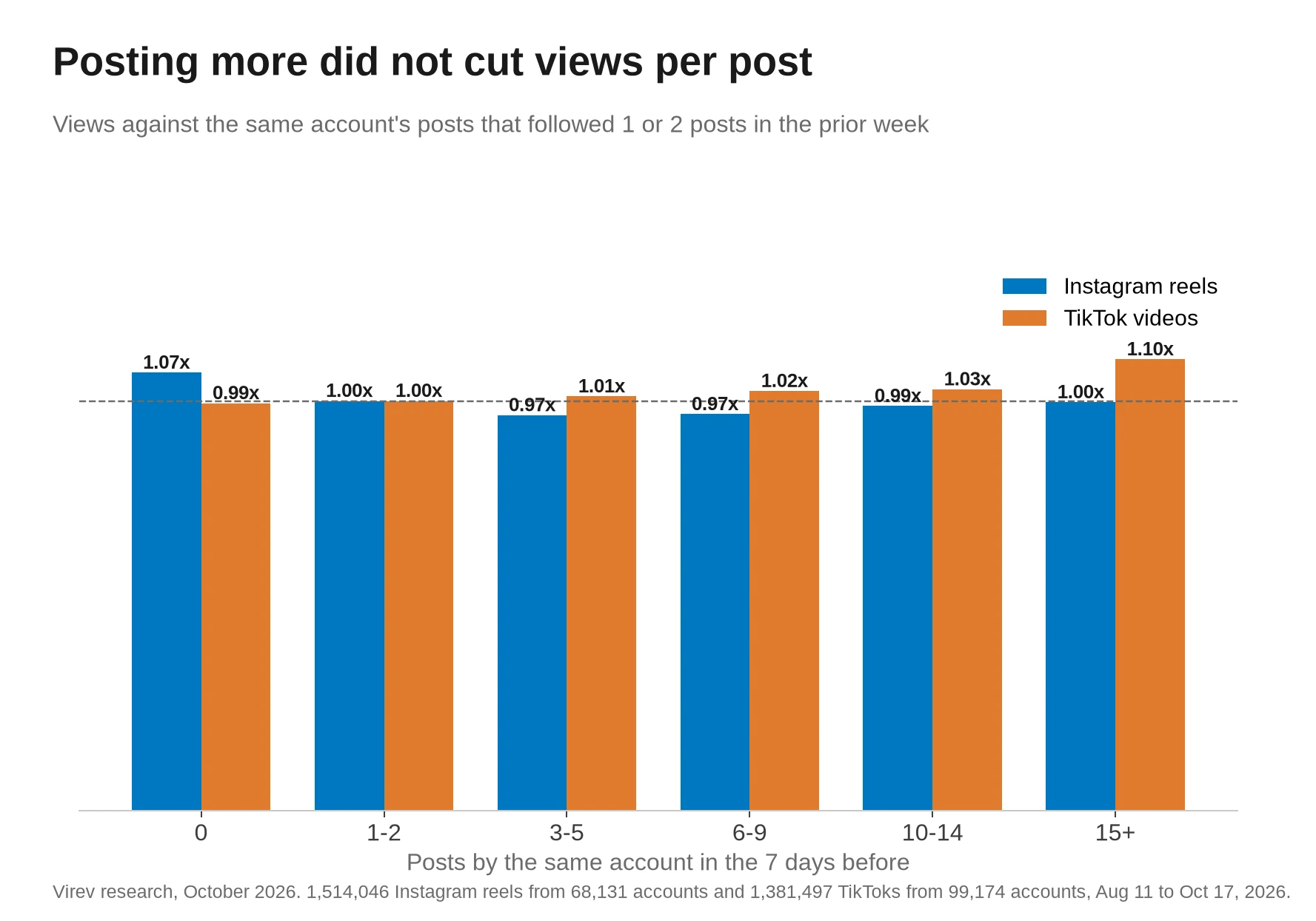
On Instagram, a reel that followed 3 to 9 posts in the prior week got 0.97x the views of one that followed 1 or 2. A reel after 15 or more posts got 1.00x. A reel after a week with no posts did best, at 1.07x. On TikTok, every busier week came out between 1.01x and 1.03x, and the 6,743 videos that followed 15 or more got 1.10x.
Likes and comments per post fell a little more on Instagram as posts piled up: 0.97x after 6 to 9 posts and 0.94x after 15 or more. On TikTok they stayed between 1.00x and 1.01x up to 14 posts.
Our Instagram algorithm study found that how often you post moves reel views by 9% or less, comparing no posts in the prior 7 days with 15 or more. This study uses newer posts and counts every post in the prior week, and lands close to it. The gap between no posts and 15 or more is 7%. The widest gap on Instagram is 11%, between 1.07x after a week with no posts and 0.97x after 3 to 5 posts.
Buffer reported up to 24% more reach per Instagram post at 10 or more posts a week, and up to 34% more TikTok views per post at 11 or more. Buffer's TikTok study also says the median views per post stayed flat and the gain came from more posts that break out. Our same-account comparison matches the flat median: each post gets about the same views whether the week was busy or quiet.
More posts in a week, more total views
If each post keeps its views, more posts add up. Within the same account, a week with twice the posts got 2.37 times the total reel views on Instagram and 2.39 times the total views on TikTok. Likes and comments came out at 2.27 and 2.42 times.
Those totals grow a little faster than the post count. Creators post more in weeks that go well, such as a trip, a launch or a post that took off, so this number overstates what one extra post adds. A post count that doubles brings roughly double the total views.
Does posting more grow followers faster
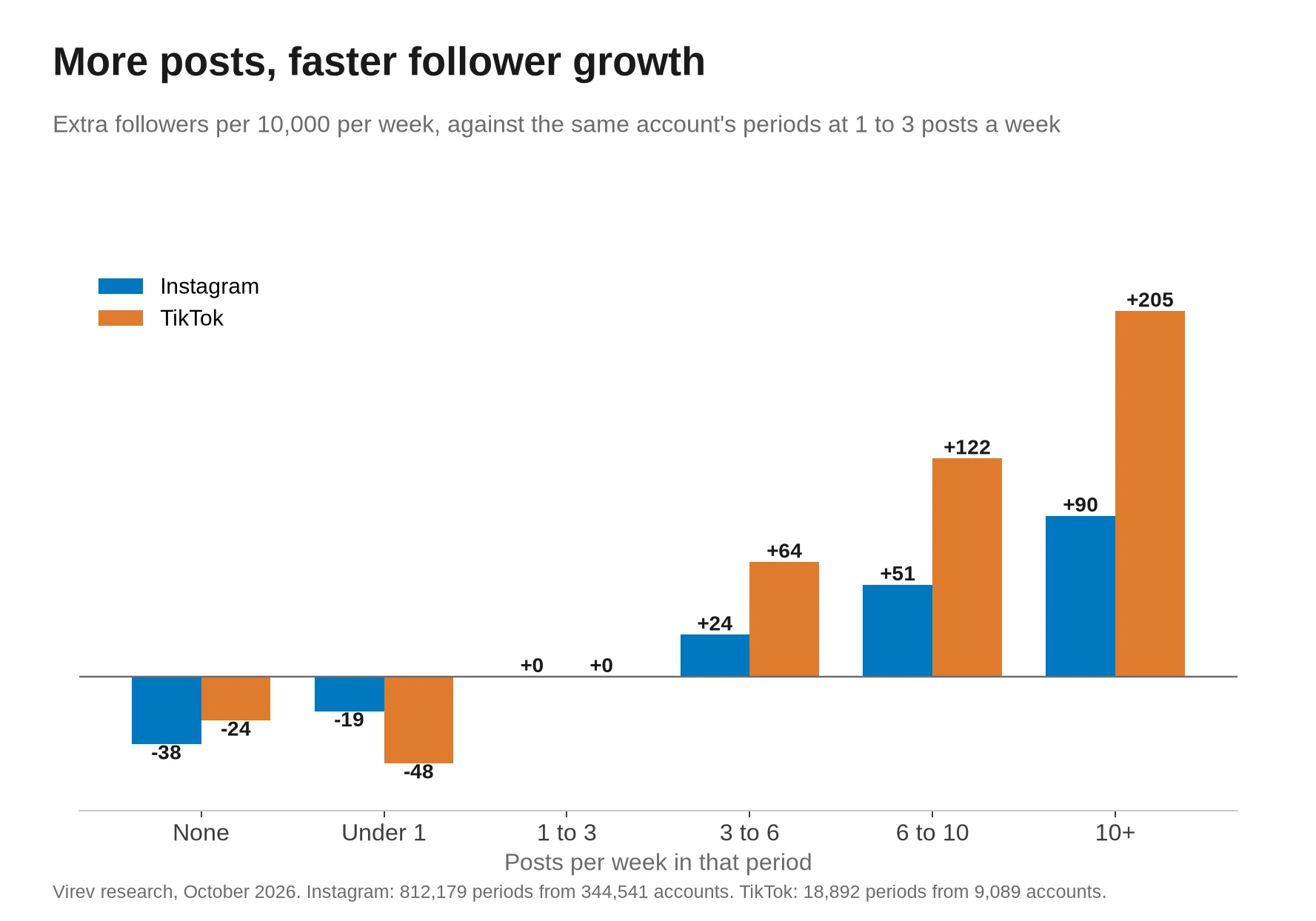
For follower growth we split each account's reads into periods of at least 7 days and compared periods of the same account. On Instagram, a period with 3 to 6 posts a week added 24 more followers per 10,000 each week than the same account's periods at 1 to 3 posts. At 6 to 10 posts it was 51 more, and at 10 or more 90 more. A period with no posts lost 38 per 10,000 against the 1 to 3 baseline. The typical Instagram account in these periods grew 15 followers per 10,000 a week, so these are large differences.
TikTok shows the same order with bigger steps: 64 more followers per 10,000 a week at 3 to 6 videos and 205 more at 10 or more. Only 9,089 TikTok accounts had two or more periods, so the TikTok numbers are less certain.
Most of the gain comes from a minority of periods with a jump. On Instagram, 6.9% of periods at 1 to 3 posts a week grew half a percentage point or more above the account's own median week, against 12.4% at 10 or more posts and 2.5% with no posts. That matches Buffer's TikTok finding that posting more raises the chance of a big week. Buffer's Instagram model, which also compares each account with itself, found the same order: weekly growth 0.12 points higher at 1 to 2 posts than at none, up to 0.66 points at 10 or more.
Across accounts the pattern holds too. The median Instagram account at 1 to 3 posts a week grew 0.8% in 30 days, against 2.1% at 10 or more. On TikTok it was 1.5% against 4.8%. These are different accounts, so size, niche and luck differ as well.
How often should you post
- Post at least 3 times a week if you can keep the quality. Most accounts post less than that, and our data shows no cost to each post for posting more.
- Expect each post to get about the same views whether you posted once or six times that week. The gain from posting more comes from more posts, not better ones.
- Do not stop. Periods with no posts grew followers slowest on both apps.
- Space posts out within a day. Our best time to post study found that a post less than 3 hours after the previous one got 4.4% less engagement on Instagram and 6.5% less on TikTok.
- When you compare creators for a campaign, compare posting pace within the same follower tier, because a TikTok creator with 500,000 followers posting 4 times a week is normal and one with 5,000 is busy.
Brands can see each creator's recent posts and filter by follower count and category in Virev creator search, which covers 180M+ creators. For what else moves views, see our TikTok algorithm study and how long a reel should be.
How we measured, and what can be wrong
- The sample is every public Instagram and TikTok account with 1,000 or more followers that Virev's crawler read with a post count at least twice, 28 or more days apart, between August 2 and October 24, 2026. Accounts the crawler reads more than once lean toward accounts brands look at.
- Posts per week is the change in the profile's post count divided by the weeks between the first and last read. 6.2% of Instagram accounts and 7.3% of TikTok accounts had a lower count at the second read, because they archived or deleted posts, and we left them out. Archiving also hides some new posts in accounts we kept, so a few rates are a little low.
- For the post-level test we kept accounts whose crawled posts matched the change in the post counter within 5%, 47% of Instagram accounts and 57% of TikTok accounts. These accounts post less, a median of 1.2 times a week on Instagram and 1.0 on TikTok, because each crawler read sees a fixed number of recent posts, and for a slow account that covers all of them. Few of them post 15 or more times a week, so that bucket has wide error bars.
- Views are reel plays on Instagram and video plays on TikTok, from the last read at least 7 days after posting. The model compares each post with the same account's posts, with 4 age bands held equal. Multipliers are the exponent of the model coefficient, with 95% intervals in the CSV.
- Follower growth uses reads at least 7 days apart. A period's growth is the change in followers per week, and the model compares periods of the same account, with the top and bottom 1% of growth values capped.
- Categories come from Virev's creator profiles, which a language model writes from public profile text, and cover 28,266 Instagram and 67,523 TikTok creators in this sample. We grouped free-text niches into 17 categories by keyword.
- This is an observational study. Creators choose when to post more, and they post more around trips, launches and posts that took off. That makes busy weeks look better for growth than one extra post would make them. The per-post test is less exposed to this, because it compares posts with posts.
Download the data
The tables are in one CSV: how-often-should-you-post-2026.csv. Each row has a platform, a table, a group and a metric, with the count and the 25th, 50th, 75th and 90th percentiles, or a single value. The tables cover posts per week overall, by follower tier, by account type and by creator category, the share of accounts in each posting band, views and likes per post against the same account by posts in the prior 7 days, weekly totals, and follower growth by posting band within the same account and across accounts. Please cite "Virev, October 2026" and link this page.